Date published 4th October 2026
Fifty years ago, Aston Martin unveiled one of the most extraordinary cars in its history. William Towns’ Lagonda looked towards a digital future at a time when the company behind it had only recently fought for survival. Yet the Lagonda story began almost eight decades earlier, and its connection with Aston Martin runs far deeper than one remarkable four-door saloon.
Your guide to Lagonda at 50
This feature follows the Lagonda story from Wilbur Gunn and the independent pre-war marque, through W.O. Bentley and David Brown, to William Towns’ extraordinary 1976 wedge and the electronic technology that helped define it.
Along the way, we’ll look at the Rapide, Aston Martin’s financial crisis and rescue, the production cars, Tickford, the question of whether the Lagonda really helped save Aston Martin, and the later return of the name through Taraf and the modern concepts.
This is one of FTP’s deeper historical features.
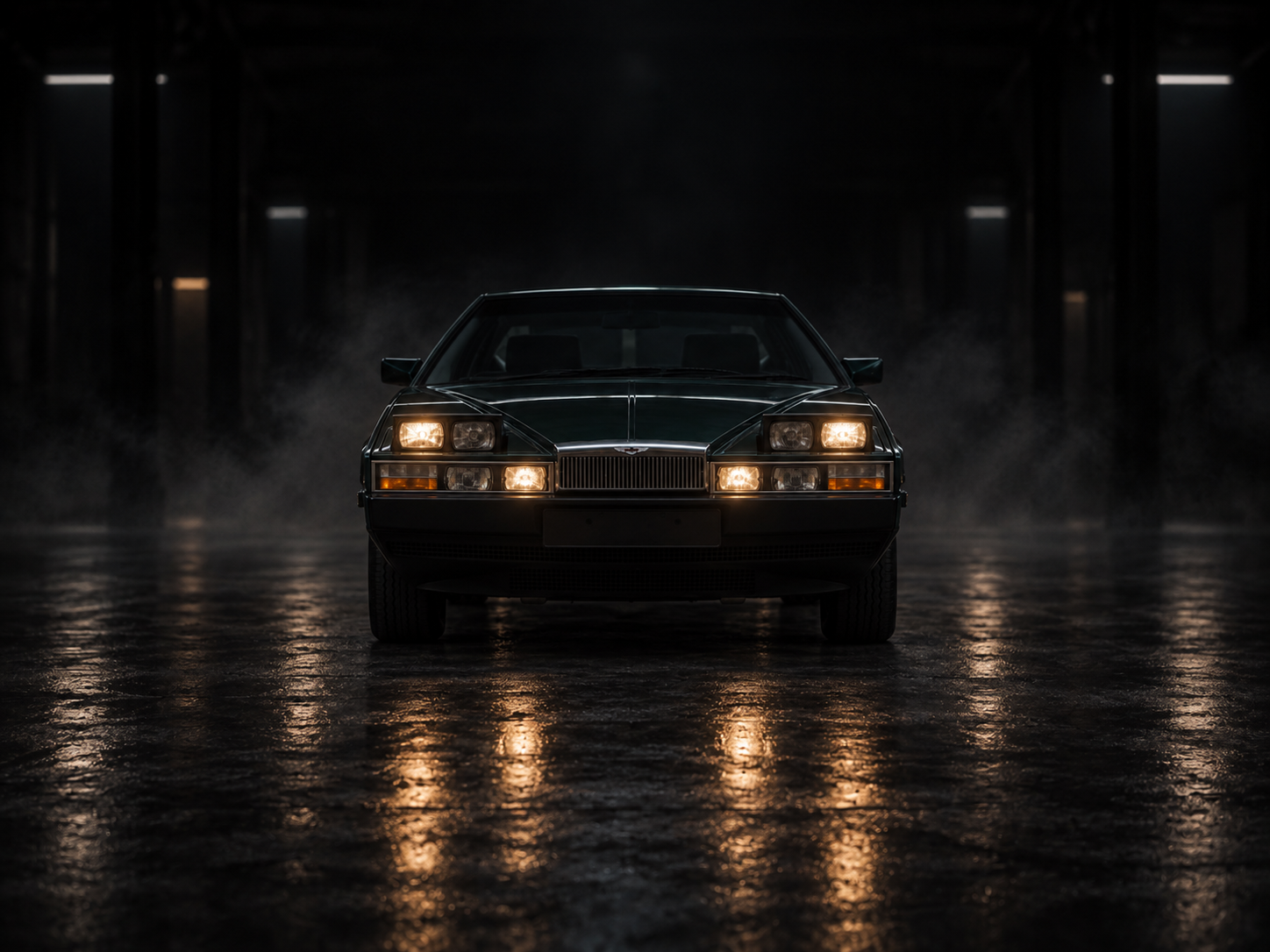
Image © Fuel the Passion. For illustrative purposes.
1976: Aston Martin Shows the Future
In 1976, Aston Martin did something that, viewed from half a century away, still seems remarkably audacious.
The company had only recently emerged from one of the most precarious periods in its history. Receivership had brought production to a halt at the end of 1974, a new consortium had revived the business during 1975, and Aston Martin was operating on a scale that bore little resemblance to the large international manufacturers against which its cars were judged.
One of the central figures in that rescue was American businessman Peter Sprague. After becoming involved with Aston Martin during the 1975 revival, Sprague helped bring together the investment and people required to restart the company and went on to become co-chairman of the revived business. He would also become closely involved in the decisions shaping Aston Martin’s next generation of cars, giving his later recollections of the Lagonda programme particular significance.
Designed by William Towns, the new four-door looked almost impossibly low, long and angular. Its narrow nose, sheer surfaces and geometric bodywork rejected many of the conventions of the traditional luxury saloon. Inside, Aston Martin intended to go further still, replacing familiar analogue instrumentation with electronic displays and touch-sensitive controls.
The press presentation took place at Aston Clinton before the car’s first public Motor Show appearance at Earls Court later in 1976. Specialist historical records place the Aston Clinton presentation on 12th October 1976. Even the manner in which the prototype appeared before television cameras has become part of Lagonda folklore. The show car wasn’t yet a functioning, production-ready road car. Aston Martin has since described it as a non-runner, while Sprague recalled how television footage was achieved by allowing the car to roll downhill.
What mattered at that moment wasn’t whether the prototype could complete a road test. It was what people saw. At £24,750 in 1976, roughly £170,000 in 2026 purchasing power, the Lagonda was already extraordinarily expensive. Yet Sprague later recalled that Aston Martin received 76 orders at the 1976 Motor Show, most of them for Lagondas.
Aston Martin had succeeded in making people look. The harder part would be turning the spectacle into a car customers could actually drive.
Before Aston Martin: The Original Lagonda
Image © Fuel the Passion. For illustrative purposes.
The name on the nose, however, was much older than William Towns' wedge. Lagonda's story began with Wilbur Gunn, an American-born engineer and entrepreneur from Springfield, Ohio, who settled in Britain. The name itself came from Lagonda Creek near his American home town, giving one of Britain's most evocative motoring marques distinctly transatlantic origins. Different dates sometimes appear for the beginning of the business because they refer to different milestones. Gunn was operating his engineering concern by 1899, while the Lagonda Motor Co Ltd followed in 1904.
Lagonda’s reputation wasn’t built overnight. Gunn moved from marine engines into motorcycles, tricars and increasingly sophisticated motor cars, while competition helped establish the name beyond Britain. In 1910, he drove a Lagonda to a gold medal in the demanding St Petersburg–Moscow–St Petersburg reliability trial. By the inter-war years, Lagonda had developed into a manufacturer capable of combining sporting performance with increasingly luxurious long-distance cars.
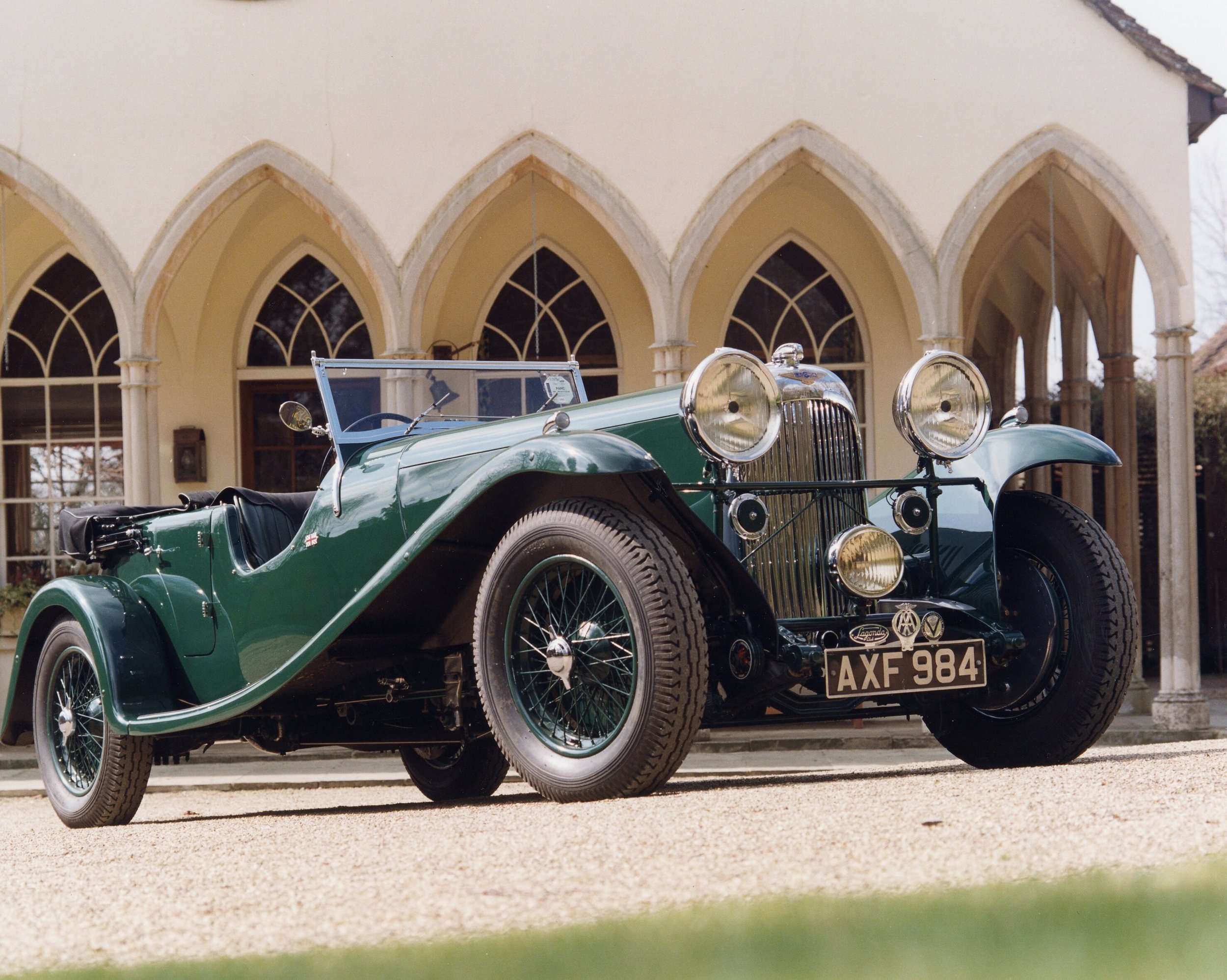
Image © Aston Martin Lagonda. Used for editorial purposes. 1924 Lagonda M45 Tourer.
By the mid-1930s, Lagonda had moved well beyond its early experimental years. Cars such as the 4½-litre M45 combined imposing long-distance touring ability with genuine performance, helping to establish the marque among Britain’s serious high-performance manufacturers.
Long before the name became attached to an Aston Martin luxury saloon, Lagonda had established its own identity through road cars, competition and technical development.
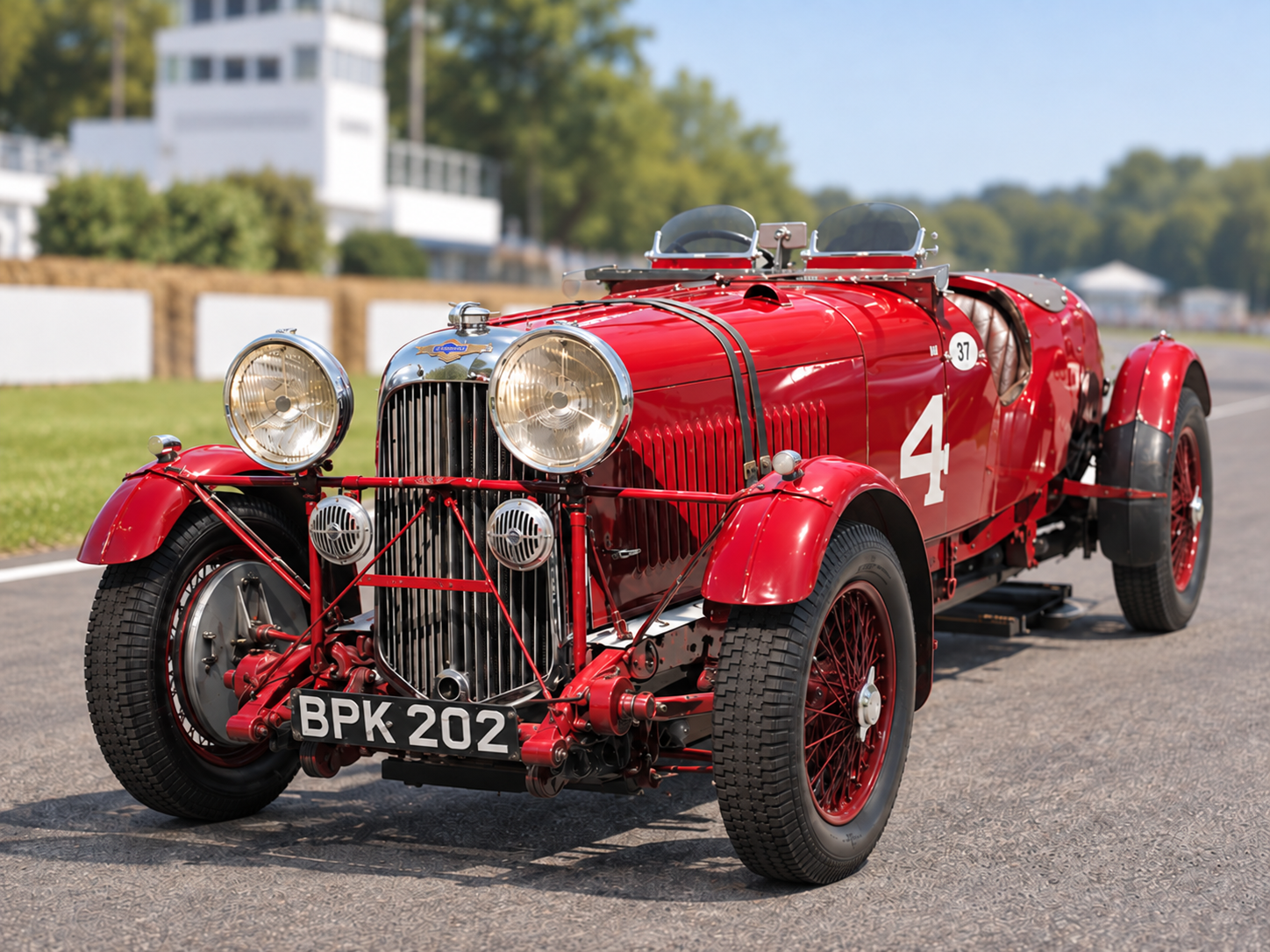
Image © Fuel the Passion. For illustrative purposes.
That independent history reached one of its most celebrated moments in 1935. At the 24 Hours of Le Mans, the Lagonda driven by John Hindmarsh and Luis Fontés took overall victory.
It remains one of the defining achievements in the marque's history and an important reminder that Lagonda was not created as an Aston Martin sub-brand. It had already earned its place in motoring history.
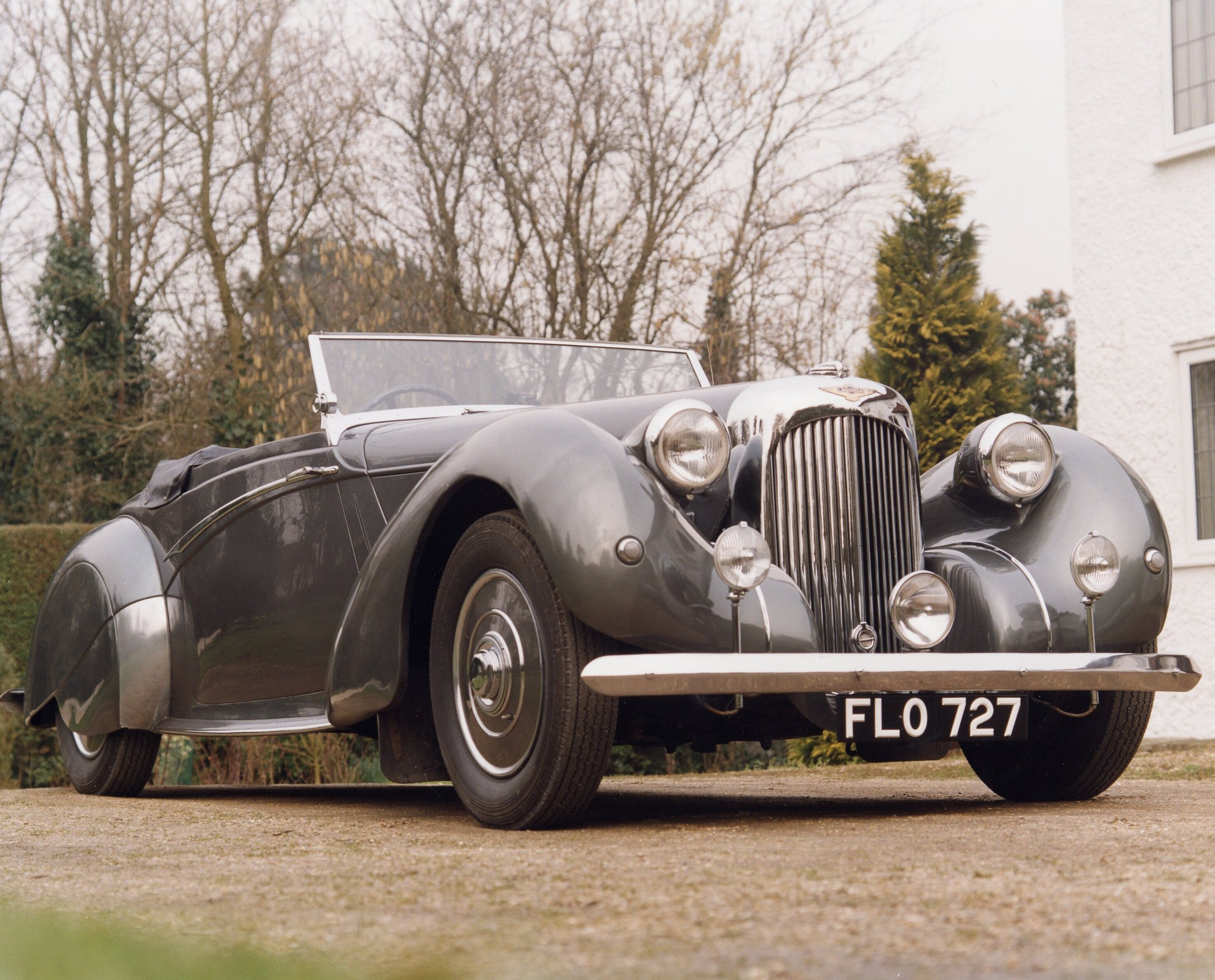
Image © Aston Martin Lagonda. Used for editorial purposes. 1939 Lagonda V12 Rapide.
Lagonda’s ambitions continued to grow as the decade progressed. By the late 1930s, the marque had developed sophisticated V12 models that combined substantial performance with the refined long-distance character expected of an increasingly prestigious luxury manufacturer.
By the eve of the Second World War, Lagonda had developed into a highly sophisticated luxury and performance marque, with its V12 models representing a significant step forward in engineering and refinement.
LAGONDA: A STORY SPANNING THREE CENTURIES
From Wilbur Gunn’s engineering business to William Towns’ extraordinary wedge, the Lagonda name had already travelled a remarkable road before becoming one of Aston Martin’s most distinctive chapters.
Wilbur Gunn begins the Lagonda story
The American-born engineer establishes his engineering business in Britain. The Lagonda name comes from Lagonda Creek near his home town of Springfield, Ohio.
Lagonda Motor Co Ltd established
The business develops into a British motor manufacturer in its own right.
Victory at Le Mans
John Hindmarsh and Luis Fontés win the 24 Hours of Le Mans for Lagonda.
David Brown acquires Lagonda
Brown buys Lagonda for £52,500, bringing the marque and its W.O. Bentley-developed engineering into the same ownership as Aston Martin.
The Lagonda Rapide
Aston Martin revives the Lagonda name for an exclusive DB4-derived four-door. Just 55 are built.
Crisis and rescue
Aston Martin enters receivership before a new consortium restarts the company during 1975.
The wedge arrives
William Towns’ extraordinary four-door Lagonda is unveiled, introducing an entirely new visual and technological interpretation of the name.
The wedge era ends
Aston Martin records production ending in 1989 after 645 chassis; specialist records place completion of the final Series 4 cars into January 1990.
W.O. Bentley, David Brown and the Engine Aston Martin Needed
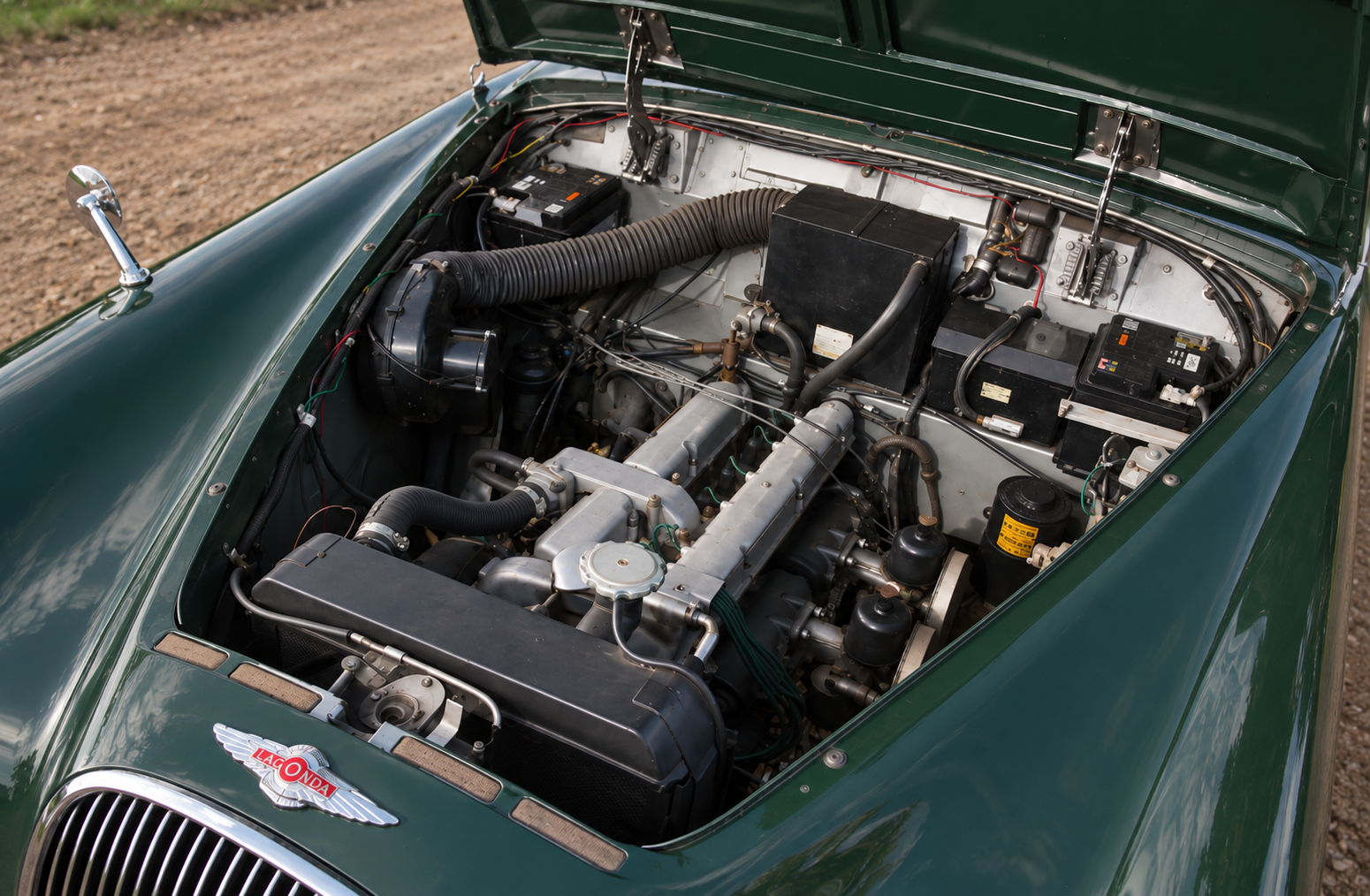
Image © Fuel the Passion. For illustrative purposes.
The connection with Aston Martin would begin through a combination of engineering opportunity and David Brown's post-war ambitions. W.O. Bentley had joined Lagonda after his period at Rolls-Royce and contributed to the engineering programme that produced Lagonda's post-war 2.6-litre twin-cam straight-six.
The engine would prove particularly significant after industrialist David Brown acquired Aston Martin in 1947 and then bought Lagonda for £52,500. Brown didn’t acquire Lagonda simply for one engine. The marque brought engineering capability, intellectual property, people and a respected name.
Aston Martin itself has described it as a vital part of Brown's plans. Developed from W.O. Bentley's work, it became the basis of the engine used in the early DB Aston Martins and helped provide the technical foundation from which Brown could develop the company's post-war grand tourers.
This is where the relationship becomes particularly interesting. Lagonda was initially bringing something to Aston Martin that Aston Martin needed. Its engineering helped power the DB era. Later, that relationship would begin to reverse.
ASTON MARTIN + LAGONDA:
A RELATIONSHIP THAT KEPT CHANGING
Lagonda did not simply become an Aston Martin badge. Over decades, the relationship moved in both directions — first contributing engineering to Aston Martin, then becoming a name through which Aston Martin could explore different interpretations of luxury.
Lagonda as an independent marque
Lagonda develops its own engineering, road cars and competition history long before becoming part of Aston Martin.
W.O. Bentley and the post-war six
Lagonda develops the twin-cam straight-six that becomes a crucial engineering asset in the years that follow.
David Brown buys Lagonda
Aston Martin and Lagonda come under common ownership, bringing the two marques together and giving Aston Martin access to Lagonda's engineering capability.
Lagonda technology helps power Aston Martin
The Lagonda-derived twin-cam engine becomes fundamental to Aston Martin's early DB-era road cars.
The Lagonda Rapide
The direction of influence changes. The Rapide is created largely from Aston Martin engineering and architecture, including its DB4-derived foundations.
Lagonda becomes Aston Martin's different proposition
During the 1970s, the name returns first on the V8-based four-door cars and then on William Towns' radical wedge.
Lagonda as Aston Martin's luxury laboratory
In later decades, Taraf, the Vision Concept and the All-Terrain Concept return to the Lagonda name whenever Aston Martin explores a less conventional interpretation of luxury.
The Rapide: The Relationship Reverses
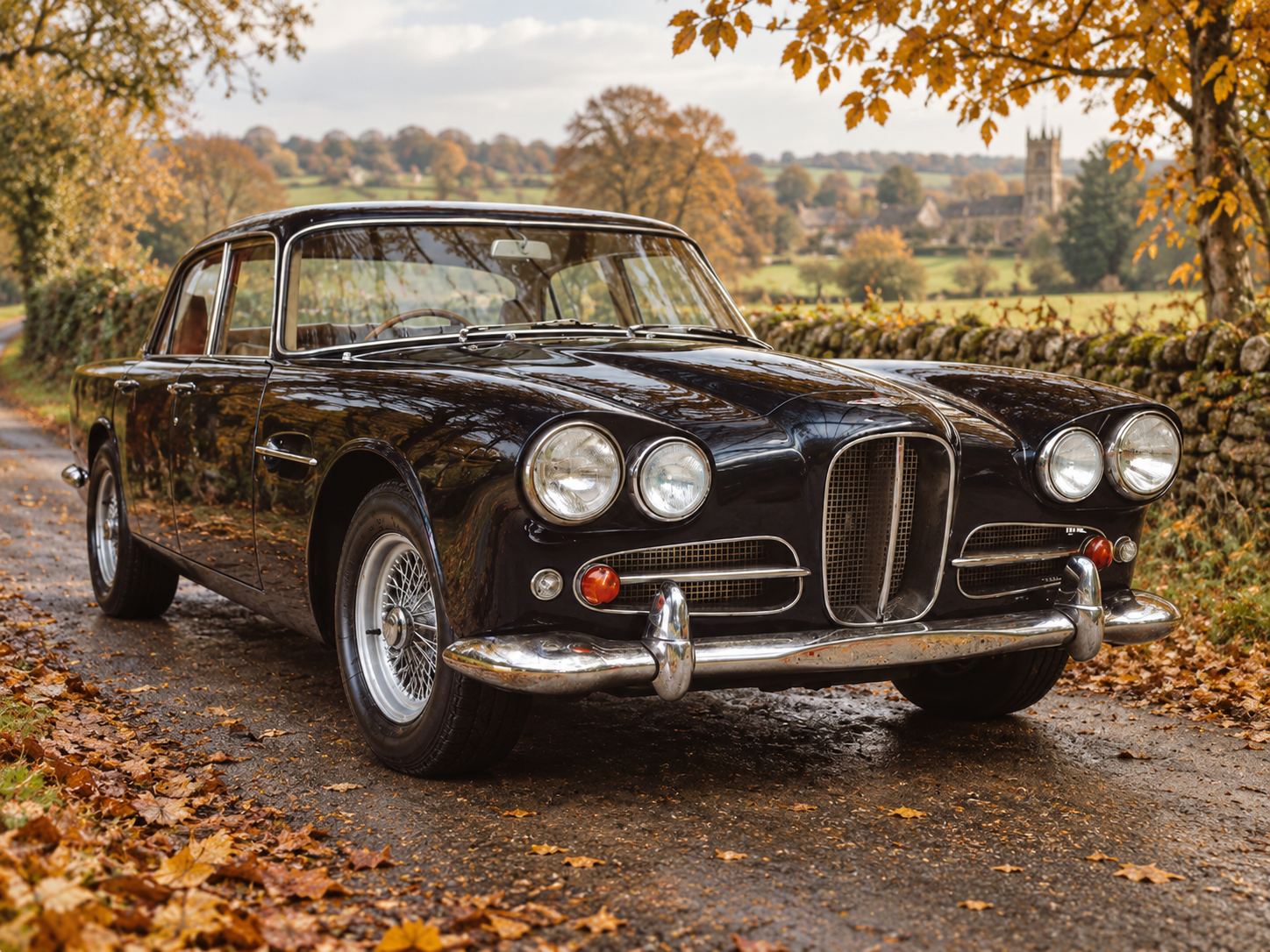
Image © Fuel the Passion. For illustrative purposes.
By 1961, the Lagonda name had returned on a very different proposition. The Lagonda Rapide was unveiled at the Paris Motor Show as a luxurious four-door derived from Aston Martin's existing engineering rather than the other way around.
Its relationship with the DB4 was clear, but the wheelbase was extended by 16 inches and the specification included de Dion rear suspension and a 4.0-litre version of Tadek Marek's straight-six. Only 55 were produced.
The Rapide therefore occupies an important place in the story not because it was a mass-market success, it plainly wasn’t, but because it established an idea that would return repeatedly. Lagonda could provide Aston Martin with a name under which to explore a different kind of car: still fast, still expensive and still exclusive, but with four doors and a different definition of luxury.
Before the Wedge: The Seven-Car Lagonda
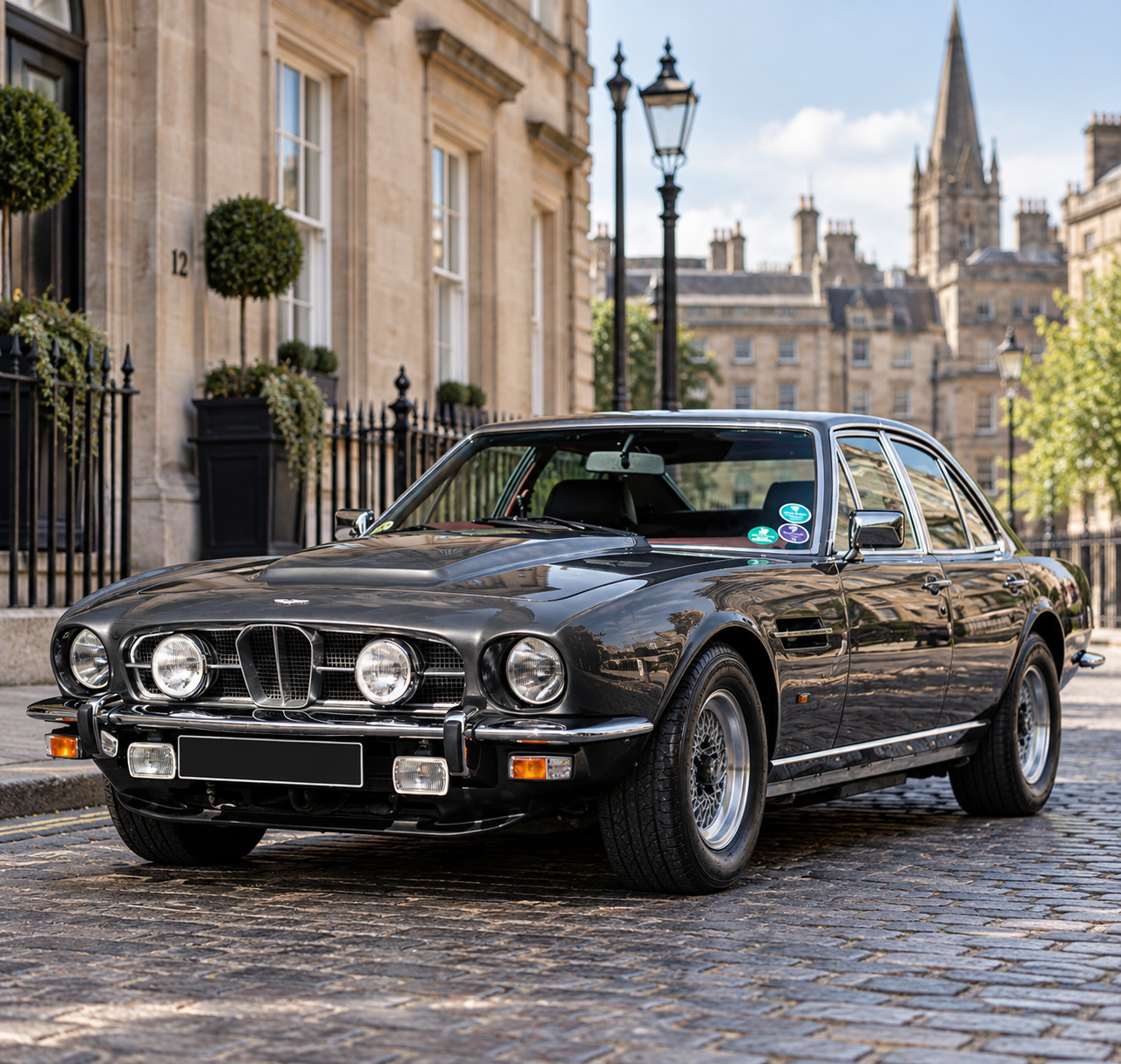
Image © Fuel the Passion. For illustrative purposes. The pre-wedge Lagonda: one of the V8-based four-door cars built before William Towns’ radical 1976 design transformed the name.
The Towns-designed car was not Aston Martin's first attempt to revive Lagonda as a four-door during the V8 era. Seven V8-based four-door Lagondas were produced before the wedge arrived. Visually, these cars were far closer to Aston Martin's existing V8 than to the extraordinary design that followed.
Today, they are commonly described as Series 1 Lagondas, which is why the Towns wedge is so often referred to as Series 2.
The neat Series 1, 2, 3 and 4 structure familiar to enthusiasts today was not necessarily applied with complete consistency throughout the car's original life. It is best understood as a convenient way of distinguishing the major stages of Lagonda development rather than an unbroken piece of period factory nomenclature.
What the seven earlier cars demonstrate is more important. The four-door Lagonda idea already existed. What changed after Aston Martin's 1975 rescue was the scale of the ambition.
Receivership, Rescue and a Dangerous Moment
The context in which the wedge Lagonda was created is essential to understanding why the project was so extraordinary. Aston Martin had endured repeated financial difficulty throughout its history, but events reached a particularly serious point at the end of 1974. Peter Sprague recalled the factory being locked on 30th December and employees being told the following day that the company was in receivership.
During 1975, a consortium including Sprague, George Minden and Jeremy Turner assembled the investment required to revive Aston Martin. The new owners inherited an unusual problem. Aston Martin needed something new to create interest and generate future business, but replacing its existing two-door V8 immediately carried considerable risk.
A four-door could sit alongside the V8 rather than replace it. William Towns already had ideas. What followed wasn’t the conservative programme one might expect from a small manufacturer recovering from receivership. Aston Martin instead attempted to create one of the most technologically ambitious luxury cars in the world.
The decision now looks brave. At the time, it must also have looked dangerous.
William Towns and the Shape Nobody Expected
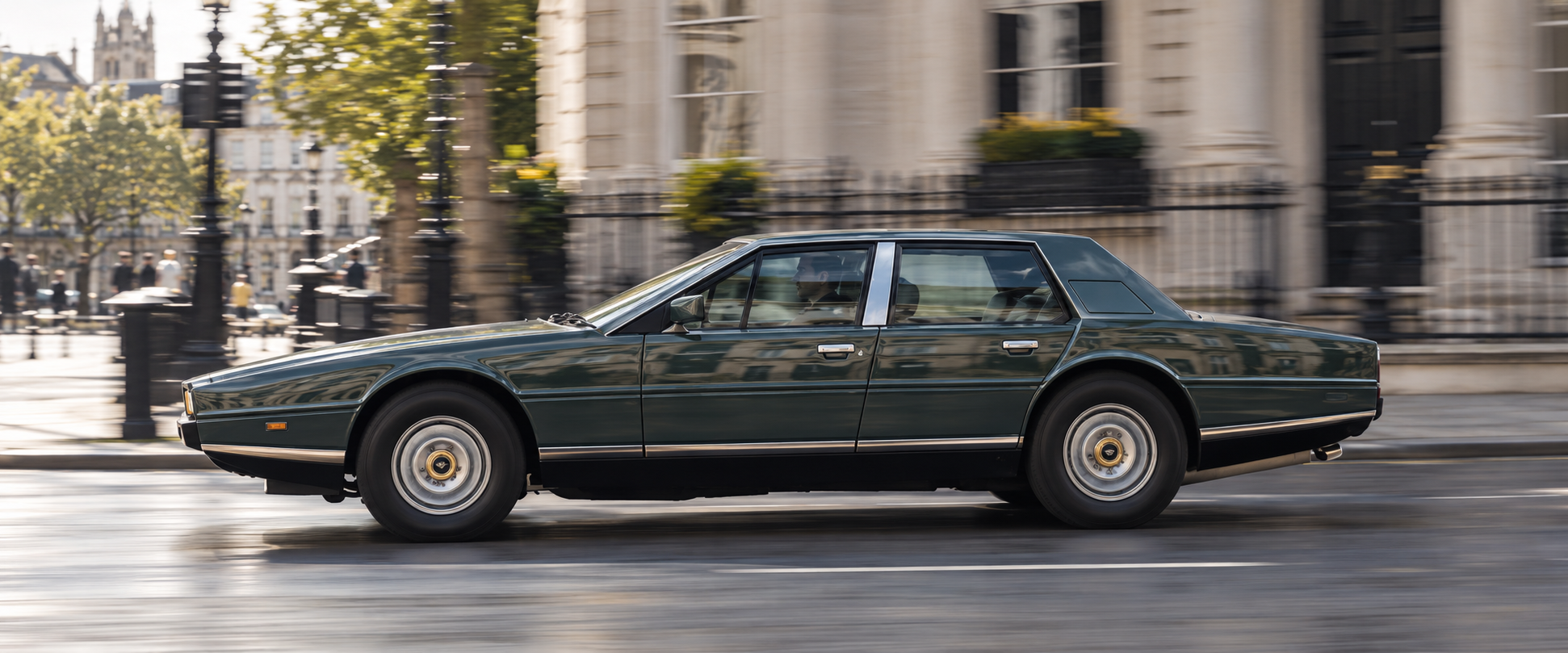
Image © Fuel the Passion. For illustrative purposes. William Towns’ Lagonda in profile: low, long and uncompromising, with the strong horizontal lines and geometric surfaces that made the 1976 design so radical.
Even without the electronics, the Lagonda would’ve been extraordinary. William Towns created a shape that seemed almost to have been drawn using a ruler. The bonnet remained astonishingly low. The glasshouse sat within a long, shallow profile. Strong horizontal lines emphasised the car's length while sharp changes in plane produced surfaces unlike the rounded luxury saloons surrounding it.
That distinction is important. The Lagonda was luxurious, but it wasn't simply an alternative Rolls-Royce. Rear accommodation was surprisingly constrained for such a long car, while the driver sat low in a cockpit dominated by the dashboard.
Even photographs struggle to convey just how unusual the proportions are. Yet there was another contrast that photographs couldn’t immediately reveal. The Lagonda looked as though it had arrived from the future, yet it was being constructed using some of the most traditional methods left in the motor industry.
The Dashboard That Tried to Leap Decades Ahead
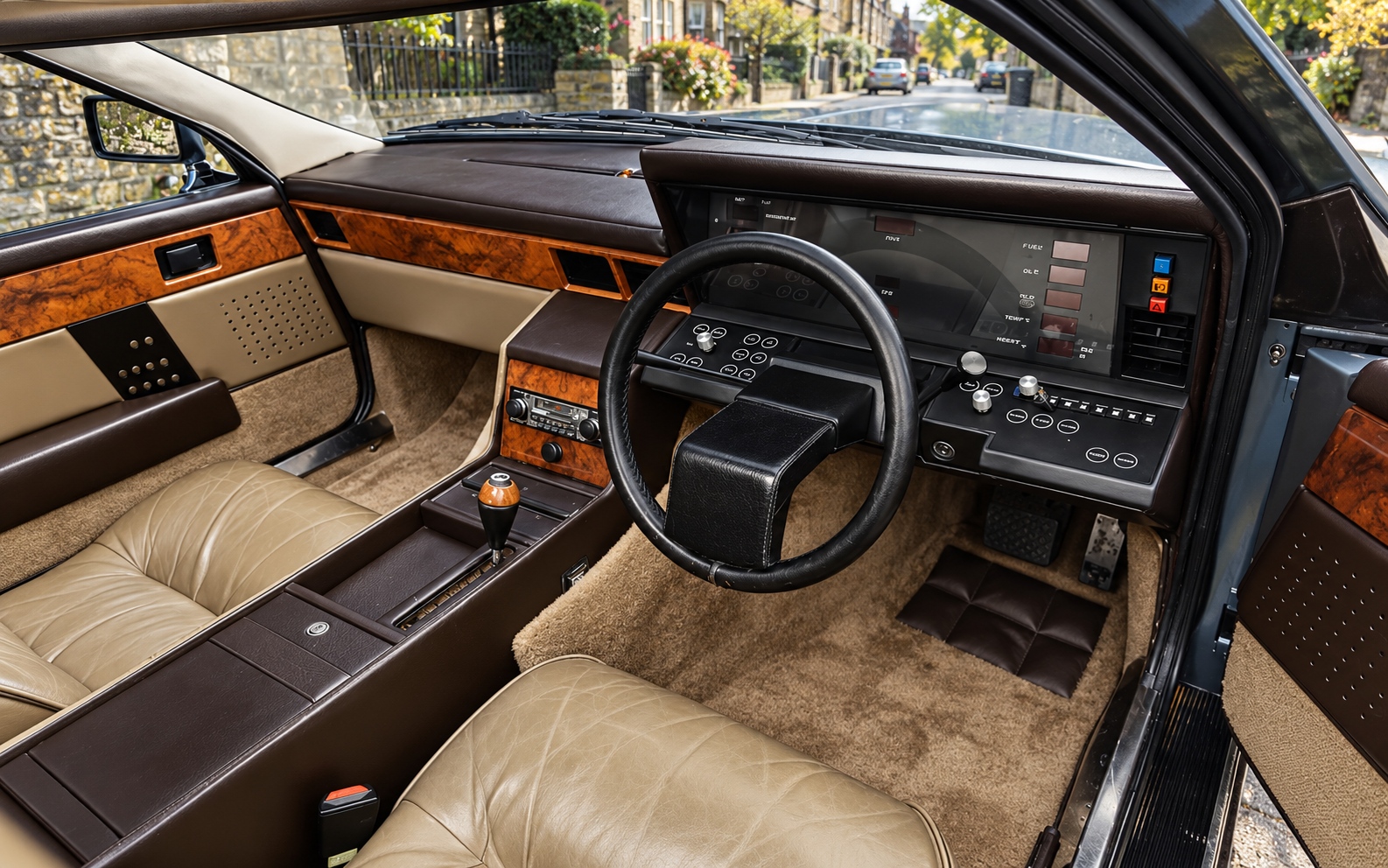
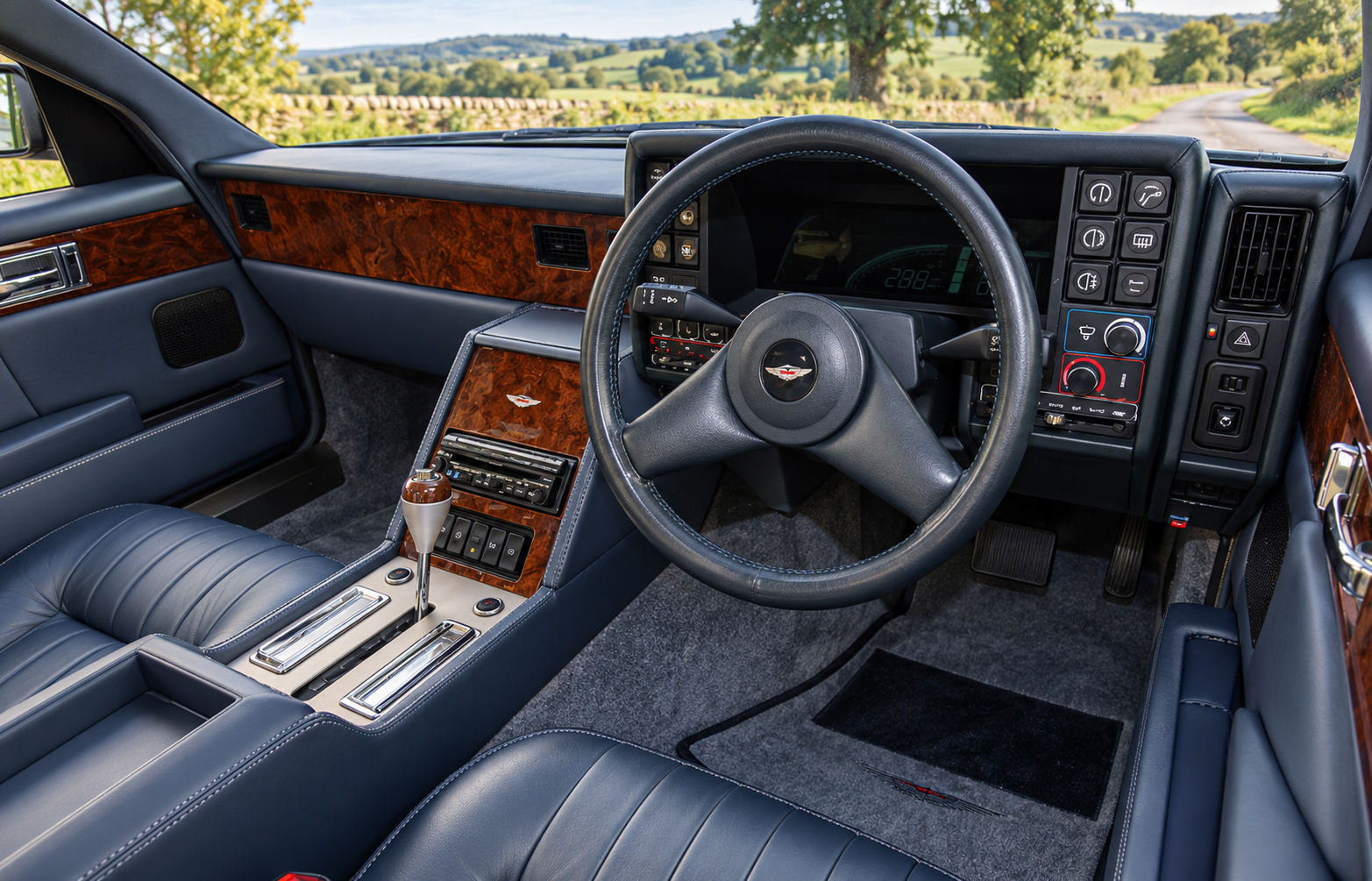
Image © Fuel the Passion. For illustrative purposes. The Lagonda cockpit brought together traditional luxury materials and an electronic control environment unlike anything normally found in a luxury saloon of the period.
If Towns made the exterior look futuristic, Peter Sprague wanted the interior to live up to it. Sprague's own account places the idea for an all-electronic control and information environment with him. Mike Loasby, Aston Martin's engineering director, became central to trying to turn that ambition into something the company could actually build.
National Semiconductor technology formed part of the early programme, including the IMP-16 microprocessor architecture. That needs to be considered in the context of the mid-1970s. This was a period when a digital watch could still feel novel. Aston Martin was attempting to replace familiar analogue instruments and conventional dashboard controls with electronic information displays and touch-sensitive switch panels in one of the most expensive cars in the world.
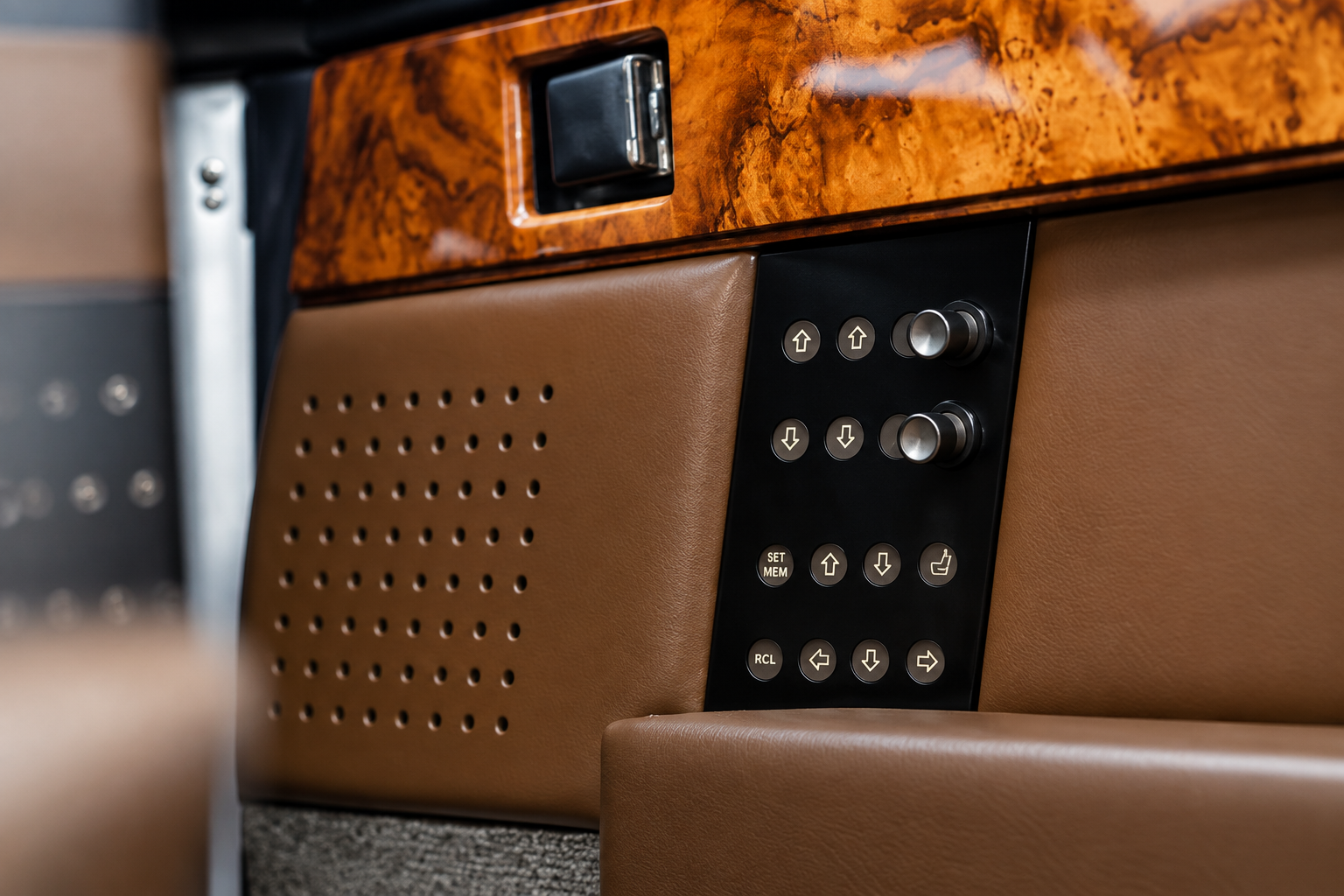
Image © Fuel the Passion. For illustrative purposes. A close-up of the Lagonda’s unconventional interior controls, combining electronic switchgear with traditional leather and wood trim.
The idea was ambitious enough. Making it reliable inside a motor car was something else entirely. Heat, cold, vibration, electrical interference and the realities of automotive use provided an environment very different from the more controlled conditions in which much contemporary electronics had been designed to operate. Later accounts often compress the entire story into a joke: Aston Martin fitted an electronic dashboard, it failed, and that was that. The real history was more complicated.
Early production cars used red electronic LED instrumentation accompanied by touch-sensitive controls around the driver. By 1980, Javelina Corporation of Richardson, Texas, was involved in developing the Lagonda's LED display system. One of its most intriguing features was known as ESO - Essential Systems Only. Selecting ESO reduced the amount of information being shown, leaving essential readings such as speed, fuel level and time. If the system detected a condition requiring attention, the appropriate information could return. That is remarkably modern thinking. Aston Martin and its suppliers were not simply trying to display as many glowing numbers as possible.
There were still concessions to conventional technology. One of the most delightful is the odometer. While the dashboard embraced electronics, the mileage recorder remained mechanical and was positioned beneath the bonnet. It’s difficult to find a better illustration of the Lagonda's character: a digital cockpit with a conventional odometer hiding beside the engine.
The electronics didn’t remain unchanged either. As the Lagonda evolved, Aston Martin continued revising the instrumentation. Later systems moved through different display technologies, including CRT-style arrangements and subsequent electronic displays. Later cars could incorporate synthesised voice warnings.
That doesn’t mean the reliability stories are fiction. The early systems created genuine difficulties and required significant engineering effort. But treating every Lagonda built over more than a decade as though it carried exactly the same problematic 1970s dashboard misses an important part of the story.
Aston Martin kept developing it.
THE LAGONDA’S ELECTRONICS:
AN IDEA THAT KEPT EVOLVING
The Lagonda’s electronic cockpit was never one fixed dashboard left unchanged throughout production. From the original red LED concept and touch-sensitive controls to later revised screen-based systems, Aston Martin kept refining the idea as the car evolved.
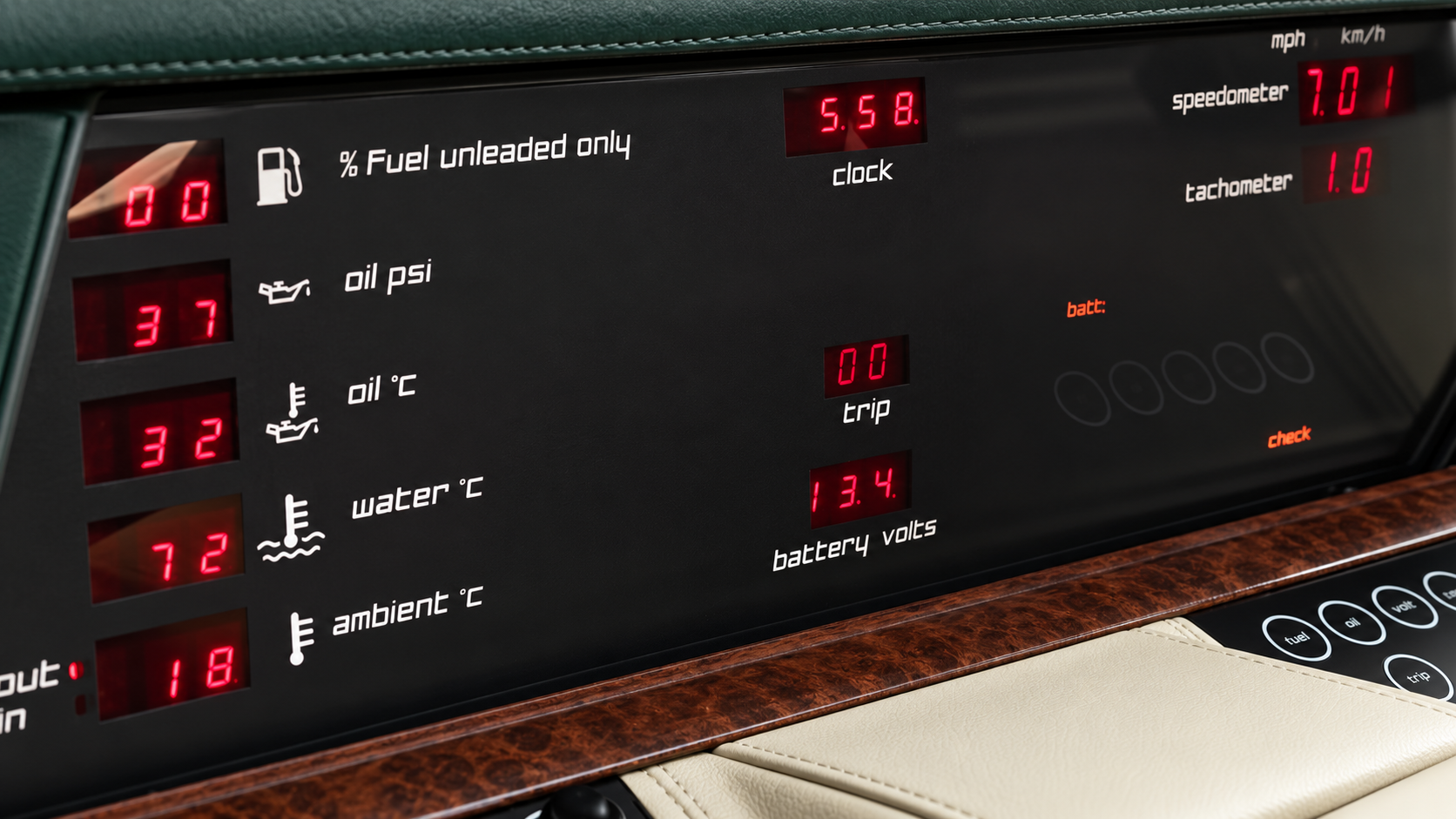
The original electronic statement
From the outset, the Lagonda’s dashboard was conceived as part of the car’s futuristic identity. Red electronic readouts and touch-sensitive controls helped create an interior that looked unlike anything else in a luxury saloon of the period.
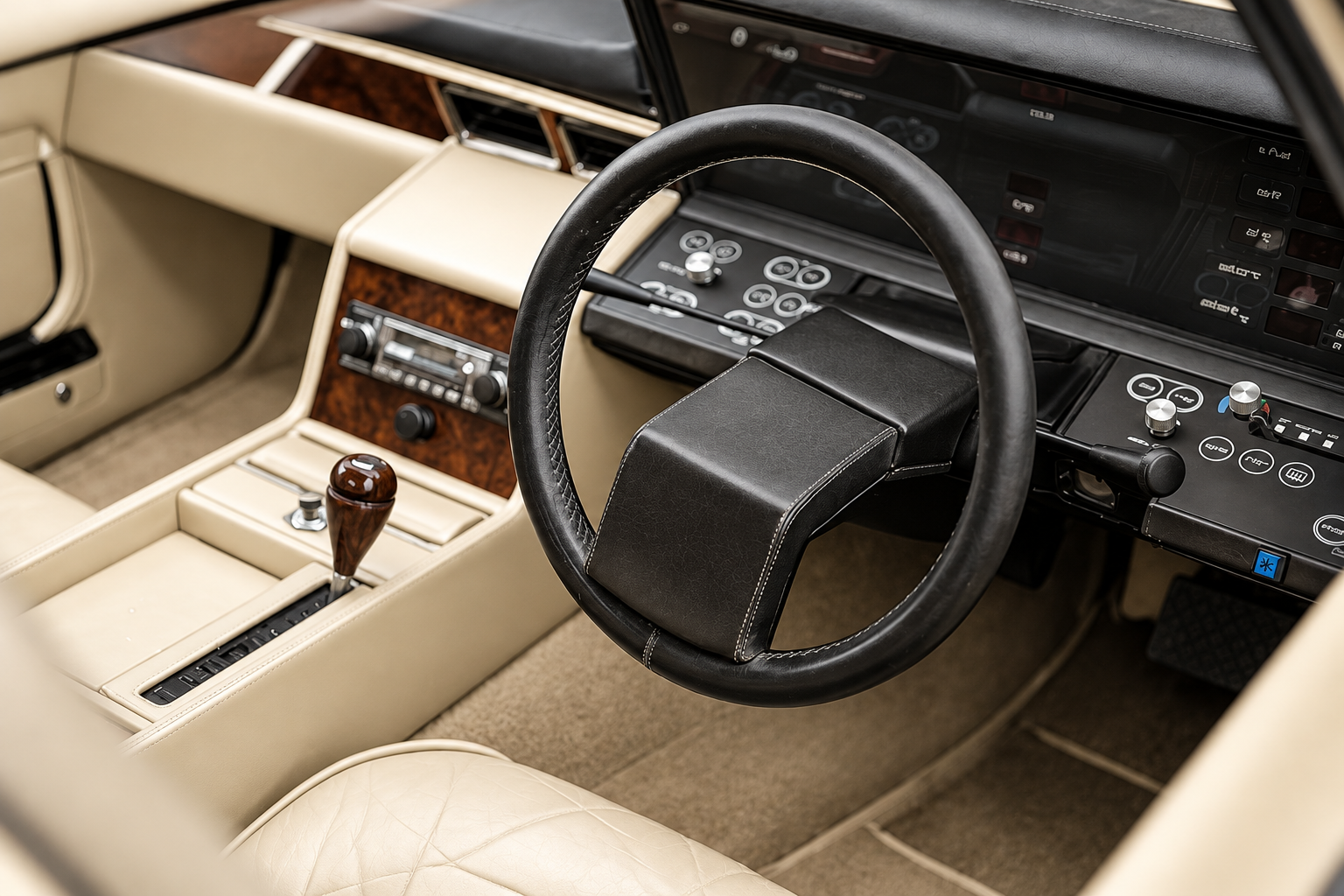
Javelina-era refinement
As the programme moved on, Aston Martin continued developing the electronic cockpit concept with specialist support. The goal remained the same: to deliver an interior that felt as advanced and as daring as the Lagonda’s exterior design.
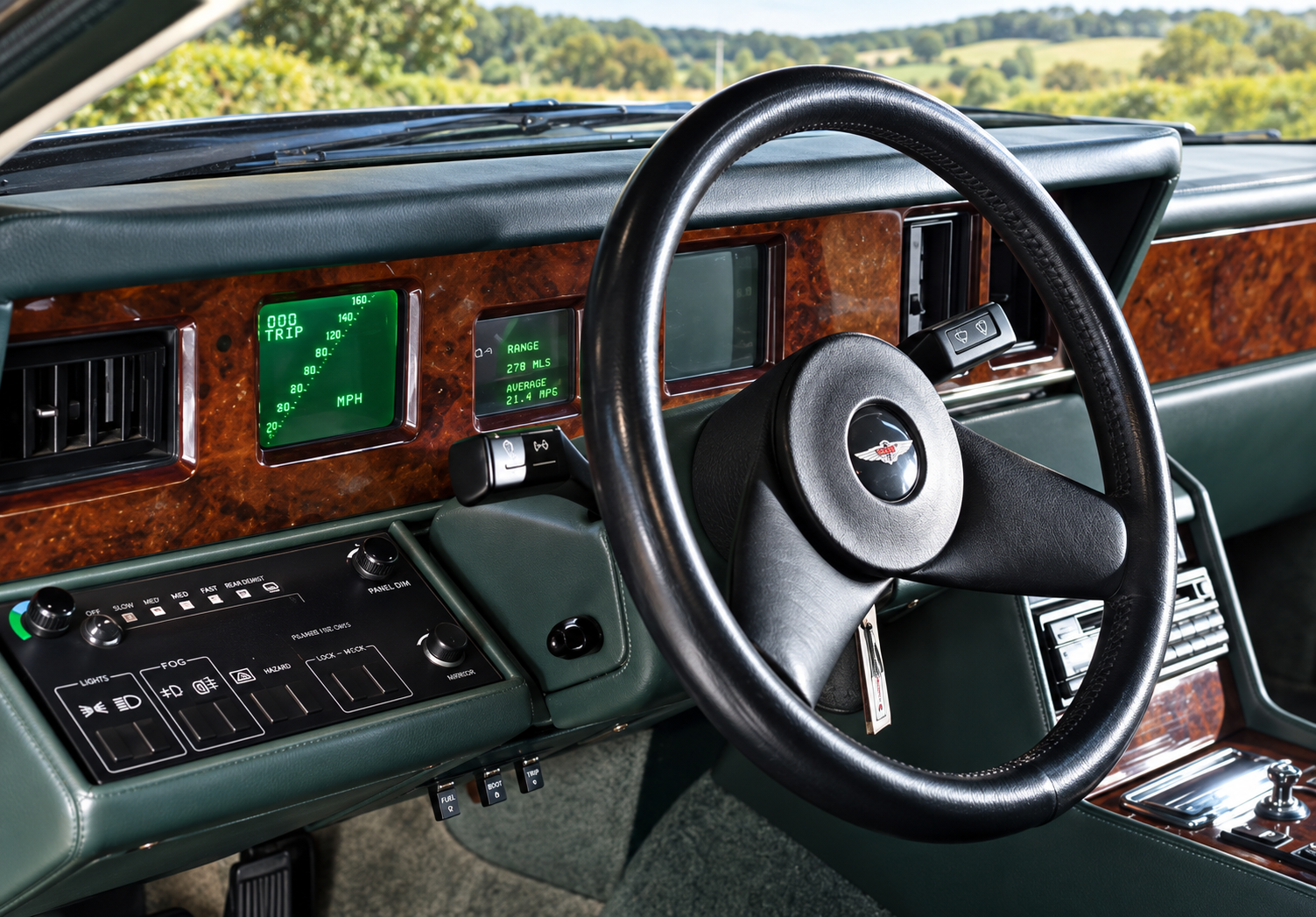
A different digital language
Later Lagondas adopted revised screen-based instrumentation, giving the dashboard a different look while preserving the core ambition. The electronics were still central to the experience, but the way information was presented continued to change.
The idea matures
By the later cars, the dashboard had become more mature and more integrated, but the principle had not changed. The Lagonda was still trying to make the future visible from behind the steering wheel.
There was no single “Lagonda dashboard” that stayed untouched from 1976 to the end of production. The electronics evolved throughout the car’s life, which is exactly why the Lagonda remains such a fascinating and unusual chapter in Aston Martin history.
Half the story told.
Plenty still to come.
We’ve travelled from Lagonda’s independent beginnings through W.O. Bentley, David Brown, William Towns and one of the most ambitious electronic cockpits of the 1970s.
From Spectacular Prototype to Usable Car
The difference between presenting a sensational prototype and delivering a production car became painfully clear. By April 1978, Thames Television's Drive In programme was filming inside Newport Pagnell and speaking directly to Aston Martin managing director Alan Curtis. The resulting footage is one of the most valuable contemporary records of the Lagonda programme.
The reporter challenged Curtis over a car that was more than a year late and substantially more expensive than originally expected. Curtis didn’t attempt to disguise what had happened. He called it a “major miscalculation.”
This contemporary Drive In film, first broadcast on 20th April 1978, includes factory footage and an interview with Aston Martin managing director Alan Curtis discussing Lagonda production, delays, demand and exports.
His explanation was equally revealing. Aston Martin had been swept along by the reaction to the car and the scale of interest generated around its unveiling before having to confront the reality that its original timescale and costing assumptions were not achievable. Yet the same film shows another side of the programme. Newport Pagnell remained intensely traditional.
Upholstery for a Lagonda required nine hides. Trim was cut and prepared by hand. Panels were individually fitted. Paint finishing remained labour-intensive. Engines were assembled by individual builders whose identity could remain associated with them. Within the same factory, craftsmen were using skills that would have been familiar decades earlier while engineers were attempting to make microprocessor-controlled instrumentation work in a production road car.
The transition into customer production was also less neat than later histories sometimes suggest. Contemporary reporting in 1978 was already discussing impending production deliveries, while Aston Martin's present-day history places the first customer car in 1979. Rather than forcing those sources into an unnecessary contradiction, it makes more sense to see 1978–79 as the transition from late development and initial production preparations towards established customer deliveries.
That also explains why stories about the “first” Lagonda can differ depending on whether the speaker means prototype, early handover, production completion or conventional customer delivery.
Price, Prestige and the Middle East
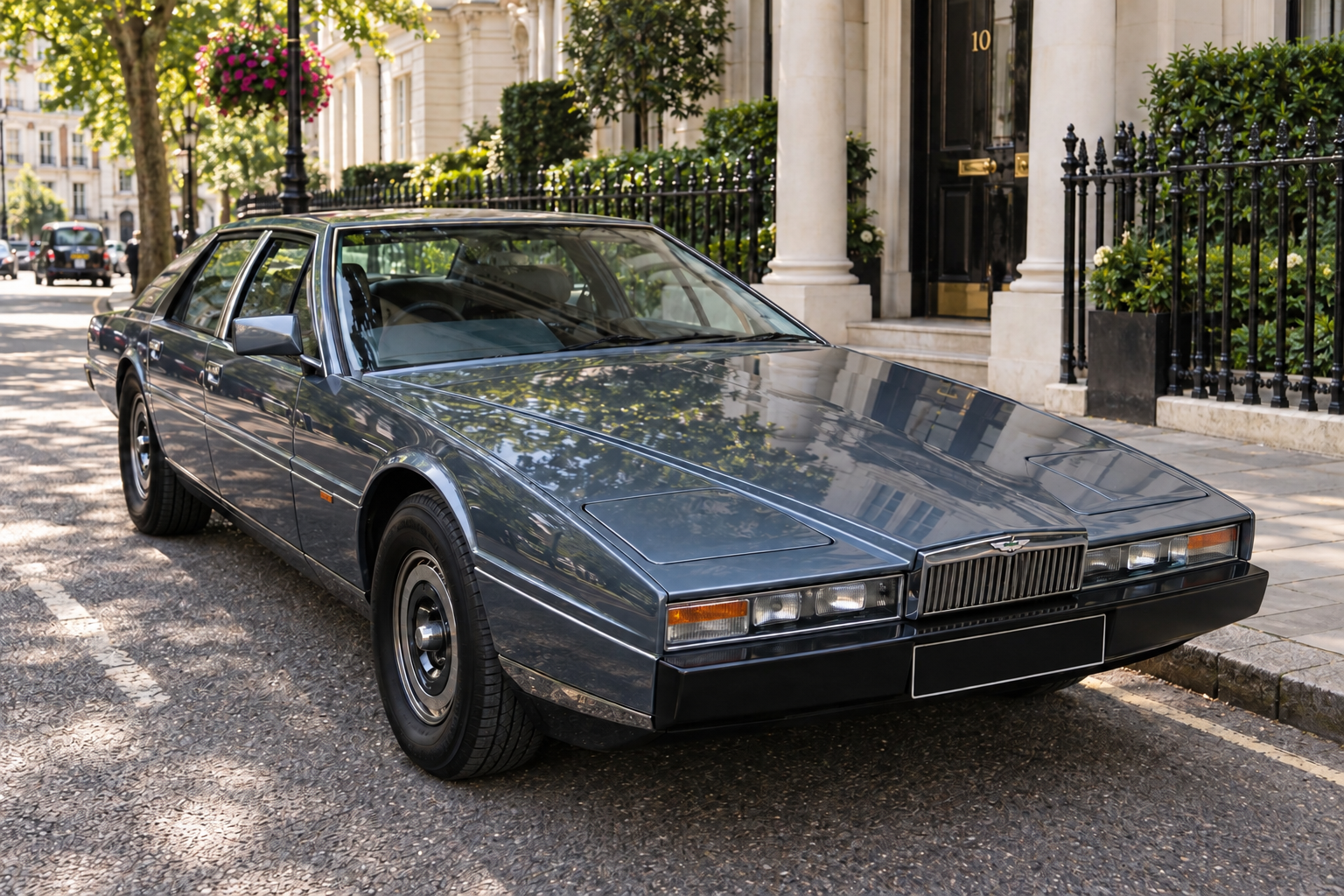
Image © Fuel the Passion. For illustrative purposes. By the early 1980s, the Lagonda had established itself as one of the most distinctive luxury cars in the world — expensive, unconventional and impossible to mistake for anything else.
The original £24,750 price didn’t survive the development process. By April 1978, the Lagonda was approaching £33,000, roughly £190,000 in 2026 purchasing power. Once again, the Thames interview provides unusually useful contemporary evidence because Curtis discussed the commercial consequences directly. He said Aston Martin had lost nine customers but gained around thirty during the same period. That doesn’t make the price escalation unimportant. It demonstrates something more interesting: despite the delay and increased cost, the car continued attracting buyers.
Aston Martin was operating in an intensely export-led market. Around three-quarters of production was being exported at that time, while dealer and service support was being established or trained in Britain, continental Europe, the United States and the Middle East.
Its combination of exclusivity, visual drama, performance and extravagant technology appealed to customers looking for something less conventional than the established luxury marques. It’s easy, however, to turn that genuine commercial importance into caricature. The Lagonda was not simply a novelty sold to royalty and oil wealth. It was an international luxury product at a time when Aston Martin desperately needed international customers.
By 1983, Motor Sport reported a UK price of £59,500, approximately £210,000 in 2026 purchasing power, with a US price of around $150,000. The Lagonda had become dramatically more expensive than the car announced in 1976. Customers were still buying it.
THE PRICE OF A LAGONDA
The Lagonda was expensive from the outset, but its price climbed dramatically as development continued and increasingly bespoke versions appeared.
Modern equivalents are rounded estimates of UK purchasing power and are intended only to provide context. They are not estimates of current vehicle values.
A Car That Kept Changing
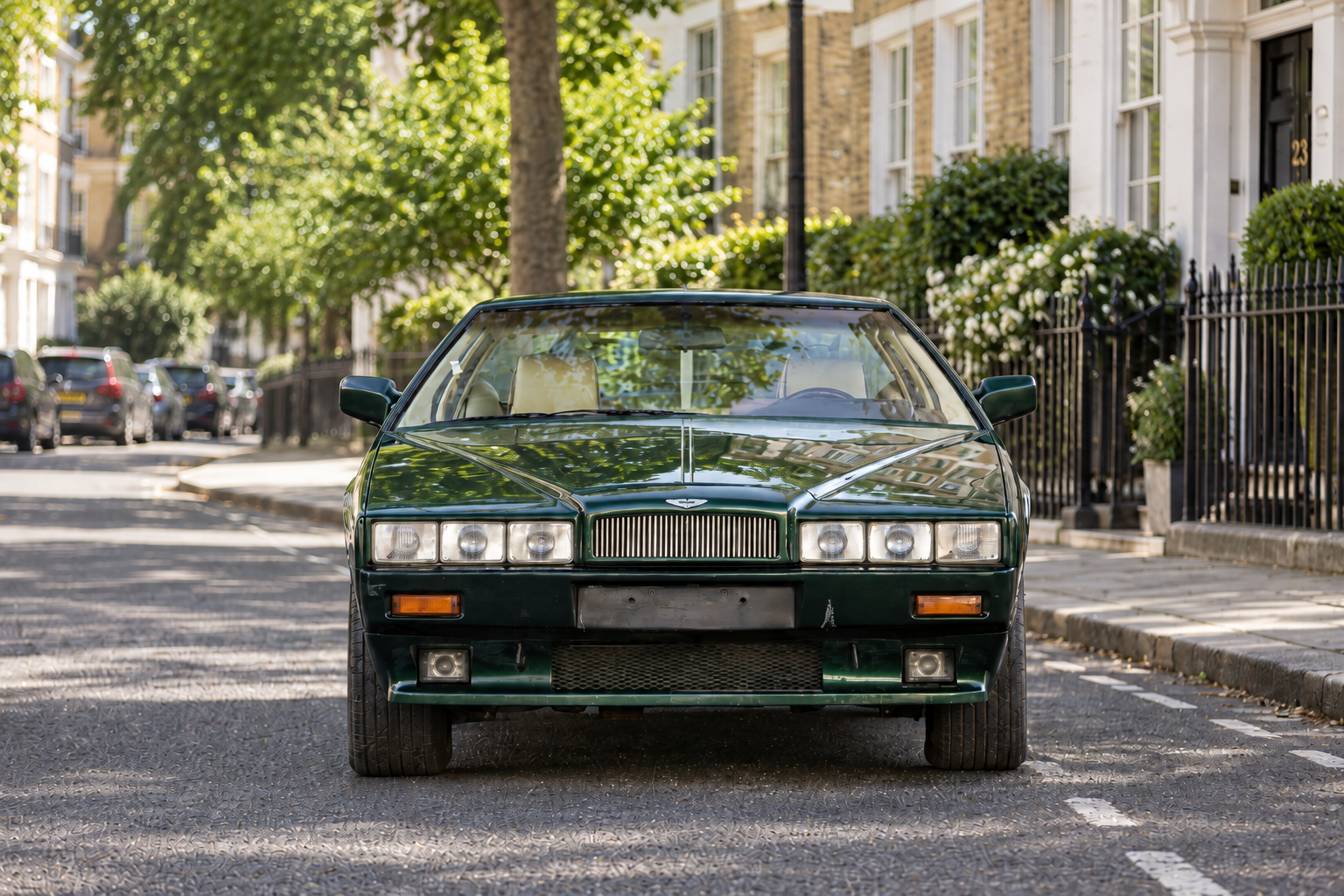
Image © Fuel the Passion. For illustrative purposes. A later Lagonda in its revised form, showing the six fixed front lamps that replaced the original pop-up headlight arrangement.
One reason the Lagonda story is so often oversimplified is that the car is discussed as though Aston Martin produced one specification throughout its life. It didn't. The early wedge established the Towns shape and electronic philosophy, but development continued throughout production.
Carburettors eventually gave way to fuel injection. Instrumentation changed. Electronic warning systems evolved. Later cars received different display arrangements and a growing level of refinement. Then, in 1987, Towns revisited the body itself.
The final major version softened many of the original knife-edge details. The pop-up headlamps disappeared, replaced by a redesigned nose using six smaller fixed lamps. The sides became cleaner, the shape less aggressively angular and the rear bodywork was revised. Some enthusiasts prefer the purity of the original wedge. Others regard the later cars as the more resolved interpretation. What matters historically is that Aston Martin continued working on the concept rather than leaving it frozen in 1976.
The Lagonda had also become far more important to the company than its modest overall production total might suggest. In 1983, Victor Gauntlett told Motor Sport that Aston Martin was producing around 150 Lagondas a year, alongside approximately 50 Saloons, Volantes and Vantages.
That doesn’t prove the car single-handedly saved the company. It does prove that it was not a peripheral curiosity. Contemporary road testing also complicates the idea of the Lagonda as little more than a rolling electronic experiment. By 1982, Motor Sport was describing a car that combined genuine luxury with sports-car road manners and performance.
Modern reviewers of well-sorted surviving cars have often reached similar conclusions. The specification could become more bespoke still. At least one surviving Lagonda is documented by its original owner as having been commissioned from Aston Martin in Vantage specification, illustrating just how flexible Newport Pagnell could be for a determined customer.
Aston Martin's current heritage record states that 645 chassis were built and places the official end of production in 1989. Specialist model records place completion of the final Series 4 cars into January 1990. Rather than choosing one record and pretending the other doesn’t exist, the discrepancy is best understood as the blurred boundary between an official production period and completion of the final cars. Either way, a design unveiled in 1976 had survived into another decade.
THE WEDGE LAGONDA:
AN EVOLVING IDEA
The William Towns Lagonda did not remain frozen in 1976. Across more than a decade, Aston Martin continued refining its electronics, mechanical specification and body design.
William Towns' radical design arrives
The Lagonda is unveiled with its extraordinary low, angular body and electronic-cockpit concept.
EARLY 1980s
The wedge reaches customers
Aston Martin continues developing both the car and its electronics as the Lagonda moves from prototype spectacle into settled customer production.
Mechanics and electronics continue to change
Fuel injection arrives, instrumentation changes and the electronic systems continue to develop.
The wedge is softened
Sharp edges are reduced, the pop-up headlights disappear and the front receives six smaller fixed lamps, creating the final major interpretation of Towns' design.
The wedge era draws to a close
Aston Martin records production ending in 1989, while specialist records indicate final Series 4 completion continuing into January 1990.
Aston Martin's official figure.
Approximately required to build each Lagonda.
Series 1, 2, 3 and 4 are useful modern distinctions, but the terminology was not applied with complete consistency throughout the car's original life.
Tickford Takes It Further
Even the standard Lagonda left considerable scope for customers wanting something more extravagant. Tickford took the concept further. Long-wheelbase and limousine conversions pushed the Lagonda into an even more exclusive category, adding space and bespoke luxury to a car that was already extraordinarily expensive.
Tickford’s treatment went beyond simply stretching the wheelbase. Aston Martin records colour-coded bodywork and flared panels on the Tickford Lagonda, with interiors that could include upgraded hi-fi equipment, cocktail cabinets, television and video systems. The long-wheelbase limousine pushed the idea still further, turning an already unconventional luxury saloon into an even more individual commission.
At the 1984 NEC Motor Show, Motor Sport reported the Tickford long-wheelbase Lagonda at more than £105,000, roughly £350,000 or more in 2026 purchasing power. That figure requires some context. Aston Martin had unveiled the original wedge at £24,750 only eight years earlier.
They show just how far the Lagonda had moved into the realm of individual commissions and ultra-luxury personalisation. Production numbers for some Tickford derivatives remain disputed, so there’s little value in pretending greater precision than the surviving evidence allows.
The principle is enough. If the ordinary Lagonda was unconventional, Tickford demonstrated that it could become more unconventional still.
Did the Lagonda Save Aston Martin?
This is perhaps the most repeated claim in the Lagonda story. It’s also one that needs the most care. There’s strong evidence that the car mattered enormously. Peter Sprague recalled 76 orders at the 1976 Motor Show, most for Lagondas. Despite the subsequent delay and price increases, Alan Curtis said in 1978 that Aston Martin had gained more new customers than it had lost. Exports were critical. The car generated international attention at precisely the moment when the revived company needed it.
By 1983, the production rate described by Victor Gauntlett placed the Lagonda at roughly three-quarters of Aston Martin's output. Those facts make it difficult to dismiss the car as a commercial sideshow. It generated orders, cash flow, publicity and international visibility.
The company continued selling V8 Saloons, Vantages and Volantes, while ownership changed again and fresh investment remained essential. The wider luxury-car market also played its part, as did the decisions made by the people running the business. Aston Martin's survival has rarely turned on one single event or one single model. The same caution should therefore be applied to the later claim that the Lagonda was somehow responsible for Ford acquiring Aston Martin in 1987.
Later Aston Martin material has referred retrospectively to a “Lagonda factor”, but contemporary reporting around Ford's acquisition described much broader attractions: entry into a prestigious specialist market, Aston Martin's reputation, engineering expertise and future-product opportunities.
The Lagonda was part of the value and identity Aston Martin had created. It was not the entire explanation.
So did the Lagonda save Aston Martin?
The evidence supports a more interesting answer. It became one of the company's most important products during a vulnerable period and, for a time, represented the majority of what Aston Martin was building. That’s substantial enough without turning it into mythology.
DID THE LAGONDA
SAVE ASTON MARTIN?
It is one of the most repeated claims in Lagonda history. The surviving evidence shows why the idea developed — but also why the story needs more careful qualification.
The Lagonda saved Aston Martin.
Immediate interest
Peter Sprague recalled Aston Martin receiving 76 orders at the 1976 Motor Show, most of them for Lagondas.
The difficulties did not end demand
By 1978, Alan Curtis said nine customers had been lost, but around thirty additional orders had been gained.
International customers were critical
Around three-quarters of production was being exported during this period.
By 1983, Lagonda was no sideshow
Victor Gauntlett described production of roughly 150 Lagondas a year alongside around 50 other Aston Martins.
The Lagonda was commercially important, generated customers and international attention, and for a period represented the majority of Aston Martin production.
The evidence does not establish that one model, acting alone, saved the company.
After the Wedge: Taraf and Another Reinvention
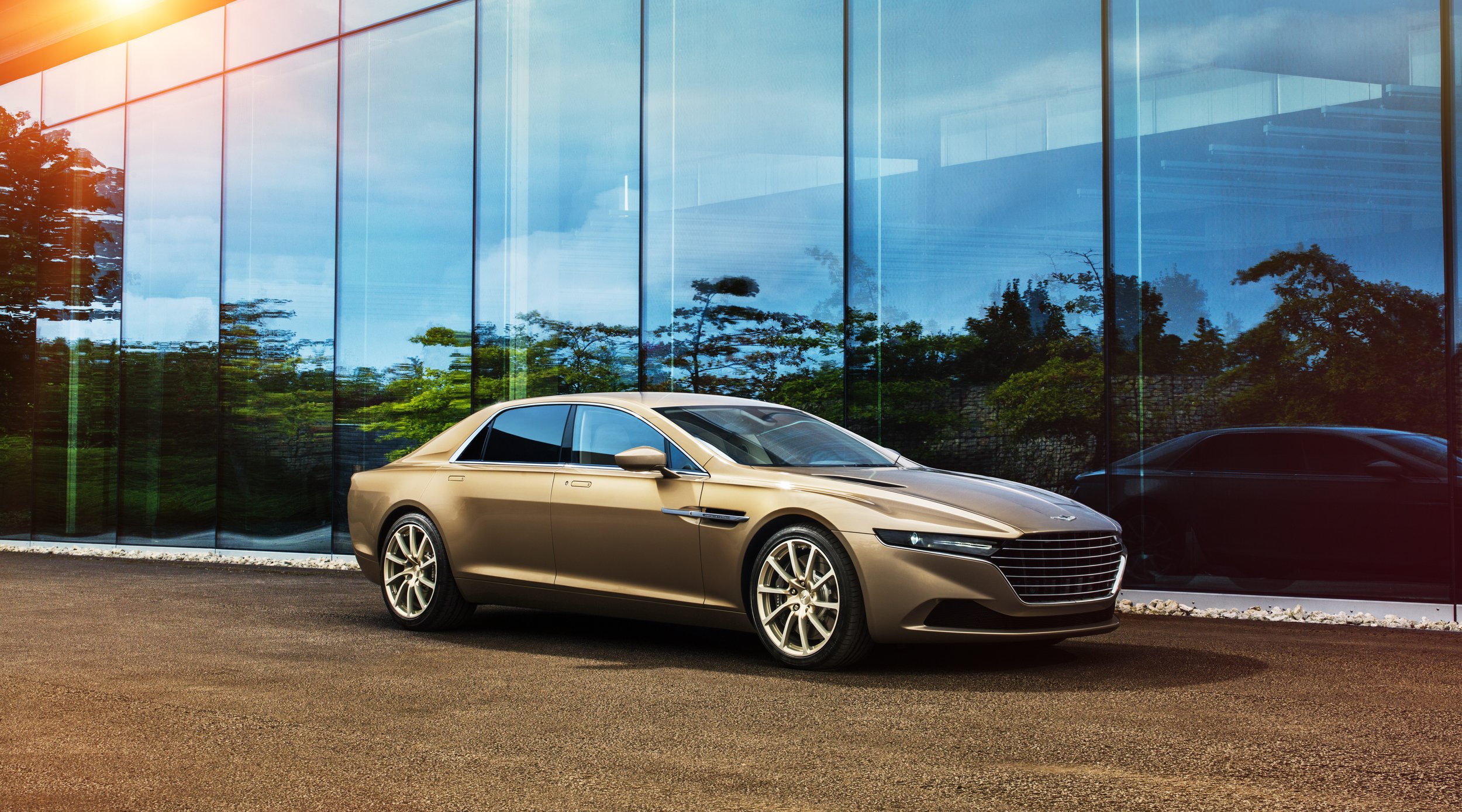
Image © Aston Martin Lagonda. Used for editorial purposes. Lagonda Taraf.
The wedge eventually disappeared, but Lagonda never quite did. Aston Martin has repeatedly returned to the name whenever it has wanted to explore a different interpretation of luxury, and in the 2010s that produced the Lagonda Taraf.
Unveiled initially for customers in the Middle East, the Taraf was conceived as an exceptionally exclusive four-door saloon before Aston Martin widened availability to other markets, including the UK. Beneath the surface sat the company’s flexible VH architecture, while the body made extensive use of carbon fibre. Each car was hand-built at Gaydon in a dedicated area of the factory previously used for production of the One-77.
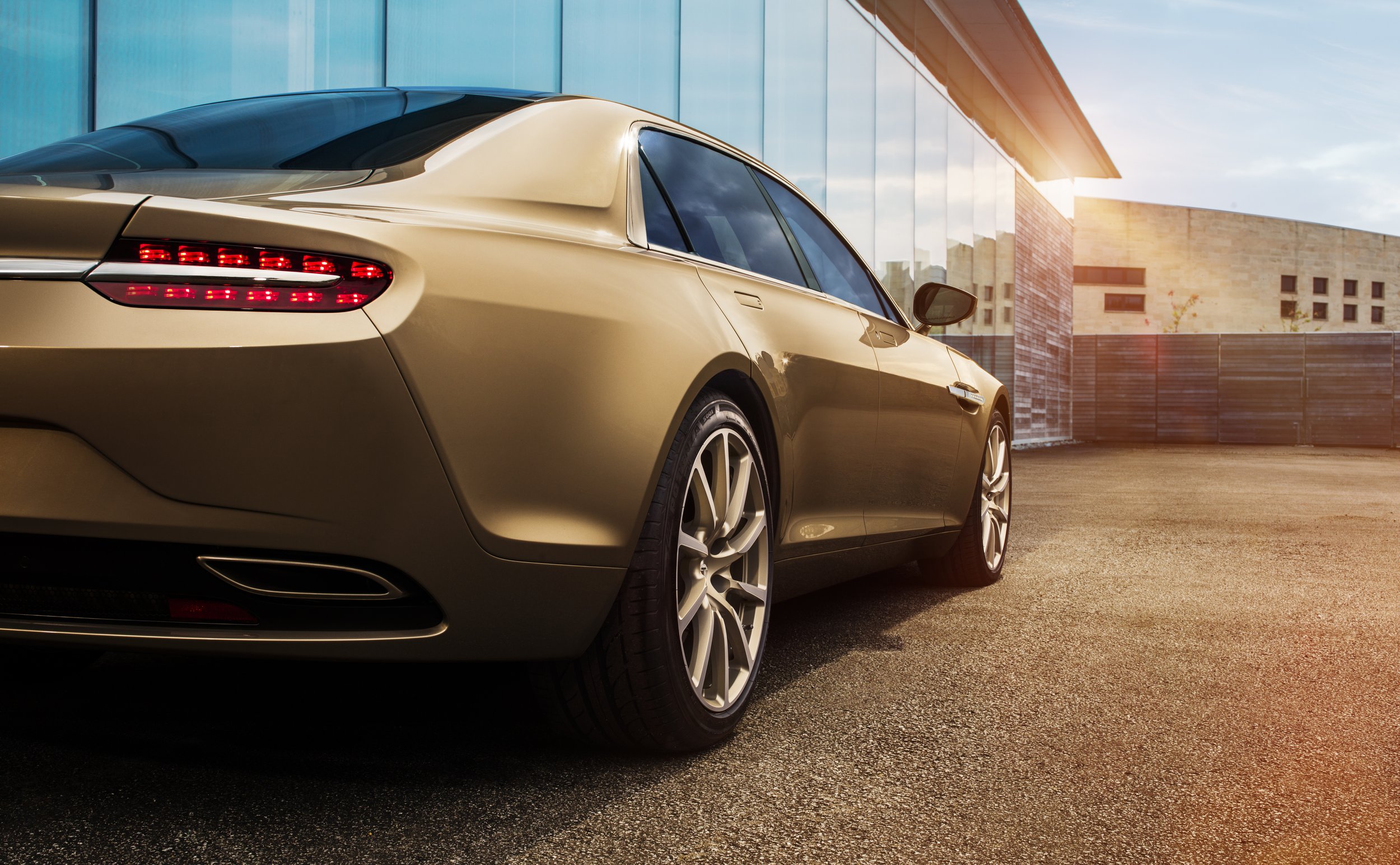
Image © Aston Martin Lagonda. Used for editorial purposes. Lagonda Taraf.
Power came from Aston Martin’s naturally aspirated 5.9-litre V12, producing around 540 bhp. Although approximately 200 cars were originally envisaged, only around 120 were ultimately built, making the Taraf one of the rarest Aston Martin-related production cars of the modern era.
There was also a deliberate historical connection. Aston Martin itself described the Taraf as drawing inspiration from the William Towns-designed Lagonda of 1976. The resemblance was not literal, but the philosophy was familiar: a dramatic four-door, built in tiny numbers, combining luxury, performance and a willingness to look unlike almost anything else in its class.
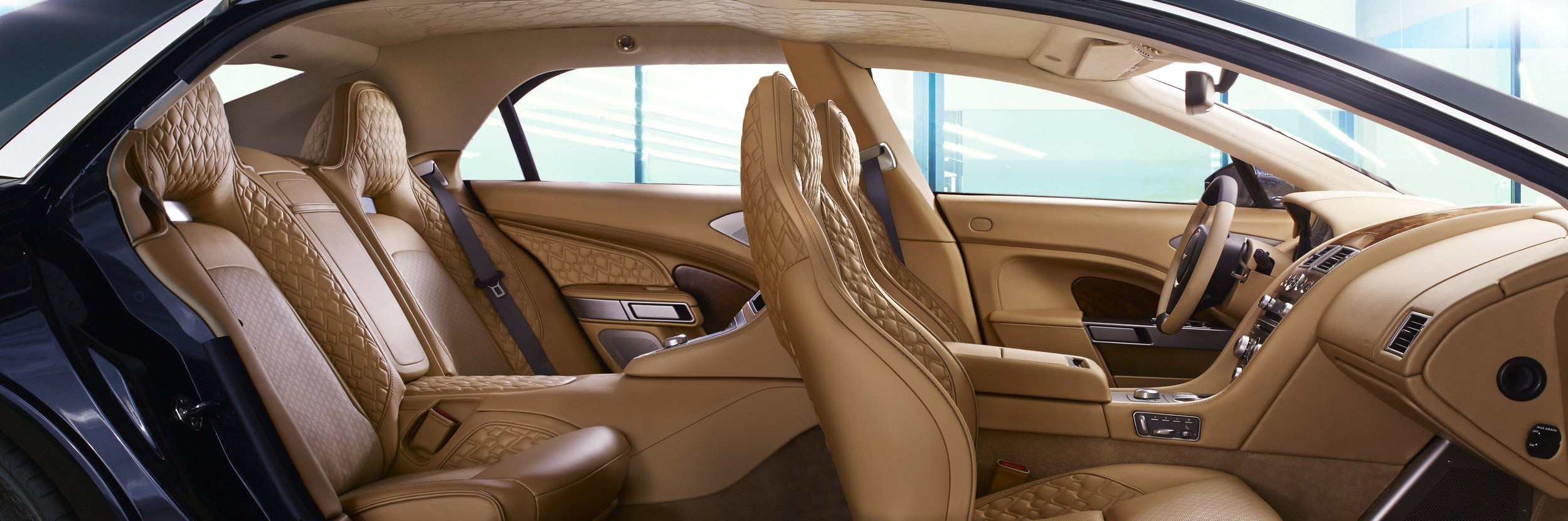
Image © Aston Martin Lagonda. Used for editorial purposes. Lagonda Taraf.
Regular FTP readers may remember that the Taraf appeared in FTP Weekly Roundup Issue 15 in March 2026, when an exceptionally rare 2017 example crossed the block at the Amelia auction in Florida. One of the approximately 120 cars produced, it hammered at $430,000, with the recorded sale reaching $478,000 including buyer’s premium, a striking result for a model that had originally carried a price widely reported at around $1 million.
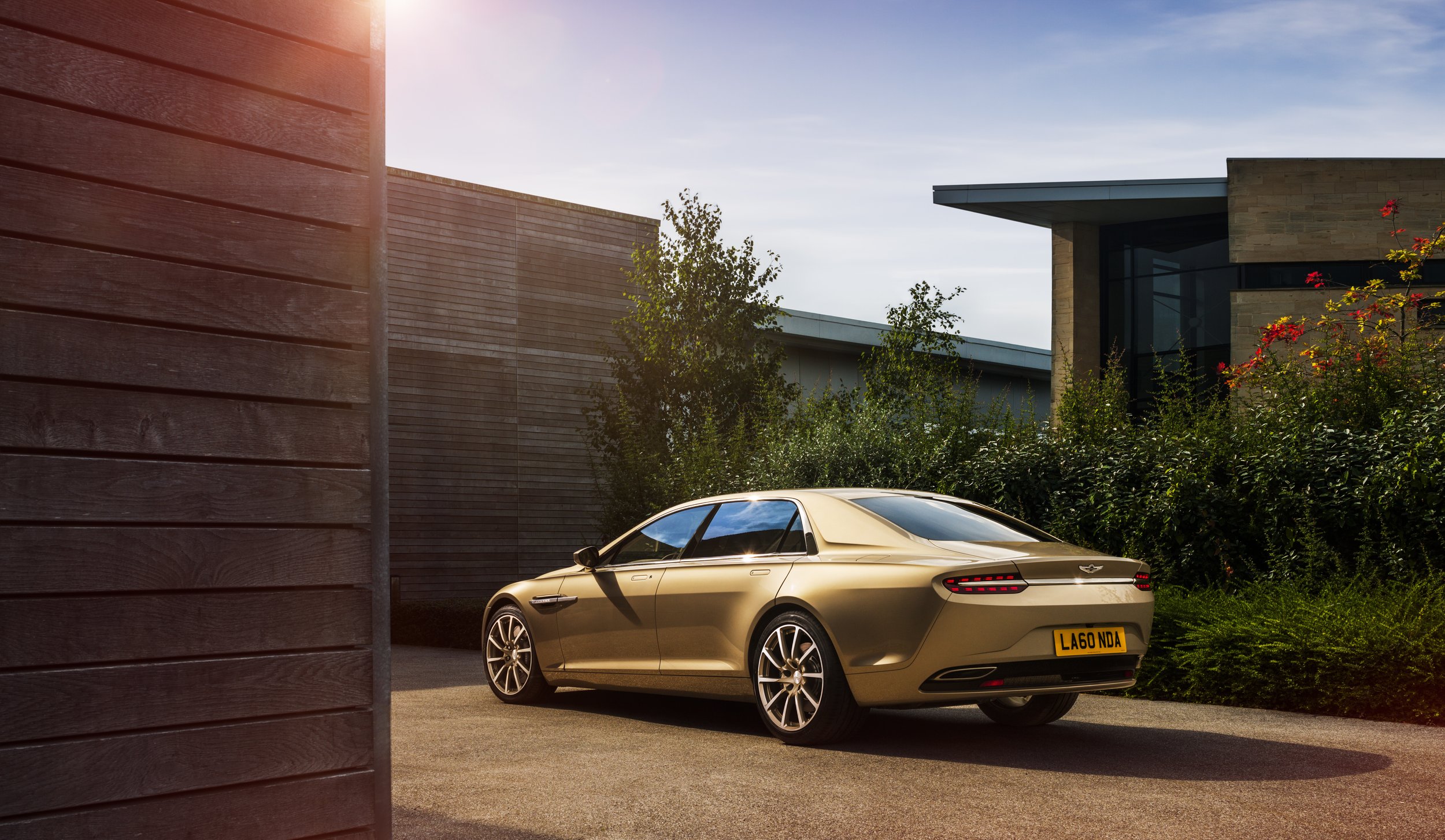
Image © Aston Martin Lagonda. Used for editorial purposes. Lagonda Taraf.
The 2018 Lagonda Vision Concept proposed transforming Lagonda into a standalone zero-emission luxury marque. Aston Martin followed it with the Lagonda All-Terrain Concept in 2019. Once again, the name was being used to ask what a luxury car might become rather than simply reproduce what already existed.
The strategy changed. In 2020, Executive Chairman Lawrence Stroll stated explicitly that Aston Martin was no longer using Lagonda as its electric platform. The proposed electric Lagonda range therefore didn’t reach production in the form originally envisaged. But there’s a clear pattern running through the history. Whenever Aston Martin has wanted to rethink luxury in a less conventional way, the Lagonda name has had a habit of reappearing.
Fifty Years Later: Failure, Pioneer - or Both?
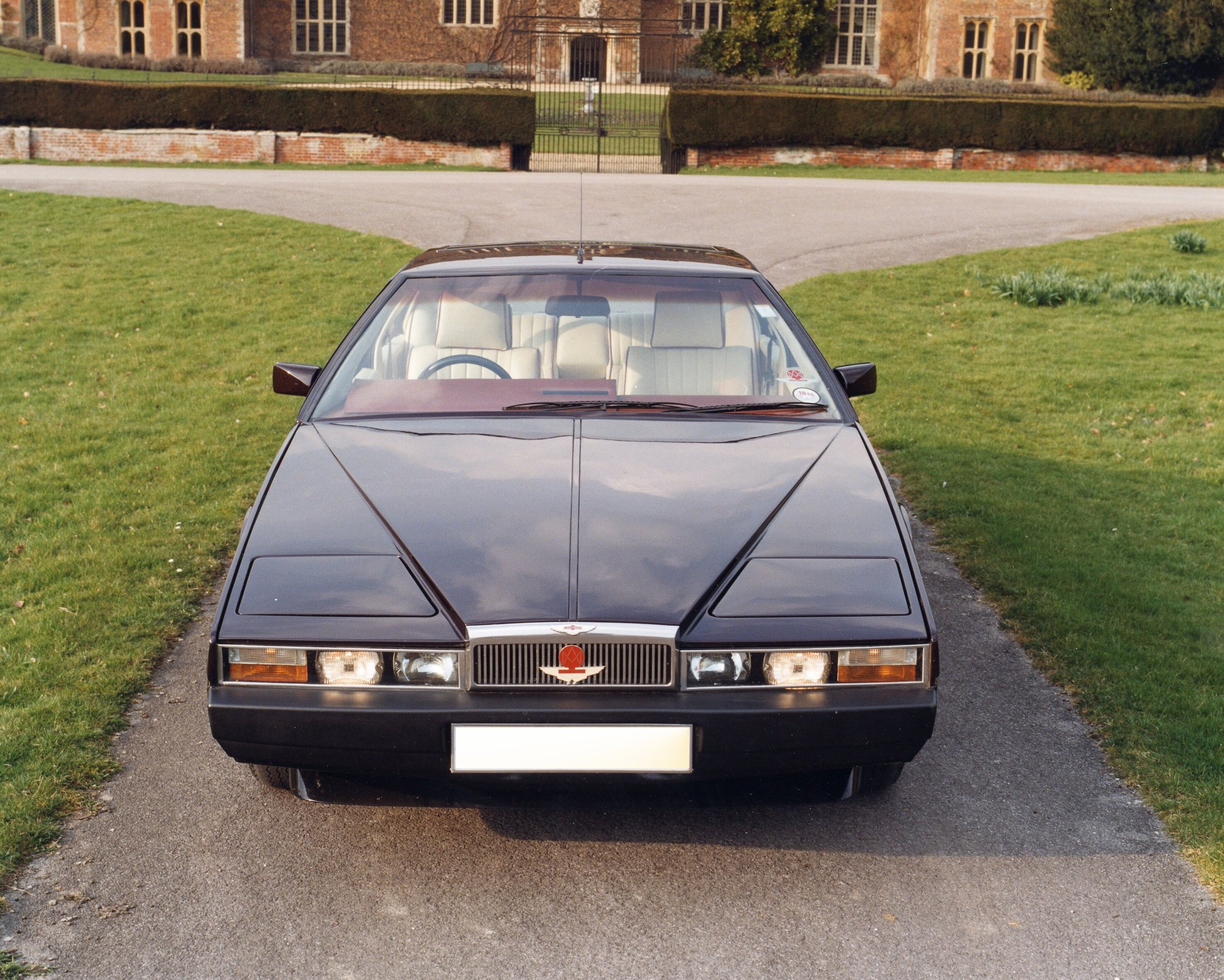
Image © Aston Martin Lagonda. Used for editorial purposes. Lagonda Wedge.
Half a century after the wedge first appeared, the Lagonda remains extraordinarily difficult to reduce to a simple verdict. That may explain why people keep trying. By the early 2000s, the car's reputation had hardened into something close to caricature. Television retrospectives could present it as a glorious act of corporate madness: strange-looking, ruinously difficult to develop and equipped with electronics that never really worked.
There’s enough truth behind parts of that story for it to be persuasive. The project did run late. Its price rose significantly. The electronics genuinely created problems.
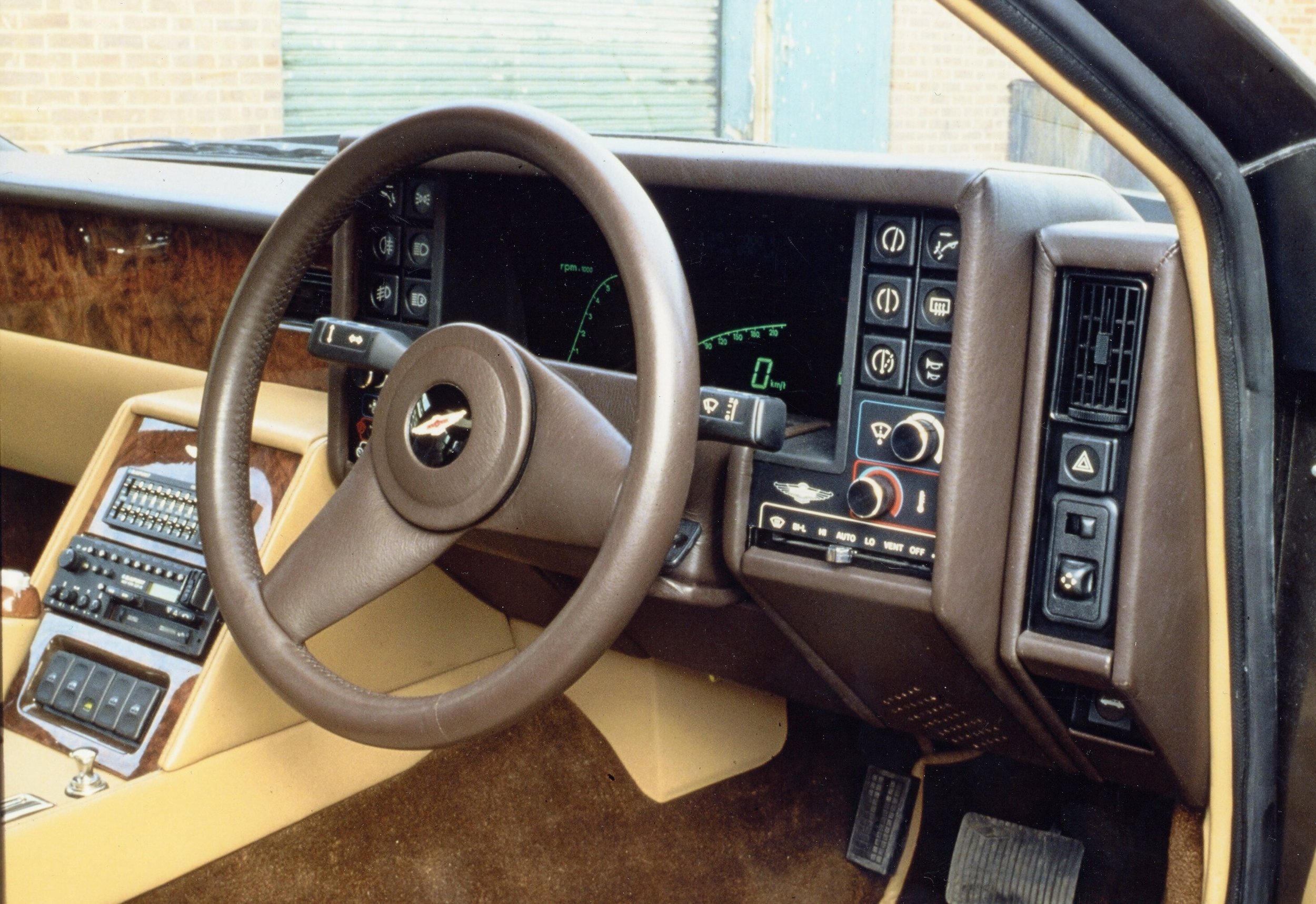
Image © Aston Martin Lagonda. Used for editorial purposes. Lagonda Wedge interior.
Aston Martin’s own managing director, Alan Curtis, acknowledged in 1978 that the original timetable had been a “major miscalculation”, while the eventual price demonstrated how far the early costing assumptions had also moved. But the caricature leaves too much out.
The electronics were not simply abandoned after one failed experiment. Aston Martin continued developing them. The car didn’t disappear after a handful of prototypes.
It remained in production for more than a decade. It was not commercially irrelevant. At one point, the production rate described by Victor Gauntlett placed the Lagonda at roughly three-quarters of Aston Martin output.
The strange combination of technology and craftsmanship also looks more remarkable with distance. A microprocessor-controlled luxury car with electronic information displays and touch-sensitive controls was being assembled by a company where craftsmen still fitted panels individually, engines carried the identity of their builders and nine hides could disappear into one interior.
There’s another part of the Lagonda story that cannot be found in a production ledger. For this feature, FTP reviewed several thousand public comments beneath a selection of modern Lagonda films, including archive material, owner features and specialist reviews. They’re not a scientific survey and shouldn’t be treated as one, but certain reactions recur with striking consistency.
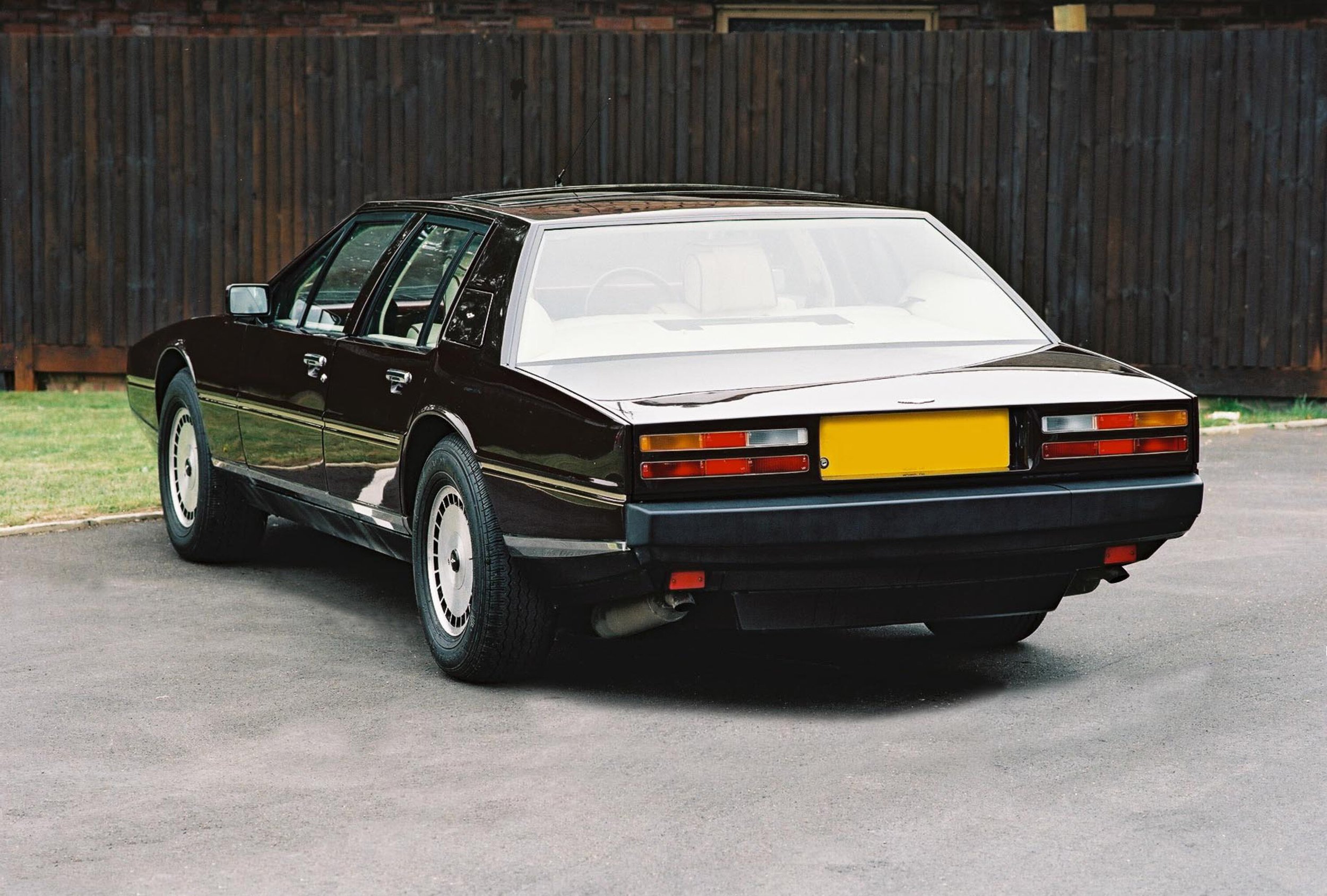
Image © Aston Martin Lagonda. Used for editorial purposes. Lagonda Wedge.
People remember where they first saw one. Some recall being children and seeing something they could barely identify as a conventional motor car.
Words such as spaceship, future, science fiction and rocket ship appear again and again. Others still think it’s ugly. Some consider it one of the most beautiful cars Aston Martin ever produced. Reliability jokes remain plentiful. So does fascination with the dashboard.
A noticeable number of commenters say their opinion has changed with time, either because the shape now appeals more than it once did, or because learning how the car was conceived and built has made them reassess it. Another recurring observation is that the Lagonda has far more presence in person than photographs suggest. Among commenters beneath the modern Lagonda films reviewed for this feature, one reaction appears remarkably consistent: indifference is rare.
The Lagonda can be technologically troublesome and historically significant at the same time. It can frustrate owners while still expanding ideas about what a luxury car might become. It can consume far more engineering effort than Aston Martin anticipated while still bringing customers, publicity and international attention.
It can be flawed without being pointless.
Perhaps that’s the fairest way to view it fifty years later. Not as the car that single-handedly saved Aston Martin. Not as a technological disaster that deserves only ridicule. Nor as a forgotten masterpiece whose faults should now be written out of history. The Lagonda was something more interesting than any of those neat conclusions.
It was created by a comparatively small British manufacturer that had only recently endured one of the most difficult periods in its history, yet chose to attempt something extraordinarily ambitious. That ambition produced one of the most recognisable cars ever associated with Aston Martin.
Fifty years later, the wedge still looks like nothing else.
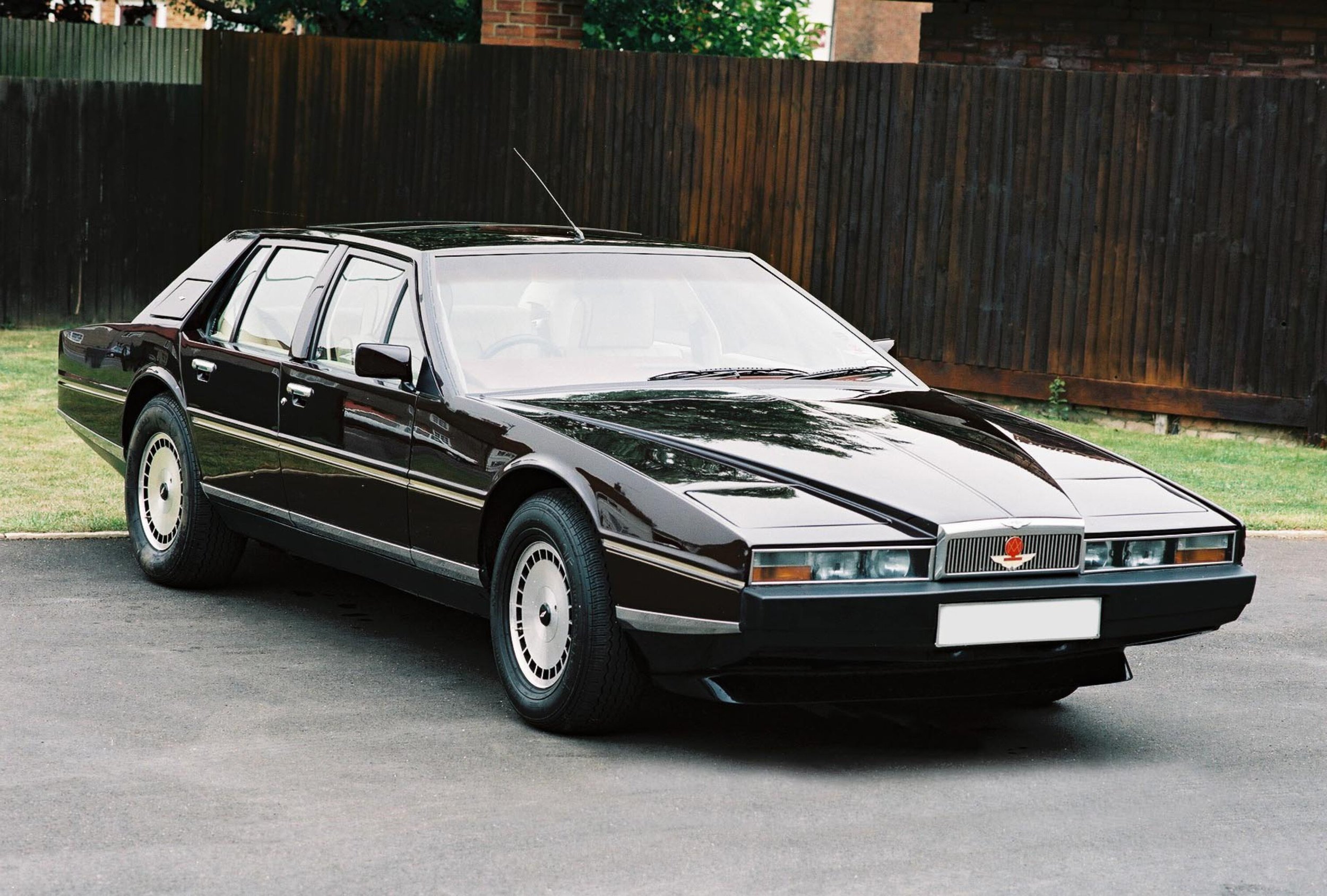
Image © Aston Martin Lagonda. Used for editorial purposes.
Perhaps the most remarkable thing is that Aston Martin built it at all.
A final thought from FTP
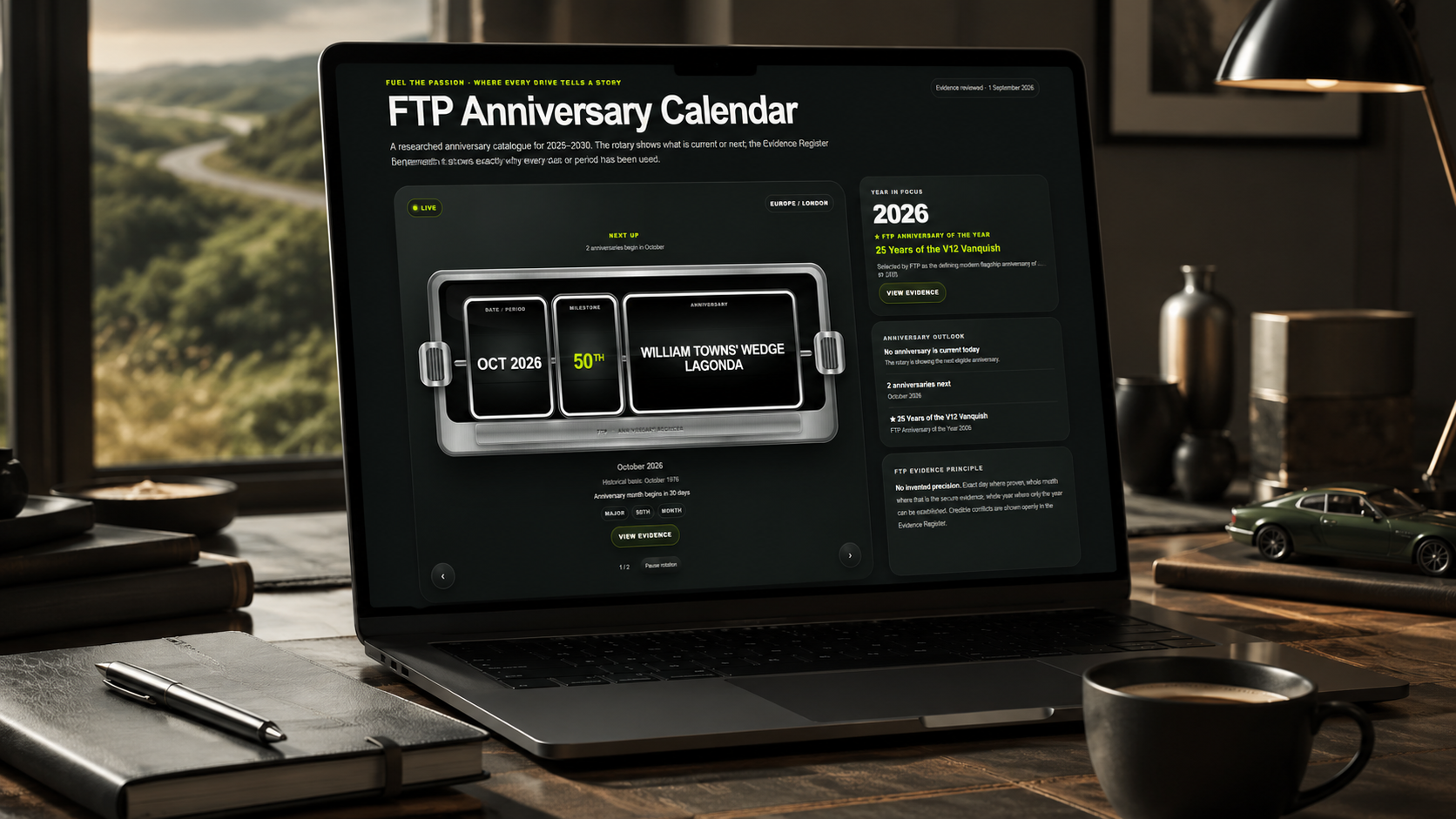
Image © Fuel the Passion. For illustrative purposes.
If it wasn’t for the FTP Anniversary Calendar, there’s every chance we might have let this anniversary pass without giving it the attention it deserves.
That would’ve been a shame, because fifty years is a significant milestone. I turned 50 myself in 2025, so I know only too well how quickly that number arrives, and how much it makes you look back at what’s changed along the way.
The Lagonda is a particularly good example of why these anniversaries are worth marking. It gives us a reason not simply to look at one extraordinary car, but to revisit the people, decisions, risks and engineering behind it, and to understand where it fits within the much longer Aston Martin and Lagonda story.
That’s exactly why we created the FTP Anniversary Calendar: to keep track of the important Aston Martin, Lagonda and wider marque anniversaries that are approaching, and to give us the opportunity to explore some of those stories properly rather than realise afterwards that an important date has quietly passed.
You can explore the FTP Anniversary Calendar HERE
SOURCES & REFERENCES
The principal sources used in researching and verifying this article.
FTP has prioritised Aston Martin and other primary material, first-hand accounts and contemporary reporting wherever available. Where later sources disagree, the article either explains that uncertainty or avoids presenting the disputed claim as fact.
Modern equivalents are rounded estimates of UK purchasing power in 2026 and are intended only to provide context. They are not estimates of current vehicle values.
Aston Martin Media — Lagonda Series 2
Corporate history covering William Towns, the 1976 car, electronics development, National Semiconductor, Mike Loasby and the non-running prototype.
Peter Sprague — Aston Martin / Swift Running
First-hand account of Aston Martin's 1974–75 crisis, rescue, development decisions, 1976 Motor Show orders and the early electronics programme.
Country Life — contemporary 1976 Motor Show coverage
Used for launch-period pricing and period context.
Aston Martin — Lagonda heritage material
Used for Wilbur Gunn, Lagonda Creek, the marque's early chronology and later Aston Martin relationship.
Automobile Club de l'Ouest — 1935 24 Hours of Le Mans archive
Used for Lagonda's 1935 overall Le Mans victory.
Aston Martin — Celebrating 70 Years of the DB Bloodline
Used for David Brown's acquisition of Lagonda and the importance of the W.O. Bentley-developed twin-cam six.
Aston Martin Media — Lagonda Rapide
Used for the 1961 Rapide's specification, introduction and 55-car production total.
Thames Television — Drive In, first broadcast 20 April 1978
Contemporary factory film and Alan Curtis interview. Used for price escalation, delays, order changes, exports, production expectations, craftsmanship, upholstery and Curtis's “major miscalculation” comment.
Motor Sport — Aston Martin's Lagonda, January 1982
Contemporary road test used for electronic instrumentation, ESO, touch controls, under-bonnet odometer and the production car's road behaviour.
Automotive Industries / Transportation Research Board archive — Relax. Your Dash is in Control
Used for Javelina Corporation's involvement and the Essential Systems Only function.
Motor Sport — Aston Martin's Renaissance, August 1983
Used for Victor Gauntlett's production figures, export context and contemporary UK and US pricing.
Aston Martin — current Lagonda model history
Used for 645 chassis, approximately 2,200 man-hours per car, the 1987 redesign and Aston Martin's official 1989 production endpoint.
Motor Sport — November 1984 NEC Motor Show coverage
Used for the £105,000-plus Tickford long-wheelbase Lagonda.
Washington Post — Ford acquisition reporting, September 1987
Used for contemporary reporting on Ford's reasons for acquiring Aston Martin.
Walter Hayes — The Birth of the DB7
Used for later first-hand Aston Martin/Ford context.
Aston Martin — Lagonda Taraf
Used for the Taraf's VH architecture, carbon-fibre bodywork, William Towns influence and hand-built production at Gaydon in the former One-77 production area.
Car and Driver / Autocar — Lagonda Taraf contemporary and retrospective reporting
Used for the Taraf's 5.9-litre V12, approximately 540 bhp output, the planned 200-car production limit and later reporting that approximately 120 cars were ultimately built.
Aston Martin — Lagonda Vision Concept, 2018
Used for the planned rebirth of Lagonda as a standalone electric luxury marque.
Aston Martin — Lagonda All-Terrain Concept, 2019
Used for the continuation of the proposed modern Lagonda programme.
Aston Martin Lagonda — Q3 2020 results transcript
Used for Lawrence Stroll's confirmation that Lagonda would no longer serve as Aston Martin's dedicated electric platform.
AstonMartins.com — specialist model records
Used principally for detailed model chronology and evidence of final Series 4 completion extending into January 1990.
For the closing section, FTP also reviewed several thousand public comments beneath a selection of modern films about the Aston Martin Lagonda, including archive footage, owner features, specialist reviews and retrospective programmes.
Those comments are used only to identify recurring audience reactions. They are not treated as representative polling or as evidence for historical facts.
We’d genuinely like to hear what you think.
Fifty years on, the Lagonda still provokes strong opinions — and we’d love to know where you stand.
What’s your view of the William Towns Lagonda today?
Is it a design masterpiece, an acquired taste, or something that has grown on you over the years?
Should Aston Martin use the Lagonda name again?
Not necessarily as a separate marque, but perhaps for a particular type of ultra-luxury, technically adventurous Aston Martin that carries the Lagonda name with a clear purpose.