
Issue 36 - Fuel the Passion (FTP) Weekly Roundup
Week Ending 9th August 2026
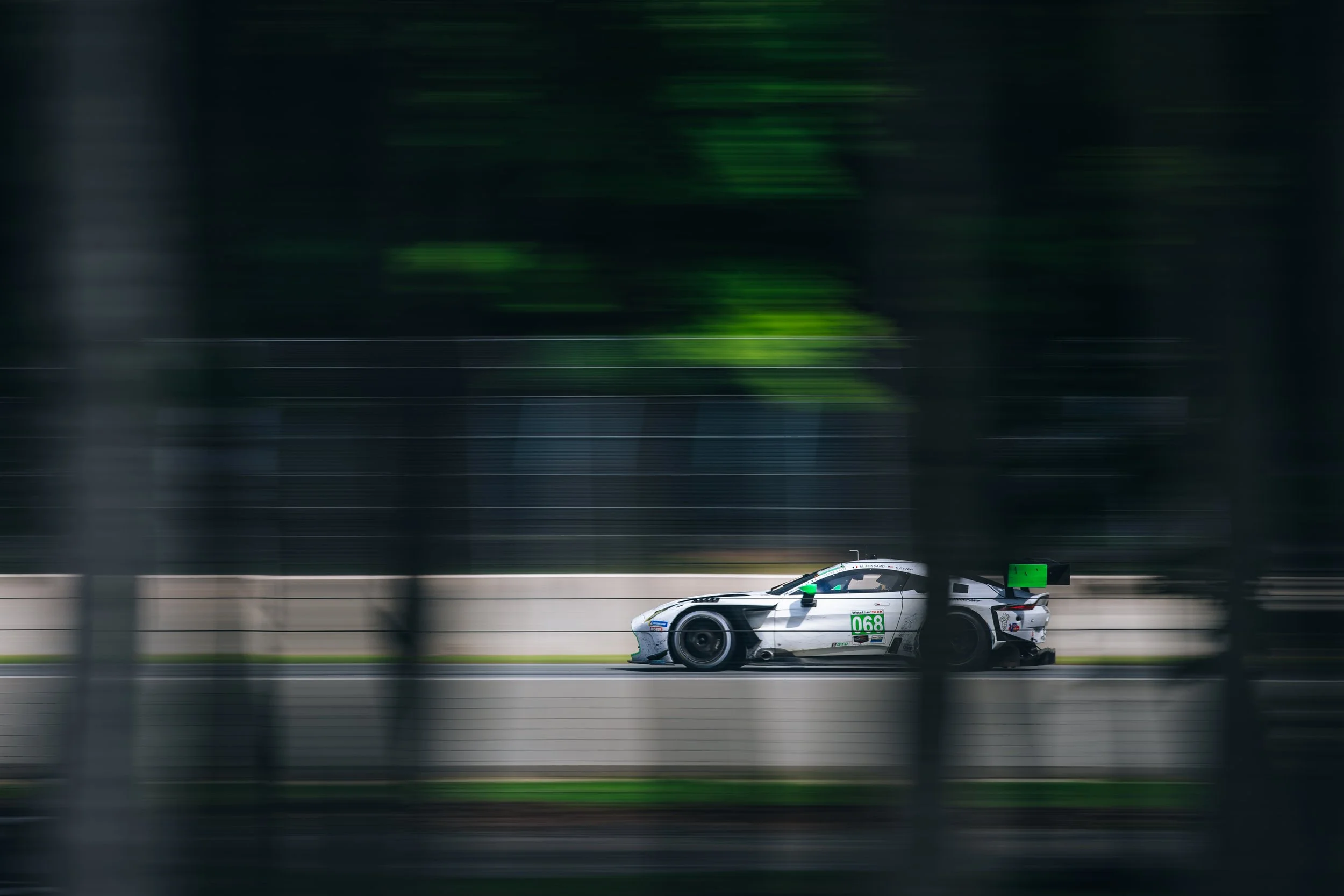
Image © Aston Martin Lagonda. Used for editorial purposes. Car Blanche at Road America
Editor’s Introduction - Dan, Fuel the Passion
A very warm welcome to Issue 36 of the Fuel the Passion Weekly Roundup, and another Sunday morning spent together catching up on what’s been an extraordinarily busy few days across the Aston Martin world.
We’ll begin this week where there’s been plenty to celebrate: on the racetrack. The image above seems a particularly fitting place to start. Car Blanche continued its remarkable arrival in the IMSA WeatherTech SportsCar Championship at Road America last weekend, taking the Aston Martin Vantage GT3 to third place in GTD and making it two podium finishes from its first two appearances in the category. Just a day earlier, the team had also tasted victory with the Vantage GT4 in the IMSA Michelin Pilot Challenge. Add Valkyrie’s best IMSA result of the season, further success for Vantage in Europe and some genuinely encouraging signs from Aston Martin’s Formula One programme, and there’s plenty of racing to work through.
Away from the circuits, however, the picture becomes rather more complicated. Aston Martin Lagonda’s recently announced £550 million financing has become the subject of a challenge from existing bondholders, while the company’s share price has fallen to another exceptionally low level. These are stories capable of generating some fairly alarming headlines, so we’ll take our time with them, strip away as much of the financial jargon as possible and explain what we currently know, what remains disputed and why it’s attracting so much attention.
Thankfully, there’s also plenty to enjoy. Q by Aston Martin has raided the marque’s colour archive for a wonderful collection of Heritage Edition cars in California; an almost delivery-mileage Valour has appeared for sale; we’ll revisit the wonderfully distinctive Oscar India; and a story from Bertone provides a fascinating and rather timely connection with the extraordinary Jet 2+2 appearing in our latest FTP film, and that film arrived this weekend too. Aston Martins Amongst Legends, our visit to the inaugural Wilton House Concours des Légendes, went live on Friday evening and takes us from beautiful and unusual Aston Martins to Formula One history, the Camel Trophy and some of the enthusiasts behind the cars themselves. There’s more on that later in the Roundup, along with a few well-deserved thank-yous.
So, coffee poured and perhaps a little more time required than usual, let’s begin Issue 36 with the latest Aston Martin action from the world of motorsport.
Aston Martin Motorsport - Aston Martin Finds Its Feet in France
We’ll begin our racing round-up in France, where the Aston Martin Vantage GT3 enjoyed another encouraging weekend in the GT World Challenge Europe Sprint Cup at Magny-Cours. The headline result came on Saturday evening, when Nicki Thiim and Kobe Pauwels brought the #7 Comtoyou Racing Vantage home third overall. It was a fine performance from the pair, with Thiim also recording the fastest lap as Aston Martin returned to the overall Sprint Cup podium.
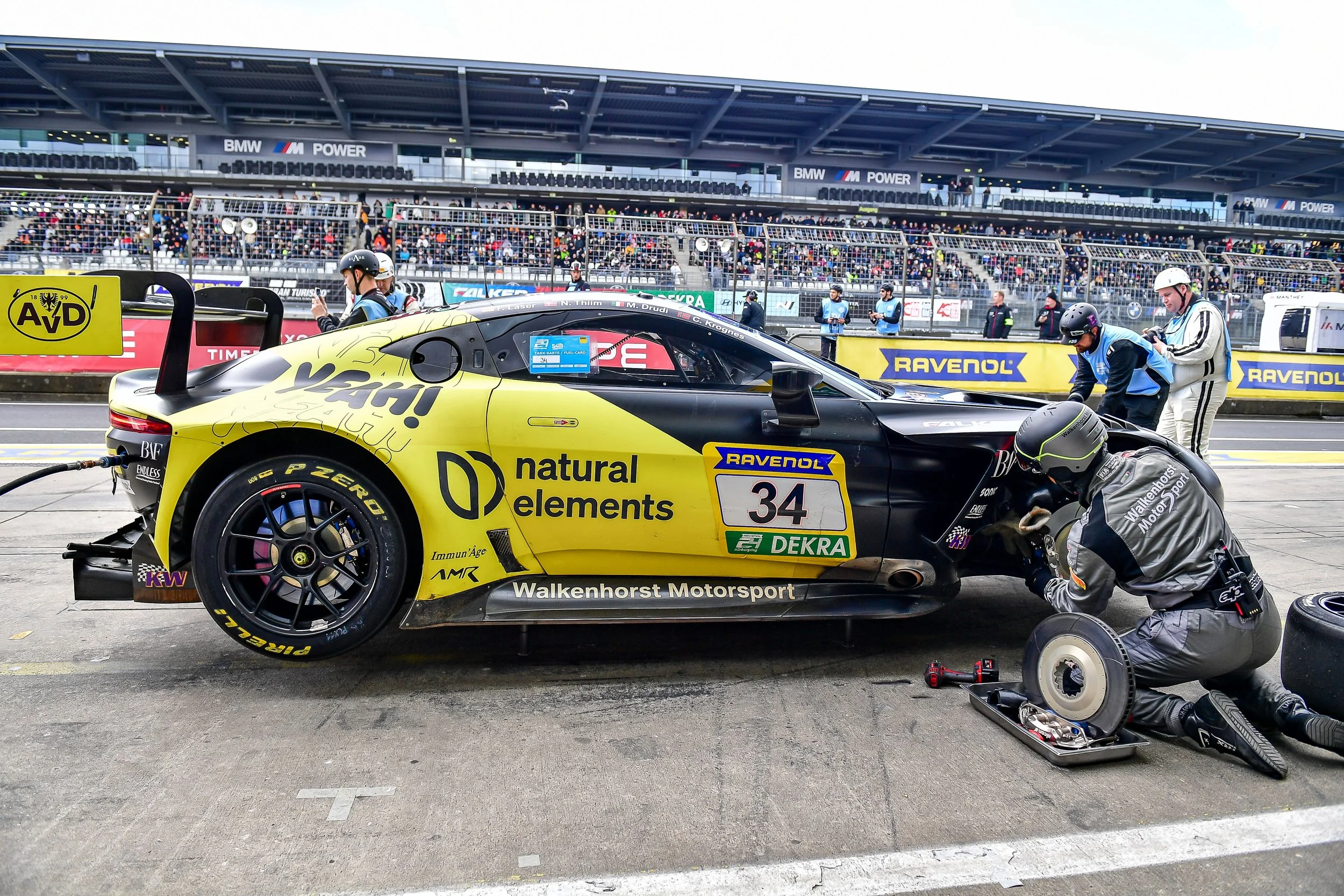
Image © Aston Martin Lagonda. Used for editorial purposes. Walkenhorst pit-stop.
There was success elsewhere in the Aston Martin ranks too. Jamie Day and Mateo Villagomez in the #34 Walkenhorst Motorsport Vantage collected second place in the Silver Cup in both races, giving the marque something to celebrate across the weekend rather than relying upon a single result.
As we’ve said before, it was also another reminder of just how competitive the current Vantage GT3 can be. Comtoyou’s #7 is competing in the Pro class against some formidable opposition, while Aston Martins continue to appear across several of the championship’s categories. Thiim and Pauwels’ podium therefore wasn’t simply a case of surviving an eventful race; there was genuine pace in the car, and from France, we head across the Atlantic, where Aston Martin had an even more eventful weekend at Road America.
Car Blanche Continues Its Remarkable Start
If you wondered why we chose a photograph of the striking white Car Blanche Vantage to open this week’s Roundup, there’s good reason.
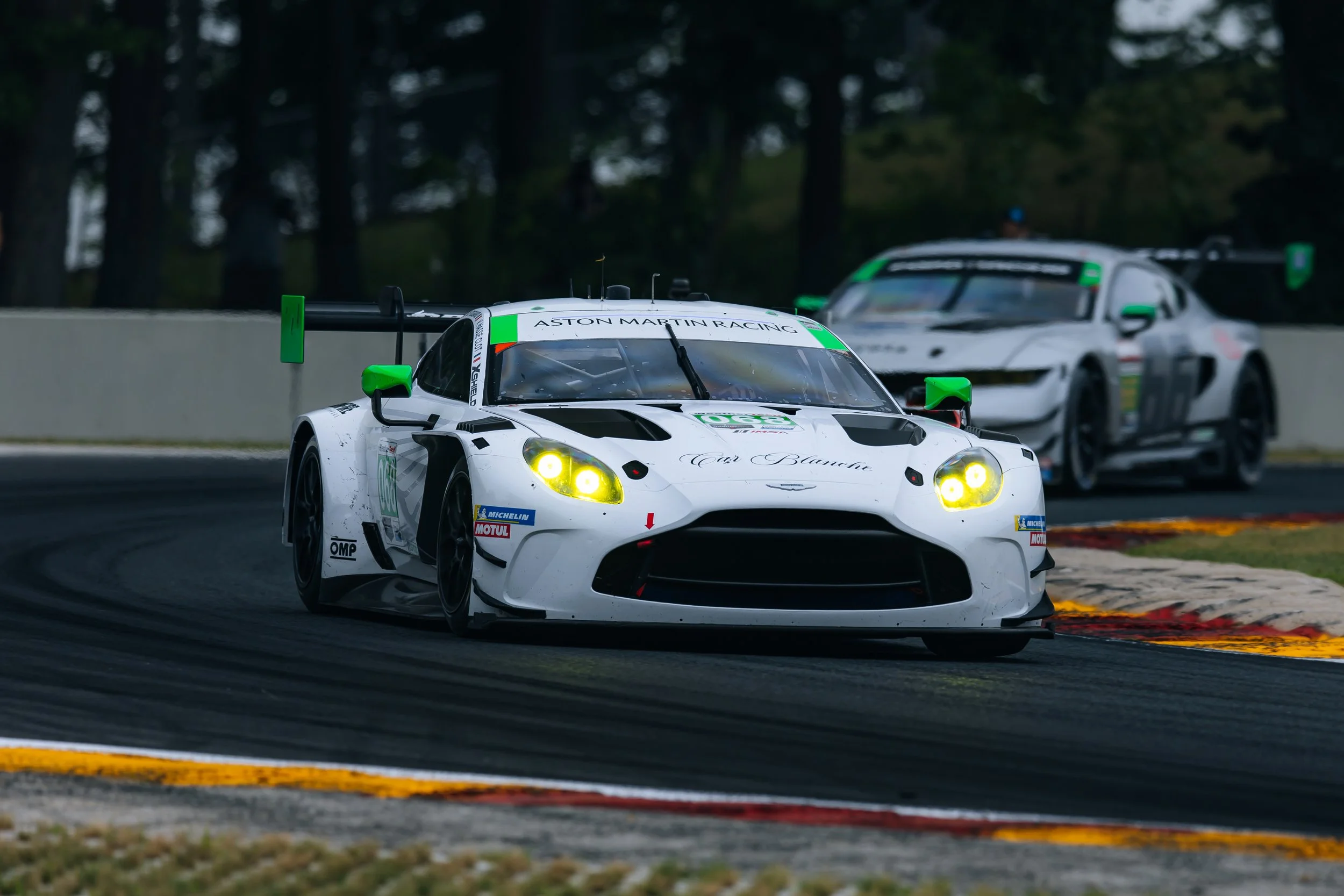
Image © Aston Martin Lagonda. Used for editorial purposes. Car Blanche at Road America
The relatively new operation continues to make quite an impression in North America. Having only made its IMSA WeatherTech SportsCar Championship debut at Watkins Glen earlier this summer, Car Blanche has quickly demonstrated that it hasn’t entered the championship simply to make up the numbers. IMSA itself described the team’s opening races as a particularly fast start, with the Vantage immediately showing front-running pace.
At Road America, the #68 Vantage GT3 returned to the GTD category and came away with third place, adding another podium to what is becoming a very impressive opening chapter for the team.

Image © Aston Martin Lagonda. Used for editorial purposes. Car Blanche Vantage GT4 at Road America
Car Blanche had already given Aston Martin something substantial to celebrate at Road America before its WeatherTech SportsCar Championship podium.
In Saturday’s Road America 120, part of the IMSA Michelin Pilot Challenge, Allen Patten and Trenton Estep drove the #66 Car Blanche Aston Martin Vantage AMR GT4 Evo to victory, completing 43 laps and beating the #46 TeamTGM Ford Mustang GT4 to the flag by just 0.110 seconds. It was an incredibly close finish and a proper outright Grand Sport victory for the Aston Martin.
There was further Aston Martin representation inside the top ten too, with Hannah Greenemeier and Hannah Grisham finishing ninth in the Heart of Racing Vantage GT4, immediately ahead of Gordon Scully and Morgan Burkhard’s CSM Vantage in tenth.
Then, just a day later, Car Blanche was back on the podium at the same circuit with its GT3 programme, the #68 Vantage taking third place in GTD in the six-hour IMSA WeatherTech SportsCar Championship race.
That makes the Road America weekend particularly impressive: a GT4 victory on Saturday followed by a GT3 podium on Sunday, across two different IMSA championships. It’s an organisation we perhaps wouldn’t have expected to be discussing so frequently only a few weeks ago, but the results are quickly earning our attention.
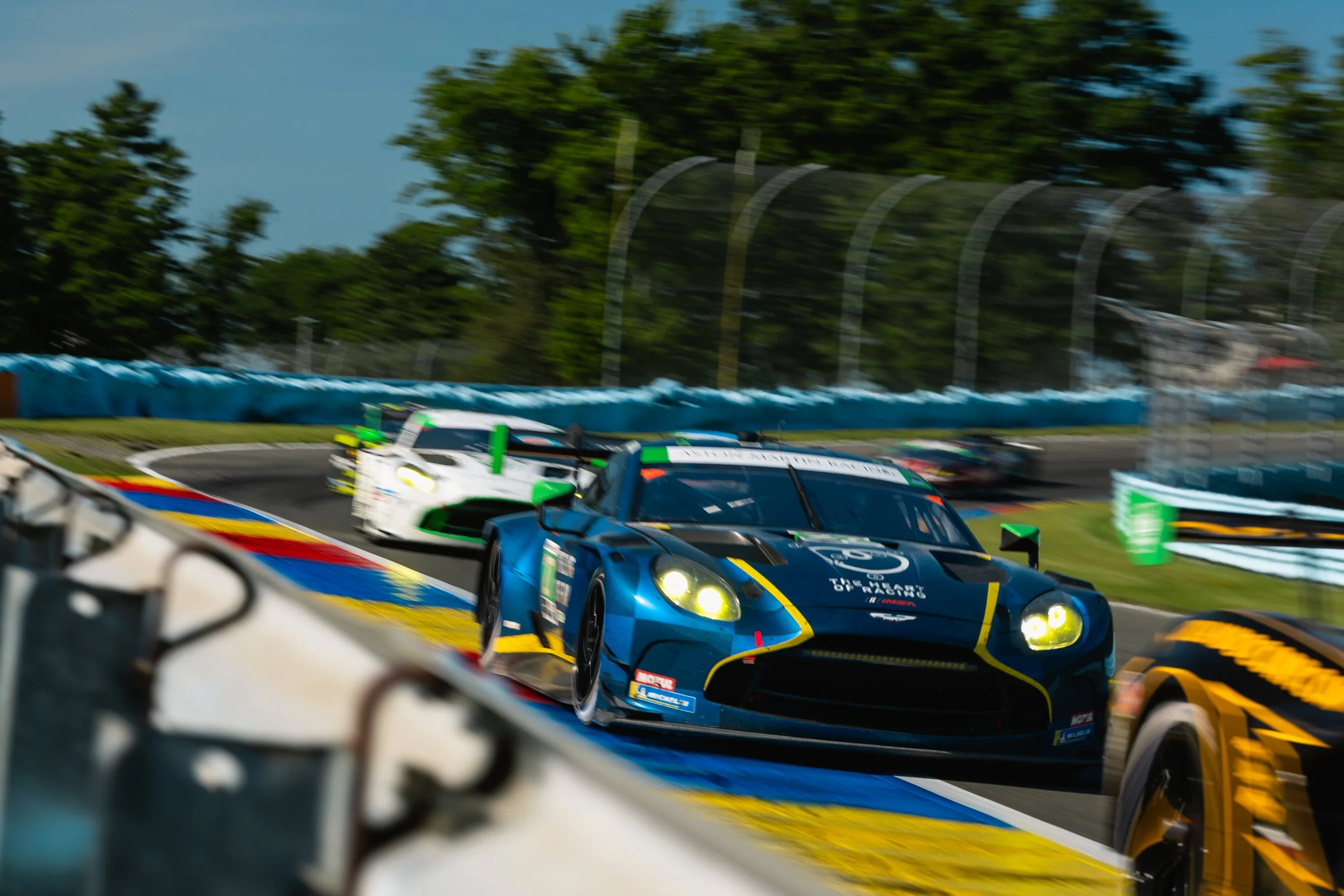
Image © Aston Martin Lagonda. Used for editorial purposes. #27 THOR Vantage GT3
The established Heart of Racing #27 Vantage endured a rather more frustrating afternoon, because for much of the six-hour race it looked capable of delivering a very strong result of its own.
Zacharie Robichon qualified second in GTD, putting the #27 Vantage on the front row, and he and Dudu Barrichello spent much of the opening four hours at the head of the class. The Aston Martin had genuine pace and, for a long period, appeared firmly in the fight for victory.
The complexion of the race changed during the final two hours. A series of incidents triggered repeated Full-Course Yellow periods, effectively neutralising the race and bunching the field together. Because so many cars then needed to pit under those caution periods, more than 20 cars were funnelled into pit lane at once. Aston Martin says Tom Gamble could only watch as the #27’s track position disappeared during that congested sequence, dropping the car out of the podium places despite all the work done earlier in the race.
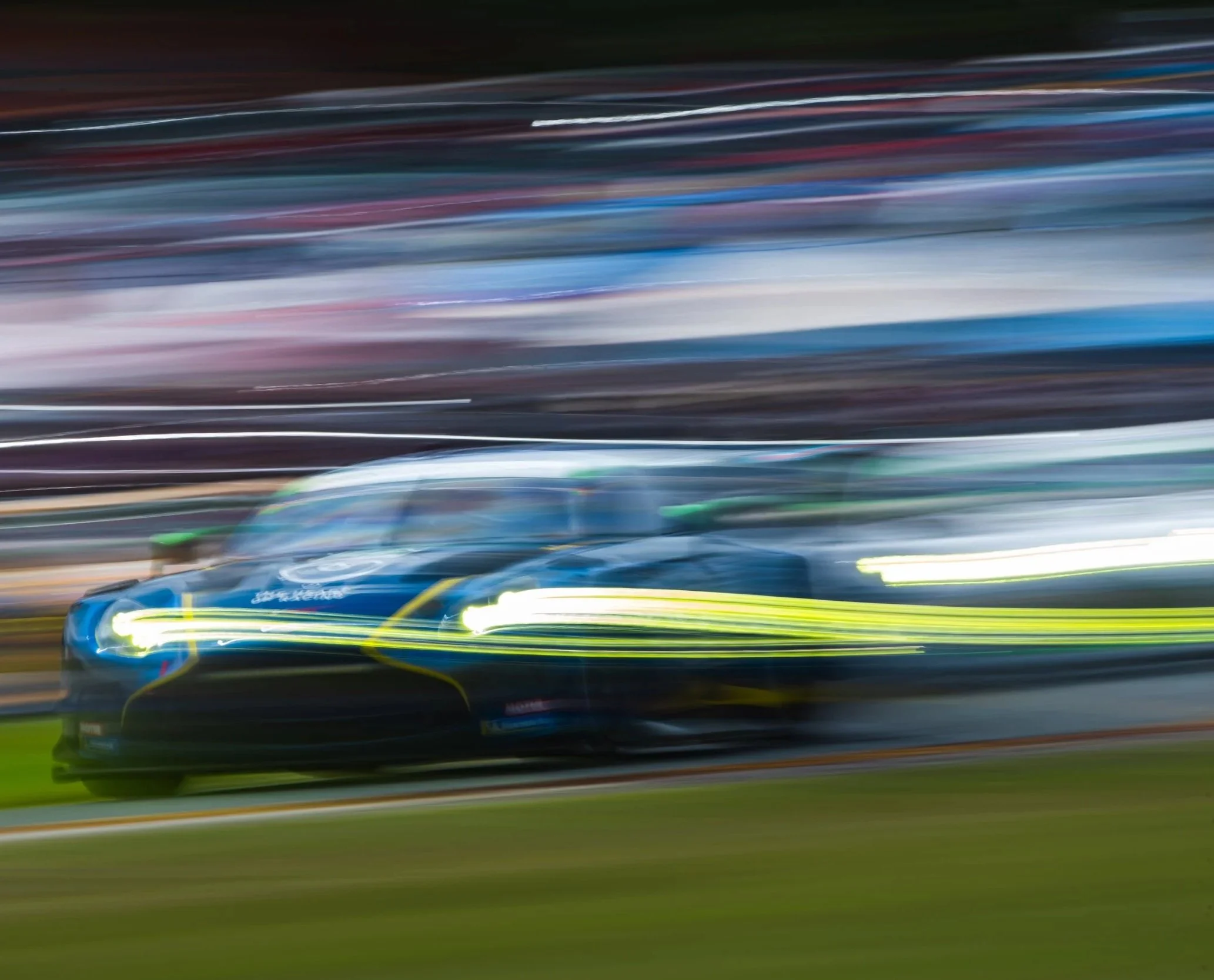
Image © Aston Martin Lagonda. Used for editorial purposes.
There was then further disappointment after the chequered flag. A post-race penalty dropped the #27 to 15th in GTD, a final classification that bears very little resemblance to how competitive the car had been for most of the afternoon. Aston Martin’s own race report doesn’t specify the reason for that penalty, so we won’t speculate beyond what has been officially stated.
The consolation is an important one. Dudu Barrichello remains at the top of the GTD Drivers’ Championship and Heart of Racing continues to lead the Teams’ standings with three races remaining. Aston Martin also sits second in the GTD standings for the IMSA Michelin Endurance Cup, only two points from the lead. So, while the result sheet says 15th, the more useful takeaway is that the #27 once again demonstrated enough pace to lead the category and contend for a much stronger result.
There was an even bigger Aston Martin story unfolding further up the Road America field.
Valkyrie Comes Agonisingly Close
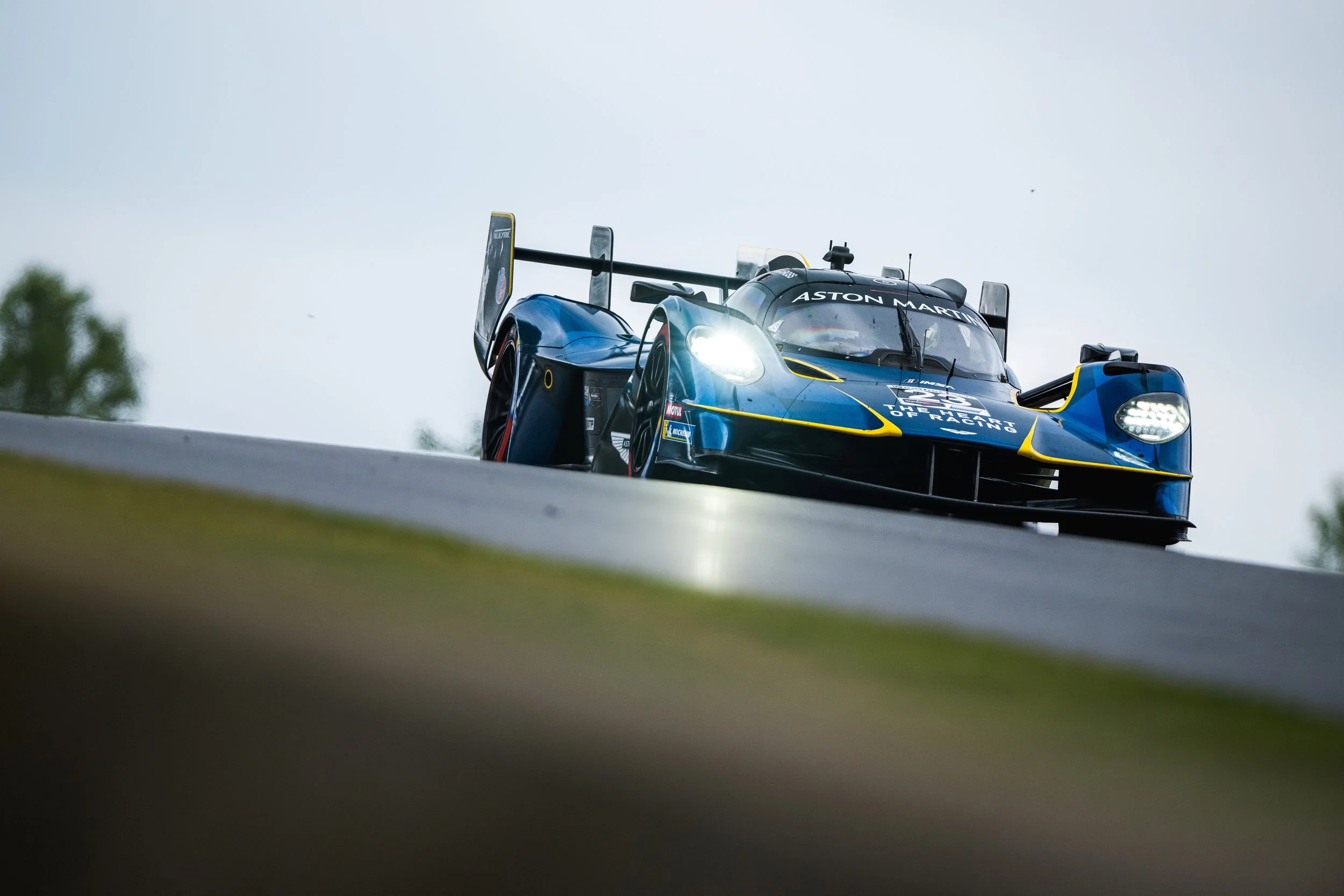
Image © Aston Martin Lagonda. Used for editorial purposes. Valkyrie racing to P5.
The Aston Martin Valkyrie programme continues to evolve before our eyes. The THOR Team’s spectacular Hypercar showed another clear step forward at Road America and, for part of the race, appeared capable of delivering something considerably bigger than simply another points finish.
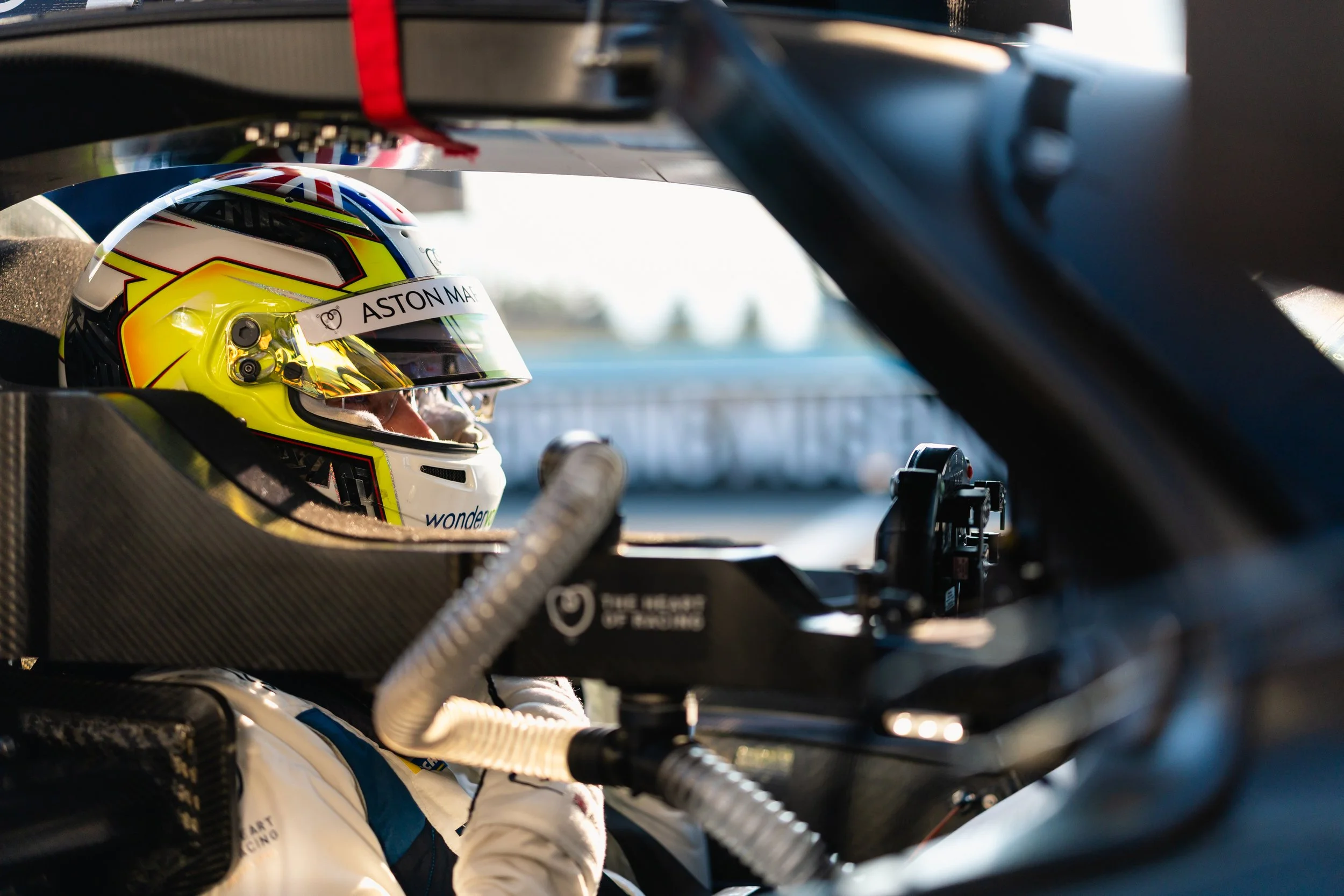
Image © Aston Martin Lagonda. Used for editorial purposes. Ross Gunn in helmet.
It was an eventful six hours for Ross Gunn and Roman De Angelis in the #23 Valkyrie. Gunn had qualified eighth in the Grand Touring Prototype (GTP) class, but two drive-through penalties during the race dropped the Aston Martin away from the leaders and off the lead lap. What followed was arguably more revealing than the setback itself.
Strong pace, together with some clever strategy from the Aston Martin THOR Team, brought the Valkyrie back onto the lead lap with around 90 minutes remaining. From there, Gunn and De Angelis continued the recovery, climbing from tenth to seventh as the race entered its final hour.
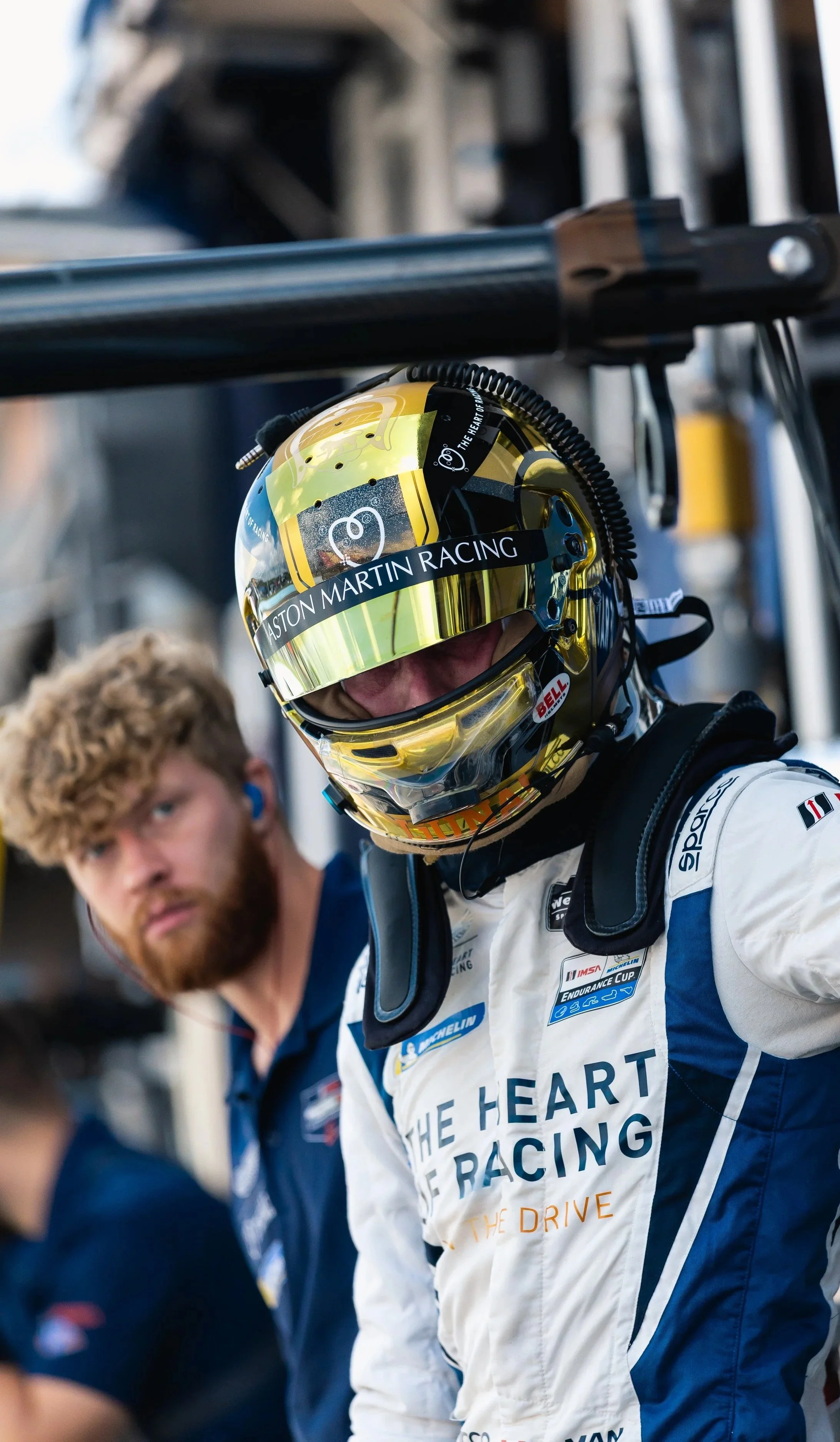
Image © Aston Martin Lagonda. Used for editorial purposes. Roman de Angelis in helmet.
The closing stages became increasingly chaotic, with repeated Full-Course Yellow periods and several incidents among the leading GTP cars. De Angelis kept himself in contention as positions changed around him and, following a dramatic late collision involving two of the front-runners, the #23 Aston Martin was initially elevated to second place overall.
A first IMSA podium of 2026 therefore looked tantalisingly close, but there was one final twist. De Angelis was subsequently given a post-race drive-through penalty for responsibility in contact with the #93 Acura of Renger van der Zande on the final restart. That penalty dropped the Valkyrie from second to fifth in the official classification.
There was understandable disappointment at losing the podium, but fifth still represents Valkyrie’s best IMSA result of the 2026 season so far. Perhaps even more encouraging was the manner in which it was achieved: after losing a lap and falling down the order, the car had the pace and the strategy behind it to fight its way back into genuine contention.
It’s worth keeping some perspective around Valkyrie. This remains a developing racing programme taking on highly experienced factory opposition in two of the toughest sportscar championships in the world. We’ve watched it accumulate knowledge, mileage and increasingly competitive performances through both the FIA World Endurance Championship and IMSA rather than expecting instant victories.
Road America provided another tantalising glimpse of where that journey might eventually lead. Coming after both Valkyries scored points in the FIA World Endurance Championship at São Paulo, the direction of travel is becoming increasingly interesting.
As always, we’re only giving you the shorter version here. Our full Aston Martin race coverage, including more detailed reports and results from the championships we follow, can be found in the FTP Motorsport Hub.
While Aston Martin’s GT and endurance programmes supplied much of this week’s silverware, there were finally a few reasons for cautious optimism on the Formula One side too.
Is the AMR26 Beginning to Respond?
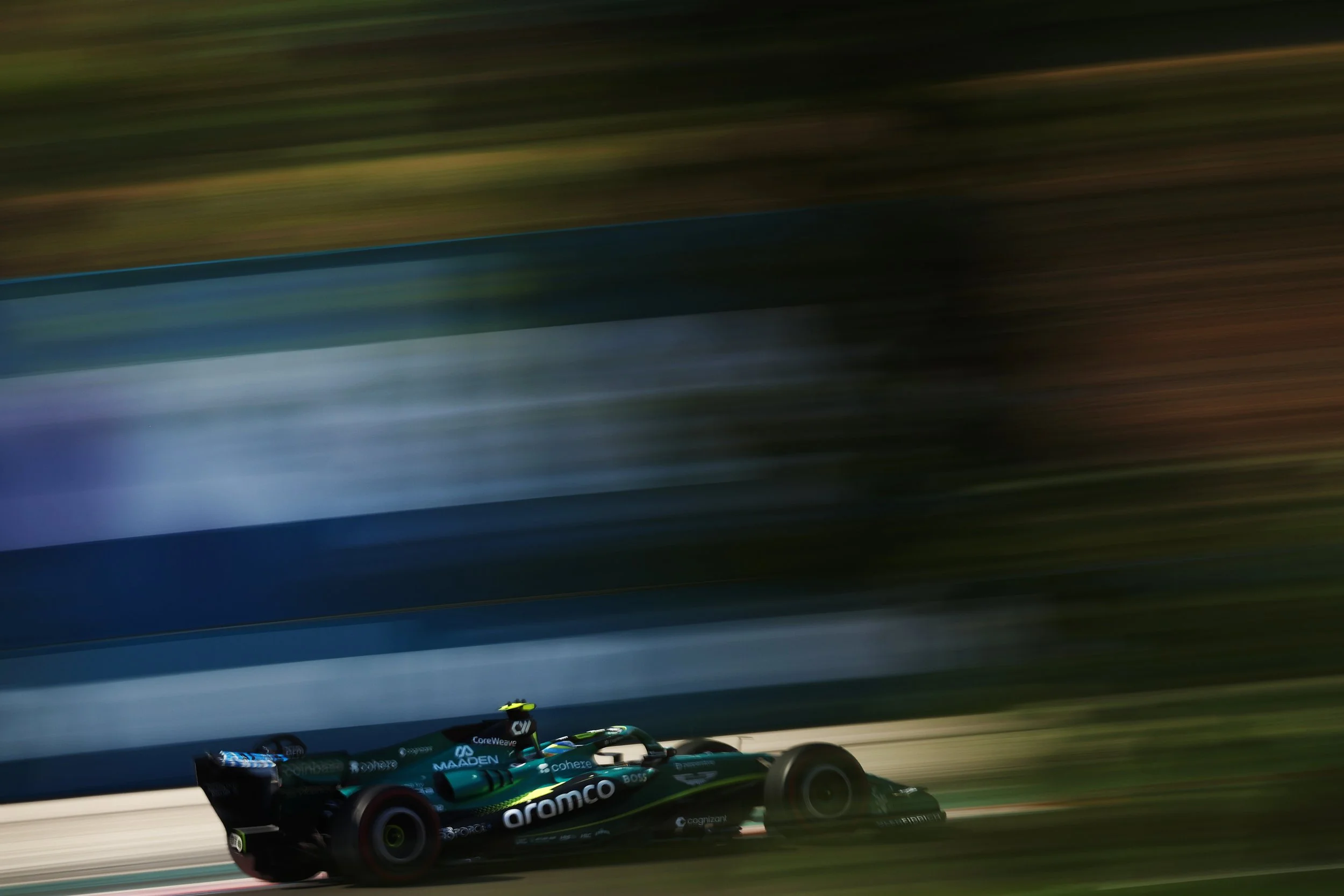
Image © Honda Motor Co. Ltd & Aston Martin Aramco. Used for editorial purposes.
Anyone following Aston Martin’s 2026 Formula One campaign will know there’s little value in pretending the first half of the season has been anything other than extremely difficult. That’s why the improvement seen at the Hungarian Grand Prix deserves attention. Aston Martin arrived with an unusually substantial development package incorporating 16 changes to the AMR26, effectively reworking significant areas of a car that has struggled badly since the beginning of the season.
The final positions, Lance Stroll 13th and Fernando Alonso 14th, hardly leap from the timing screens, but they don’t tell the whole story. Alonso reached Q2 in qualifying and, more importantly, the car appeared considerably closer to the competitive midfield than it had during several previous weekends.
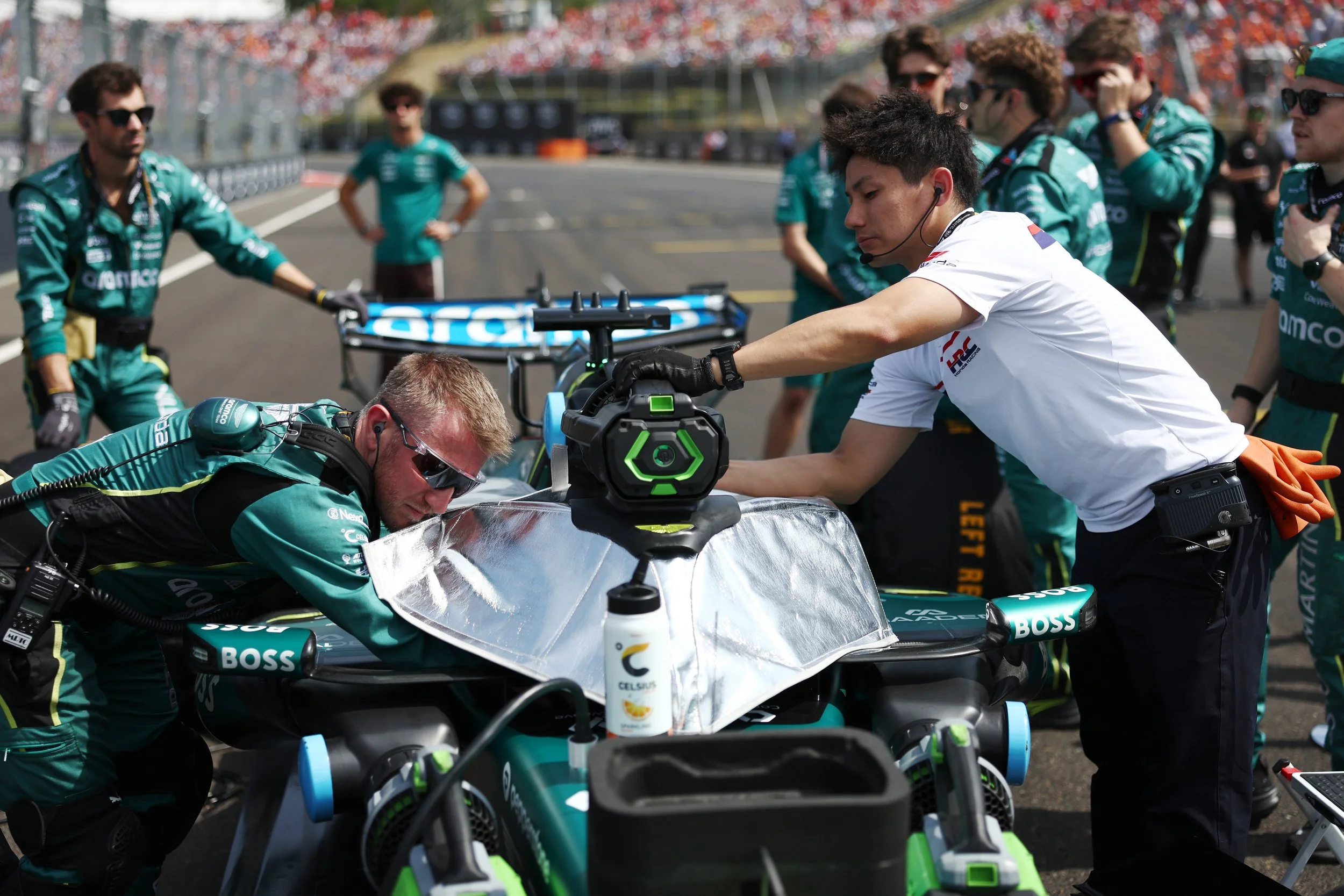
Image © Honda Motor Co. Ltd & Aston Martin Aramco. Used for editorial purposes.
Former Haas team principal Guenther Steiner was among those impressed by the scale of the improvement, noting how far Aston Martin appeared to have moved in a relatively short period. That doesn’t suddenly turn Hungary into a breakthrough result. No points were scored and Aston Martin remains a long way from where an organisation with its investment, facilities and ambitions ultimately expects to be.
But after months in which progress has often been difficult to see from the outside, Hungary at least provided something tangible.
Honda Explains Just How Difficult the Beginning Was
Some useful context has also emerged from Honda.
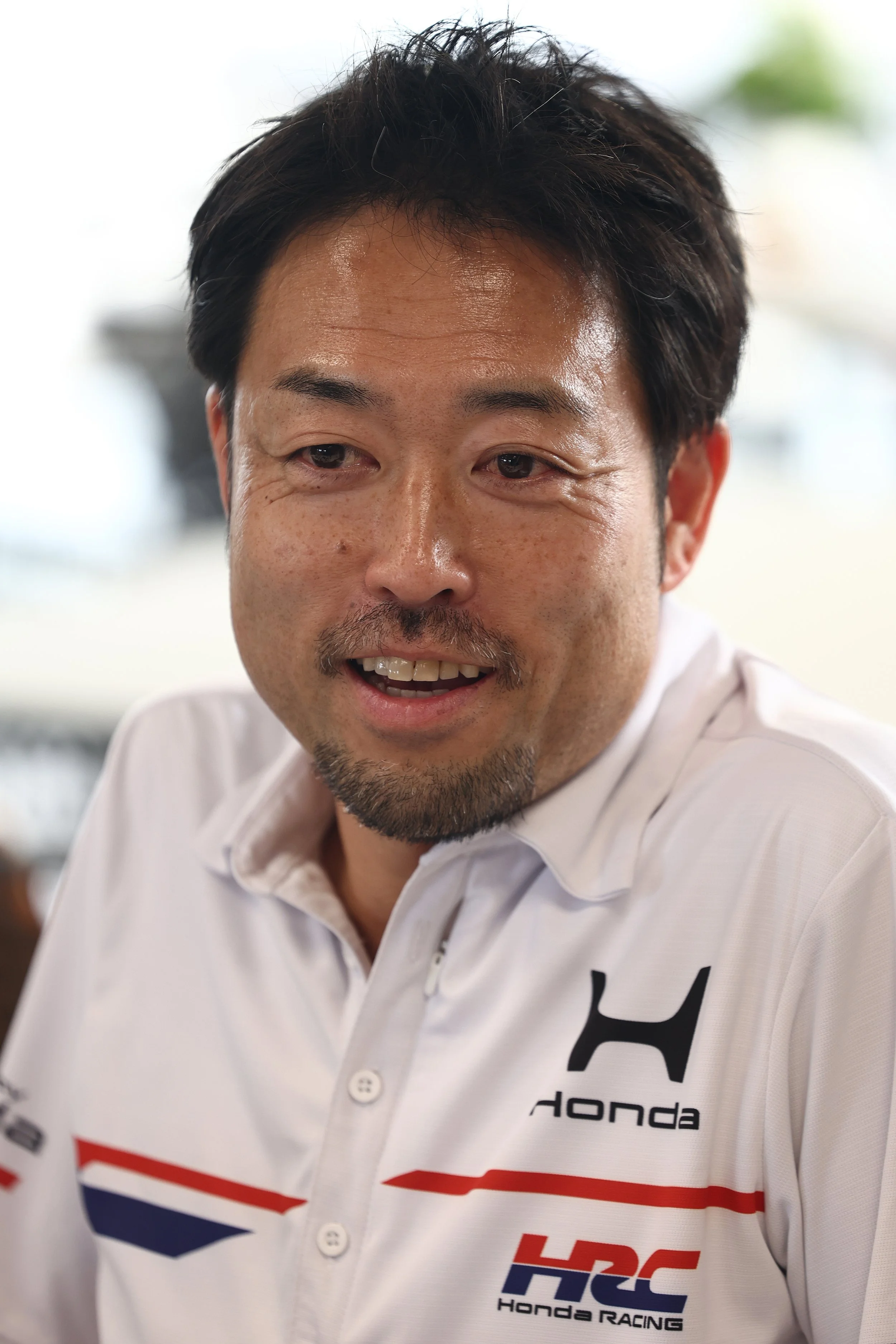
Image © Honda Motor Co., Ltd. Used for editorial purposes. Shintaro Orihara, HRC.
Shintaro Orihara, Honda Racing Corporation’s Formula One trackside general manager, has explained that it wasn’t until the Barcelona shakedown in January that Honda fully appreciated the extent of the performance and reliability deficit it faced with its new power unit. That helps explain why the first months of Aston Martin and Honda’s works partnership have looked so painful.
There have also been reports suggesting Honda’s forthcoming update could deliver something approaching a 50 bhp increase, but Honda has sensibly cooled those claims. Orihara has made clear that he would very much like such a gain, but that the widely quoted number isn't representative of reality.
An updated power unit is nevertheless expected for the Dutch Grand Prix at Zandvoort, so there’s another development to watch when Formula One returns from its summer break. Perhaps that’s the more sensible way to view Aston Martin’s position at present. The Hungary chassis changes produced encouraging signs, Honda continues working through its own programme, and Adrian Newey and his technical team are steadily influencing the car. It’s progress rather than a transformation.
What About Fernando Alonso?
One further question inevitably follows Aston Martin into the summer break, as we briefly mentioned last week: what does Fernando Alonso want to do next?
Alonso’s current contract reaches its conclusion at the end of 2026, and at 45 he’s openly acknowledged that he’ll consider his Formula One future during the break. Adrian Newey, however, appears optimistic. He’s described Alonso as an exceptional driver and indicated that he’s “pretty confident” their relationship will continue.
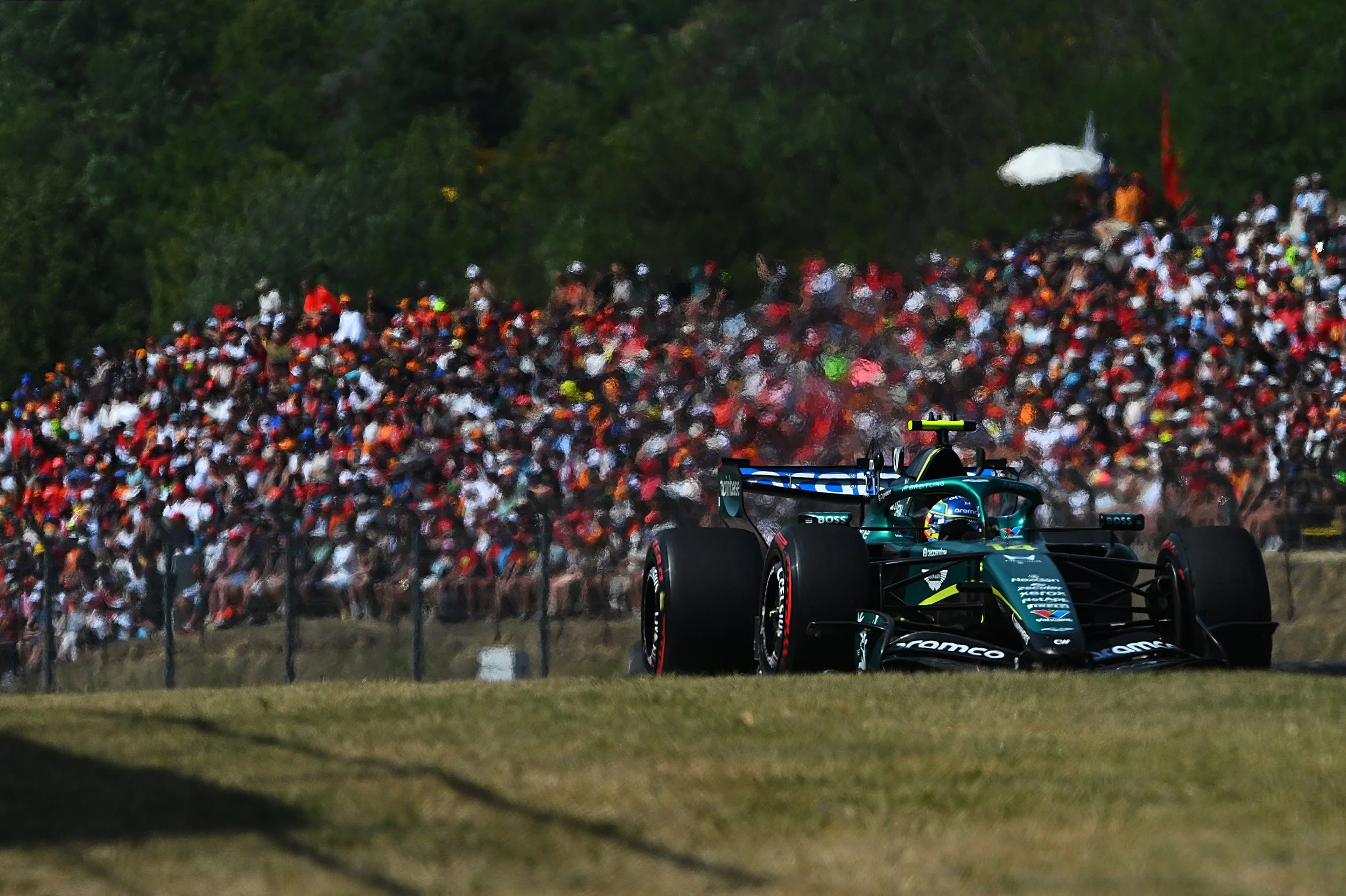
Image © Honda Motor Co. Ltd & Aston Martin Aramco. Used for editorial purposes. Fernando Alonso in the improved AMR26 at the Hungarian Grand Prix.
Alonso’s own position is more nuanced. He continues to express confidence that Newey will eventually produce a competitive Aston Martin and believes Honda will overcome its difficulties. His decision, though, appears to involve something more personal than simply whether the car becomes faster: does modern Formula One still provide the enjoyment, motivation and adrenaline that have kept him competing for so long? That’s a decision only Fernando can make.
For FTP, there’s little value in speculating about contract figures or supposed demands circulating elsewhere. What we do know is that Aston Martin has one of the most experienced and accomplished drivers on the grid, Newey clearly values his contribution, and both appear interested in seeing what this project can eventually become.
For now, Hungary has at least given everyone involved something slightly more positive to take into Formula One’s summer pause.
Building the Next Generation
Before we leave Formula One entirely, another Aston Martin driver deserves a mention. Seventeen-year-old German racer Mathilda Paatz is contesting her first full F1 Academy season this year with PREMA Racing in Aston Martin colours and is also a member of the Aston Martin Aramco Driver Academy.
Her campaign has already included a particularly memorable weekend in Montréal, where she finished third in the opening race before taking her maiden F1 Academy victory in the Reverse Grid Race, also Aston Martin’s first victory in the championship.
Paatz currently sits seventh in the Drivers’ Championship on 35 points, with the next round taking place at Zandvoort alongside the Formula One Dutch Grand Prix later this month. It’s another part of Aston Martin’s wider motorsport picture that we’ll continue to follow as the season develops, and with that, our motorsport coverage for this week is complete. As always, these are the shorter summaries; the FTP Motorsport Hub carries our fuller Aston Martin race coverage, results and championship updates across the series we follow.
From here, we move away from the racetrack and into a rather more complicated area.
Aston Martin Lagonda’s new £550 million financing package has become the subject of a challenge from some of its existing creditors, and this is one story where slowing everything down and explaining it carefully is far more useful than simply repeating the headlines.

Affiliate link note: Some links may be affiliate links, which means Fuel the Passion may earn a small commission if you purchase through them, at no extra cost to you. Thank you for your support.
Aston Martin’s £550 Million Financing - The Story Moves On
Regular readers will know that we spent considerable time last week looking through Aston Martin Lagonda’s first-half 2026 financial results, including the company’s £1.545 billion net-debt position and the new £550 million financing completed shortly after the reporting period.
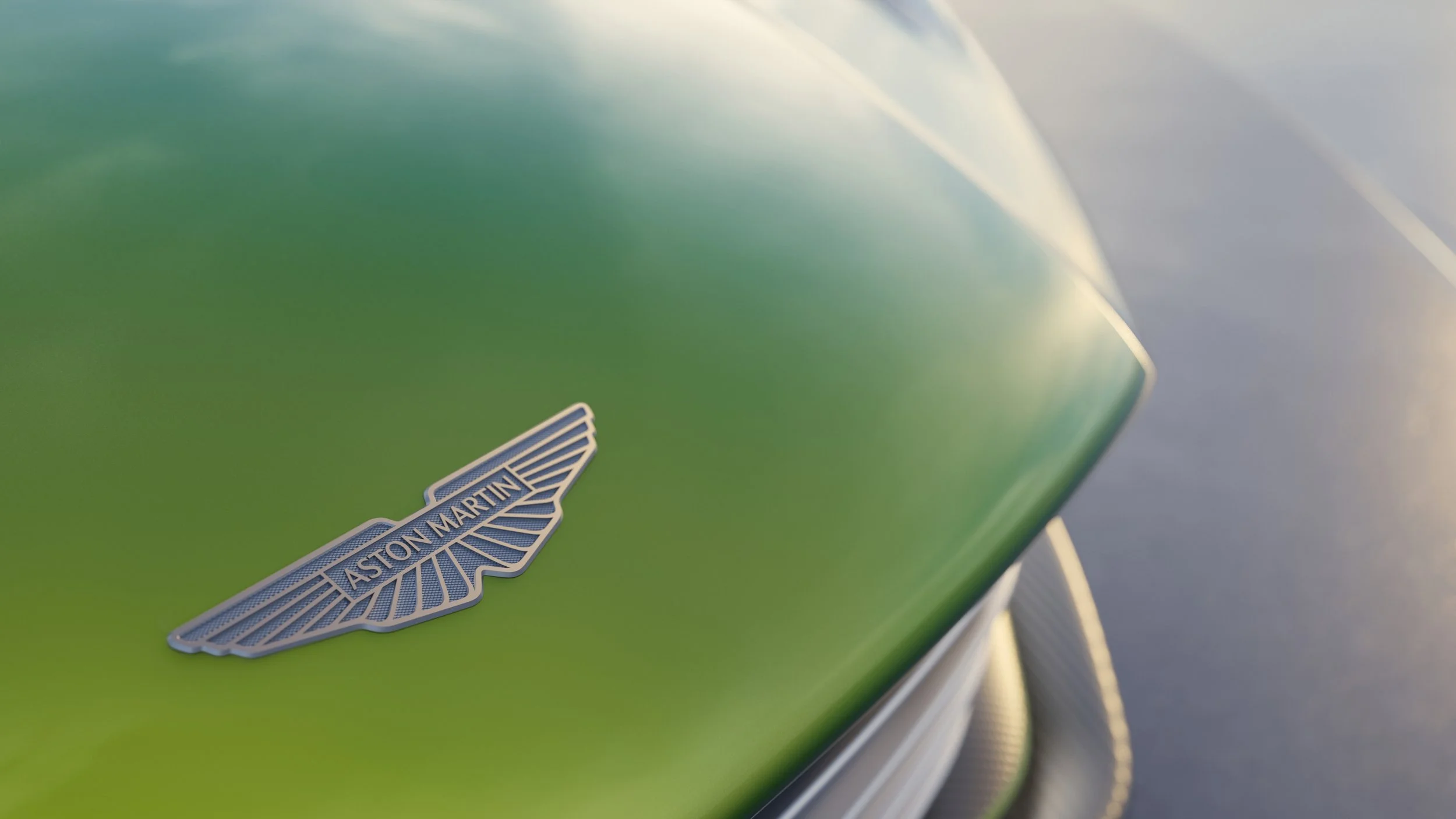
Image © Aston Martin Lagonda. Used for editorial purposes. The nose of the Aston Martin Valhalla.
There were some genuinely encouraging signs within those results. Revenue, gross profit and gross margin all improved substantially, Valhalla began making a meaningful contribution and cash used by the underlying operation reduced significantly. Yet the other side of the picture remained difficult: Aston Martin is still loss-making, continues to consume cash and carries an extremely heavy and expensive debt burden.
We then went considerably deeper in our latest FTP Featured Article, Aston Martin Beyond the Debt: What Could the Future Hold?, examining what that borrowing is costing the company and whether a stronger business is beginning to emerge beneath it.
Our conclusion was deliberately balanced. Interest is unquestionably making Aston Martin’s challenge much harder, but removing the financing burden alone wouldn’t suddenly reveal a completely self-funding business underneath. Operational improvement, stronger margins, disciplined production, continuing customer demand and genuine cash generation all remain part of the equation. One other point was already beginning to emerge when we wrote last week’s Roundup:
Some of Aston Martin’s existing creditors were questioning the structure of the new financing.
This week, that part of the story has moved on considerably.
From Concern to a Threat of Legal Action
The £550 million financing announced by Aston Martin on 22nd July comprises a £450 million Senior Secured Term Loan and a further £100 million Delayed Draw Term Loan, led by funds managed by BlackRock-owned HPS Investment Partners. We covered how that money is being used last week, so there’s little value in repeating all of those details again here. What’s now become the focus is what sits behind the borrowing as security.
Aston Martin’s original announcement stated that the new financing is secured against certain group assets held within a newly incorporated subsidiary, together with other group assets. Two days later, following questions from investors, the company provided some additional detail.
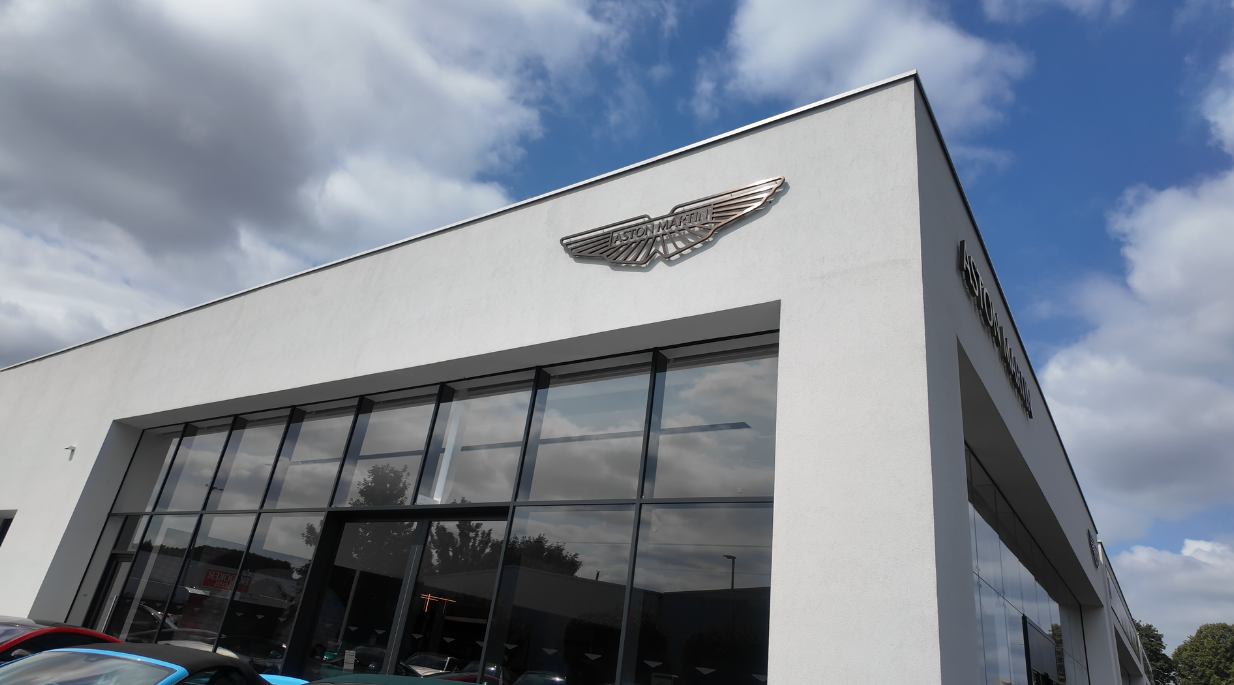
Image © Fuel the Passion. JCT600, Aston Martin Leeds
Aston Martin confirmed that its existing Senior Secured Notes due in 2029 remain secured through a pledge over shares in Aston Martin Lagonda Limited, but are not directly secured by a pledge over the shares of the newly incorporated subsidiary containing some of the assets supporting the new HPS financing. Aston Martin also said a different newly created subsidiary had been designated an “unrestricted subsidiary” under the terms governing those existing notes.
It’s technical language, but the concern from the existing lenders is relatively straightforward once we strip that away.
They lent Aston Martin money on the basis of a particular package of financial protections and security. They’re now concerned that valuable assets may have been placed into a structure that gives the new lender a stronger claim over them, potentially leaving the existing lenders with less valuable security than they believed they previously had.
According to the Financial Times, creditors representing around £1.3 billion of Aston Martin debt have now sent the company’s board a letter before action and are threatening legal proceedings.
A letter before action isn’t a court judgment. It’s essentially a formal warning that legal proceedings may follow if the dispute isn’t resolved.
The creditors reportedly believe the financing arrangement and movement of assets could breach terms contained within their existing lending agreements and may seek to have elements of the transaction reversed. Those are the creditors’ allegations. No court has ruled that Aston Martin has breached those agreements or acted unlawfully and that distinction is important.
What About the Headlines Saying Aston Martin Is “Selling Its Name”?
This is where the story becomes particularly interesting, and where some of this week’s headlines have perhaps created more confusion than clarity. The Financial Times reports that access to the additional £100 million delayed-draw element of the financing is conditional upon Aston Martin transferring a 50.1% interest in certain non-automotive intellectual-property rights to US-based Authentic Brands Group. HPS is also an investor in Authentic Brands.
There are three words in that sentence worth emphasising: Certain. Non-automotive. Rights.

Image © Aston Martin Lagonda. Used for editorial purposes. Aston Martin St. Athan.
This isn’t a report that Aston Martin is selling its road-car company. It doesn’t mean another organisation is taking control of Aston Martin’s factories, its engineers, its vehicle programmes or the right to manufacture and sell Aston Martin cars under the Aston Martin name. The reported transaction concerns particular uses of Aston Martin’s intellectual property away from the automotive business, in other words, the commercial value attached to licensing and using the Aston Martin name and identity in other areas.
Exactly which rights and commercial categories are contained within that proposed arrangement haven’t been fully disclosed publicly by Aston Martin. For that reason, FTP won’t attempt to fill in the gaps. We can accurately report what the Financial Times and subsequent reputable coverage says, while remaining clear about what Aston Martin itself has publicly confirmed.
Haven’t Aston Martin Already Sold Some Naming Rights?
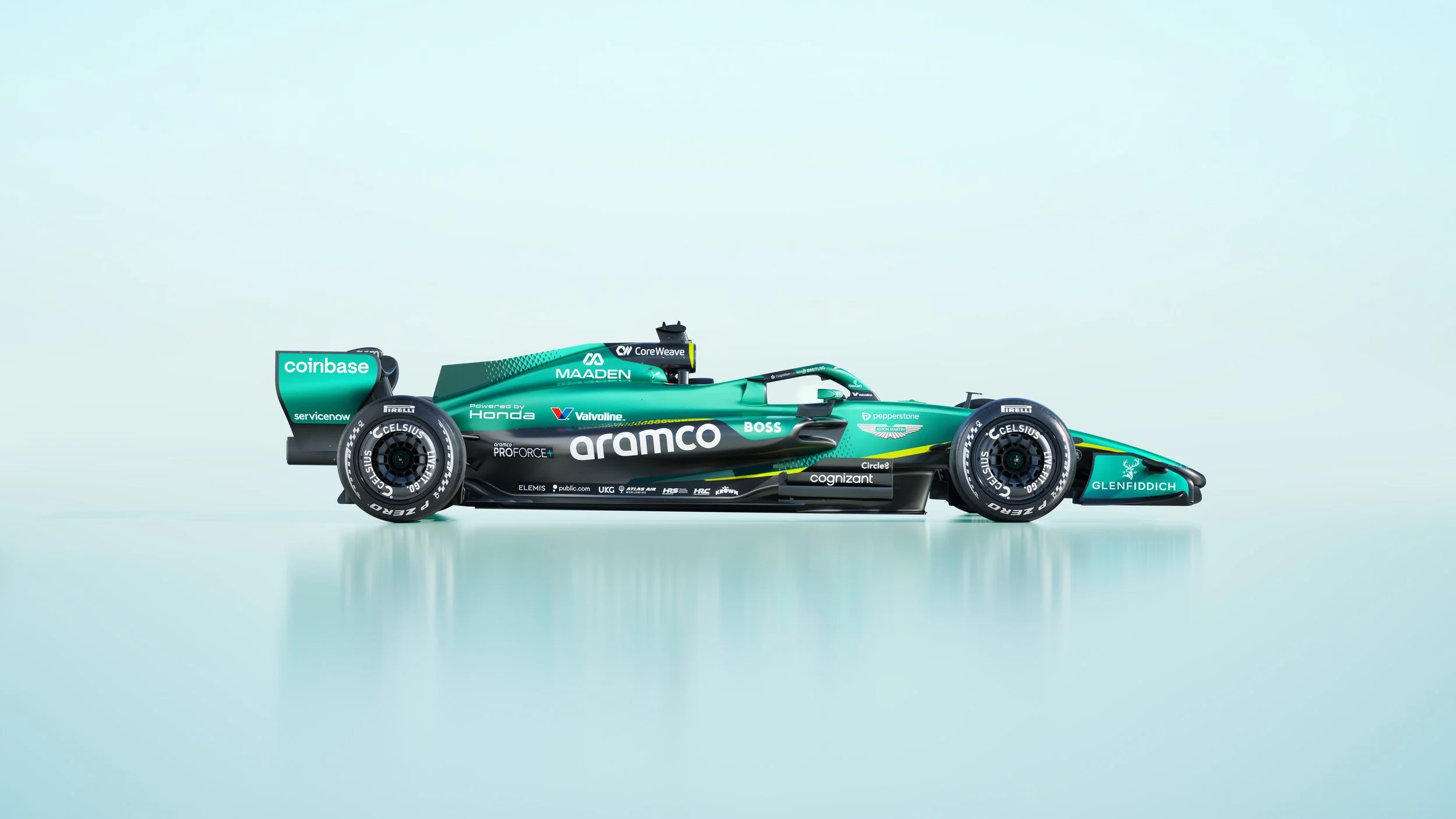
Image © Honda Motor Co. Ltd & Aston Martin Aramco. Used for editorial purposes.
Yes, but this is a separate transaction, and distinguishing the two is important. As we explained while examining the H1 results, Aston Martin completed a £50 million transaction with AMR GP Holdings in March 2026, giving the Formula One operation the perpetual right to use Aston Martin as part of the Aston Martin F1 Team name and as a Formula One chassis name, together with certain related rights specifically connected with its F1 activities.
That transaction contributed to Aston Martin’s reported first-half operating result and was something we accounted for when interpreting those numbers last week. The reported Authentic Brands arrangement is different. It concerns non-automotive intellectual property and has emerged in connection with the new HPS financing.
Keeping those two stories separate avoids giving the impression that Aston Martin has suddenly entered into one enormous sale of its entire identity. It hasn’t.
Why Can Branding Rights Be So Important to Lenders?
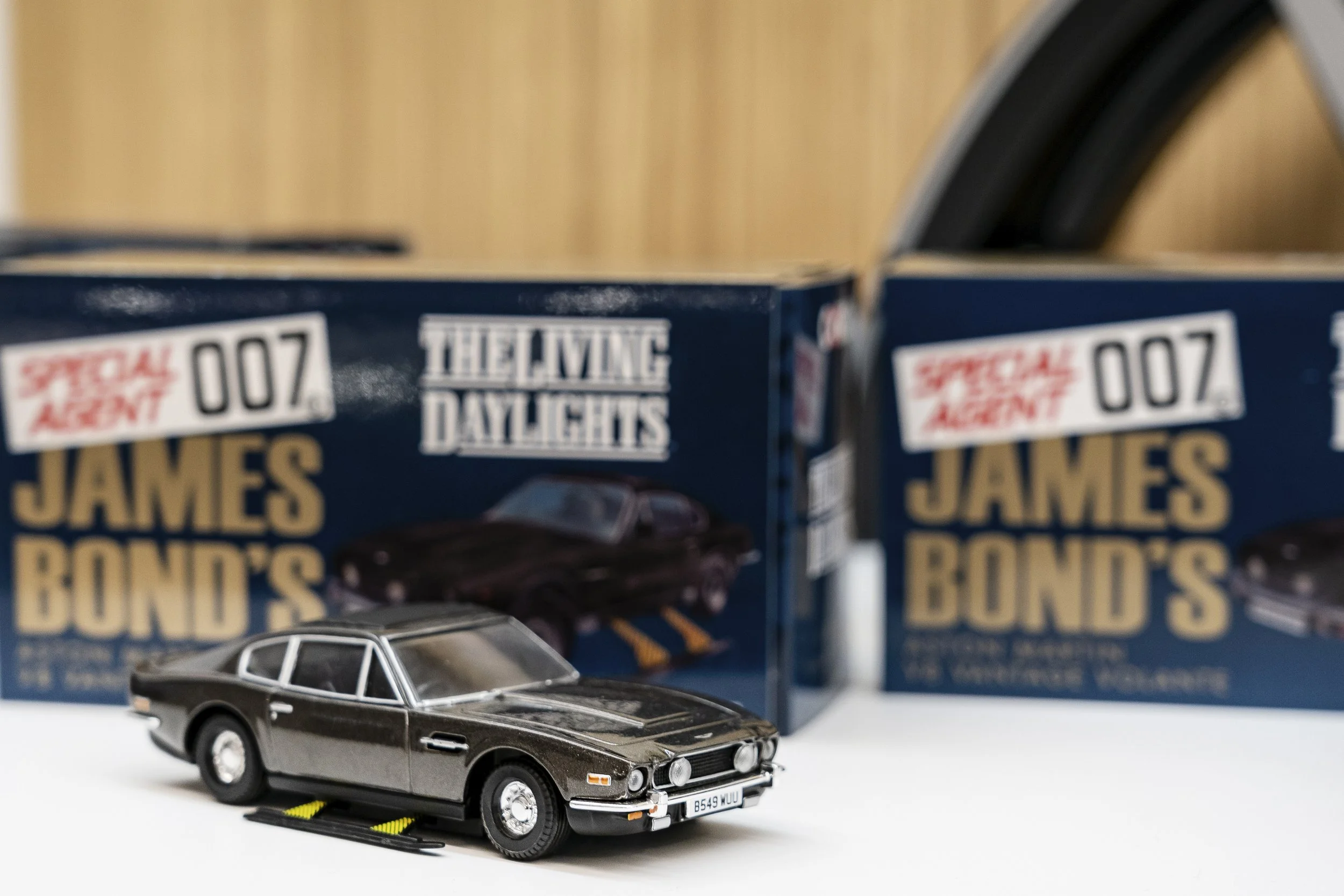
Image © Aston Martin Lagonda. Used for editorial purposes.
Because the Aston Martin name has value far beyond the metal of the cars themselves. As we know, the marque carries more than a century of history and associations with luxury, British craftsmanship, motorsport, design and, of course, James Bond. Those associations can create commercial value through licensing, partnerships and branded products or developments.
That’s why intellectual property can form part of the asset base lenders consider when deciding how well protected their money might be. From the existing creditors’ perspective, if valuable intellectual property is moved somewhere that gives another lender priority over it, they may believe their own position has weakened. From Aston Martin’s perspective, however, the company also requires sufficient liquidity to keep operating, developing cars and working towards the stronger financial performance management expects. There lies the awkward balance at the centre of the dispute.

Affiliate link note: Some links may be affiliate links, which means Fuel the Passion may earn a small commission if you purchase through them, at no extra cost to you. Thank you for your support.
Existing lenders naturally want to protect the money they’ve already advanced. But Aston Martin also needs access to funding while its underlying operation continues its transformation. As our recent Beyond the Debt investigation demonstrated, financing is currently absorbing a substantial amount of Aston Martin’s cash. Between the beginning of 2023 and the end of the first half of 2026, the company paid approximately £442 million in net cash interest.
The new financing provides additional breathing room, but it remains further borrowing rather than a reduction of Aston Martin’s underlying debt burden, another distinction we made in both last week’s Roundup and our Featured Article.
Where Does the Story Stand Now?
For the moment, the position is relatively straightforward. Aston Martin’s £450 million Senior Secured Term Loan has been completed. The company says the financing improves its resilience and gives it greater flexibility to deliver its current and future product plans. The company’s H1 results said the arrangement would have increased available liquidity at 30th June from £145.2 million to approximately £340 million had it been in place at that date.
Some of Aston Martin’s existing creditors disagree with elements of the structure and have now reportedly moved from voicing concern to threatening legal action.
Separately, reporting suggests Aston Martin must transfer a 50.1% interest in certain non-automotive intellectual-property rights to Authentic Brands before it can access the additional £100 million facility. There has been no court ruling establishing that Aston Martin has breached its borrowing agreements, improperly transferred assets or acted unlawfully. So this remains a developing financial and contractual dispute rather than a concluded legal one.
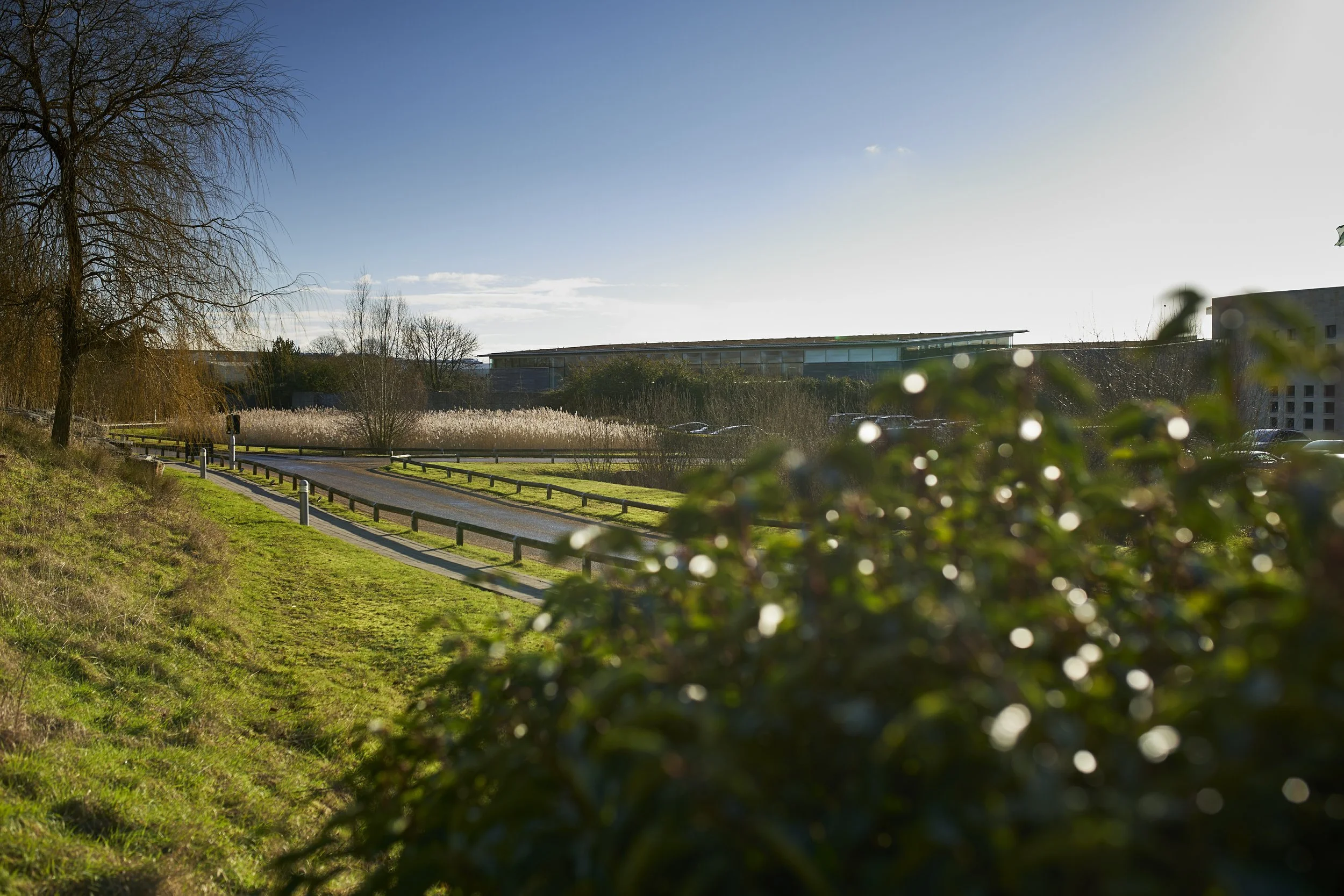
Image © Aston Martin Lagonda. Used for editorial purposes. AML, Gaydon.
For FTP, the important thing is to keep following those developments without losing sight of the wider picture we’ve already established. Aston Martin’s first-half numbers showed a business making genuine operational progress beneath considerable financial pressure. Our Featured Article demonstrated how heavily financing continues to weigh upon that progress. This week’s developments don’t replace either of those conclusions; they add another layer to them.
We’ll continue to follow the creditor dispute and will return to it if proceedings are formally launched, Aston Martin provides further information about the assets involved, or greater clarity emerges around the reported Authentic Brands arrangement. Unfortunately, there’s one more financial development we need to address before moving back towards the cars themselves.
As regular readers will know, we normally examine Aston Martin Lagonda’s share price only in the first Weekly Roundup of each month, and we did exactly that last Sunday. This week, however, the shares have fallen still further, reaching what has been reported as a new record low. Given the circumstances, an additional update feels justified. That’s where we’ll head next, albeit briefly.
AML Share Price Watch - An Unscheduled Update
So as mentioned, we wouldn’t normally return to the Aston Martin Lagonda share price this quickly. Our regular monthly Share Price Watch appeared in last week’s Roundup, where we recorded a closing price of 34.98p on Friday 31st July, down approximately 5.5% over the preceding five weeks and around 50% compared with a year earlier.
We also noted then that the shares were already sitting extremely close to their 52-week low and that investors appeared to be balancing the genuine operational improvements contained within Aston Martin’s first-half results against the company’s substantial debt, continuing losses and expensive financing. Unfortunately, the price has since moved lower again.

Image © Fuel the Passion
Earlier this week, Aston Martin Lagonda shares traded as low as 34.48p, establishing a fresh 52-week low. The move came as Citigroup reduced its price target from 55p to 40p while retaining a neutral rating. Deutsche Bank has also reduced its target to 40p, while Jefferies continues to carry a 41p target and a hold recommendation.
That’s only 0.50p below the closing price we recorded last Friday, so in isolation the weekly movement isn’t enormous. Its significance lies more in where the shares already were. As we showed last week, Aston Martin’s share price has fallen sharply over six months, one year and two years, leaving investor confidence at an exceptionally low level despite the improvements beginning to appear within the underlying operation.
The latest creditor dispute surrounding the £550 million financing is unlikely to have helped sentiment either. It adds another layer of uncertainty to a financial position we have already explored extensively both in last week’s Roundup and in our recent Aston Martin Beyond the Debt Featured Article.
For that reason, we won’t repeat all of the longer-term comparisons again this week. The position remains essentially the same: Aston Martin is showing signs of operating more effectively, but investors remain deeply cautious about the financial structure supporting that progress.
We’ll return to our normal monthly Share Price Watch in September, unless another exceptional development gives us reason to revisit it sooner.
FTP note: Share prices can move for many reasons and may change significantly during a trading session. This section is provided for editorial context and doesn’t constitute investment advice.
After rather a lot of lenders, legal terminology and share-price conversation, it’s probably time we returned to the reason most of us became interested in Aston Martin in the first place - the cars.
Five Aston Martins, Five Colours and a Trip Through the Archive
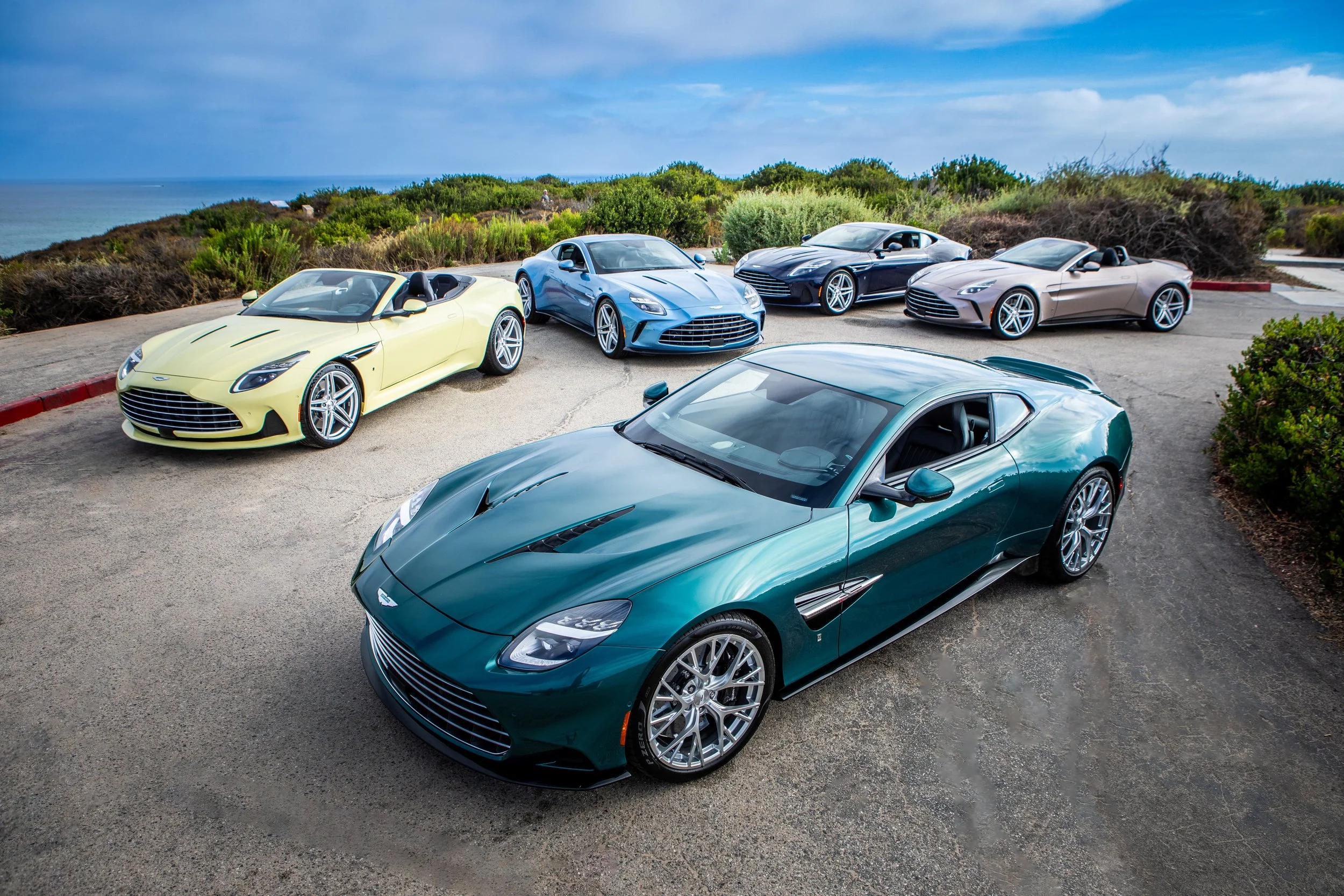
Image © Aston Martin Lagonda. Used for editorial purposes. Aston Martin Newport Beach Heritage Edition Collection.
There’s something rather appealing about seeing Aston Martin look backwards in order to create something new. Q by Aston Martin and Aston Martin Newport Beach have unveiled a collection of five individually commissioned 2027-model-year cars, each finished in a colour revived from Aston Martin’s palette of the 1960s and 1970s.
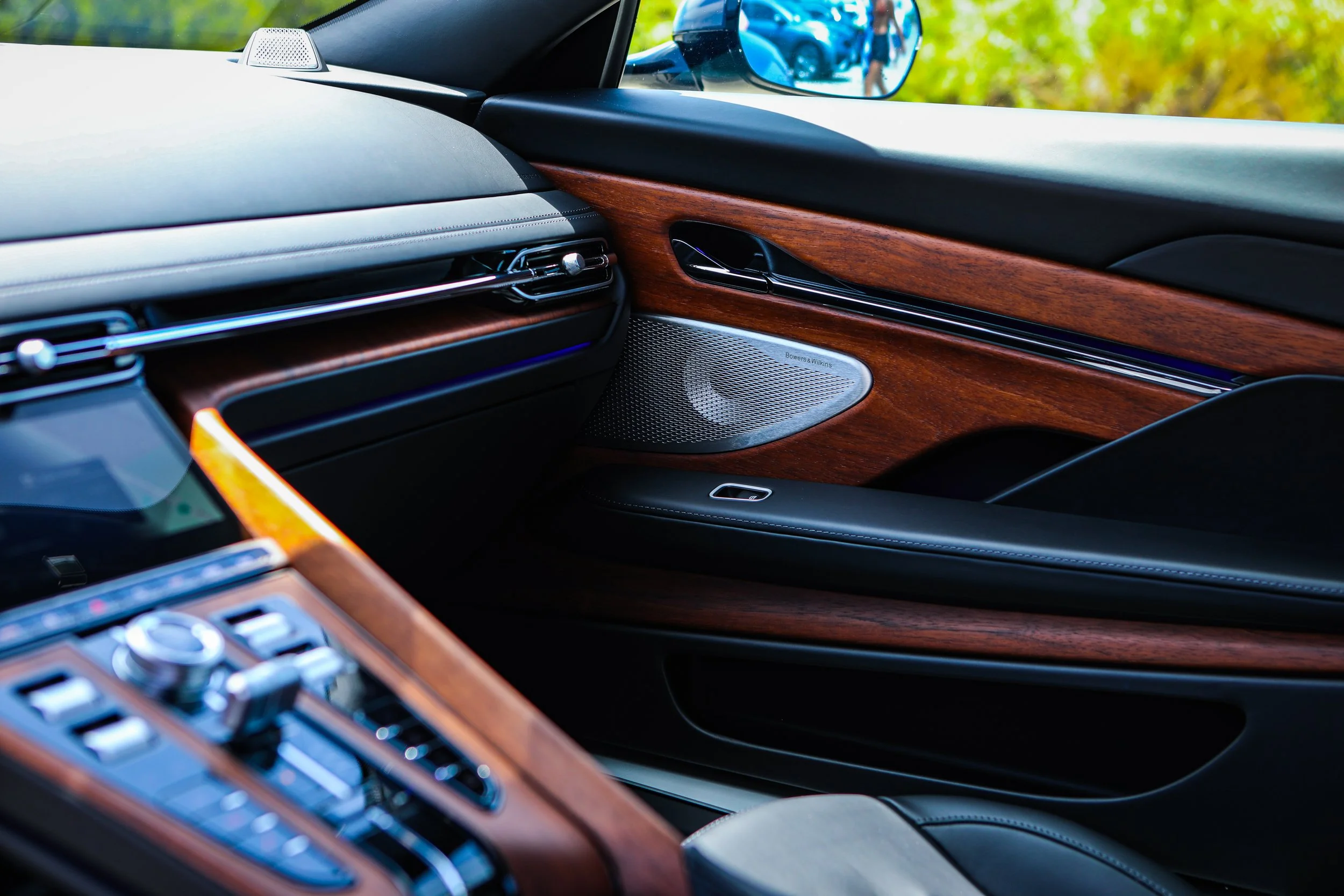
Image © Aston Martin Lagonda. Used for editorial purposes. Aston Martin Newport Beach Heritage Edition Collection.
These aren’t simply five cars painted in vaguely retro colours. Aston Martin says each is a one-of-one commission, and these are currently the only five examples from the modern range painted in their respective revived shades. The collection comprises a DB12 Volante in Pale Primrose, a DB12 Coupé in Pacific Blue, a Vanquish in Tudor Green, a Vantage Coupé in Winchester Blue and a Vantage Roadster in Mink Silver.
There are some lovely historical connections behind those choices.
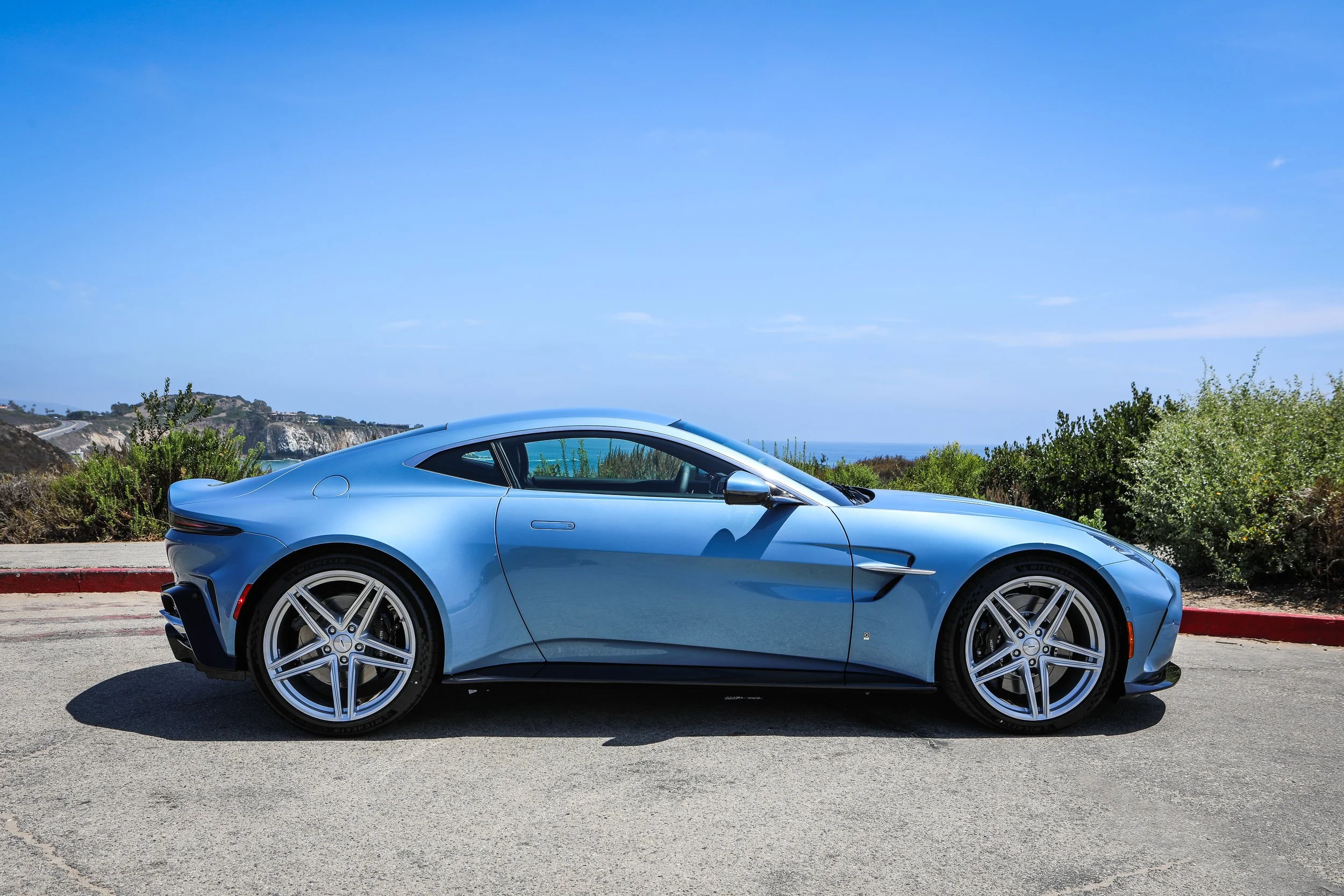
Image © Aston Martin Lagonda. Used for editorial purposes. Aston Martin Newport Beach Heritage Edition Collection.
Pale Primrose appeared on the cover of Aston Martin’s 1958 DB4 sales brochure and later became closely associated with Corgi’s famous model Aston Martins. Pacific Blue was originally offered on the DB4 before appearing on the DB5 and DB6, while Tudor Green takes us firmly into the 1970s.
Winchester Blue was another period colour that became particularly associated with the V8 Vantage, and Mink Silver recalls the elegant metallic shades seen on DB6s during the 1960s.
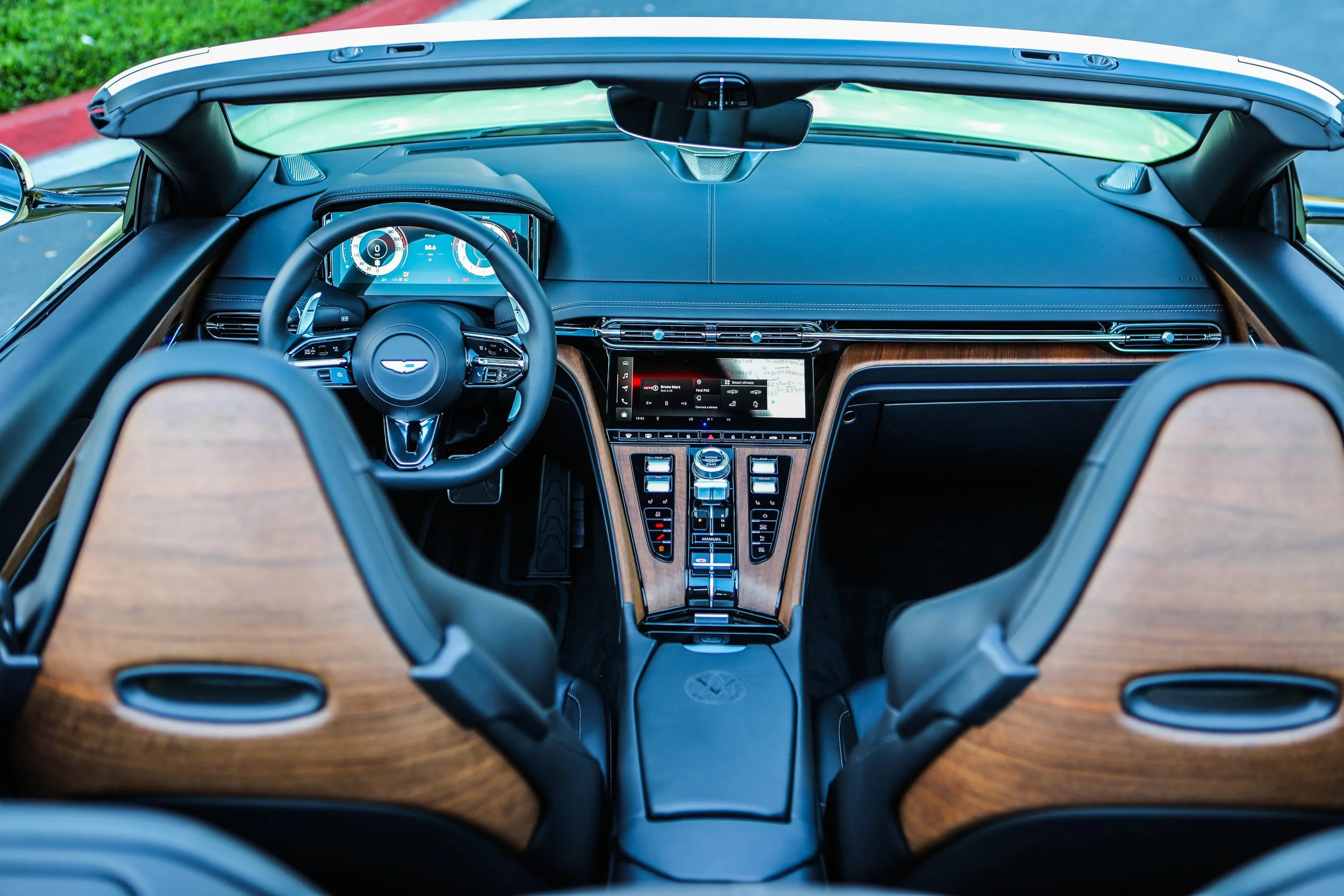
Image © Aston Martin Lagonda. Used for editorial purposes. Aston Martin Newport Beach Heritage Edition Collection.
The historical references continue inside. All five receive bespoke Q perforated fluted seats, Heritage Aston Martin logo embroidery and individual Heritage Edition sill plaques, while the DB12 Coupé, DB12 Volante and Vanquish use Dark Walnut Open Pore wood trim.
I rather like the idea.
Modern Aston Martins are very different machines from their DB4, DB5, DB6 and early V8 ancestors, but colour can provide a surprisingly strong visual link between generations.
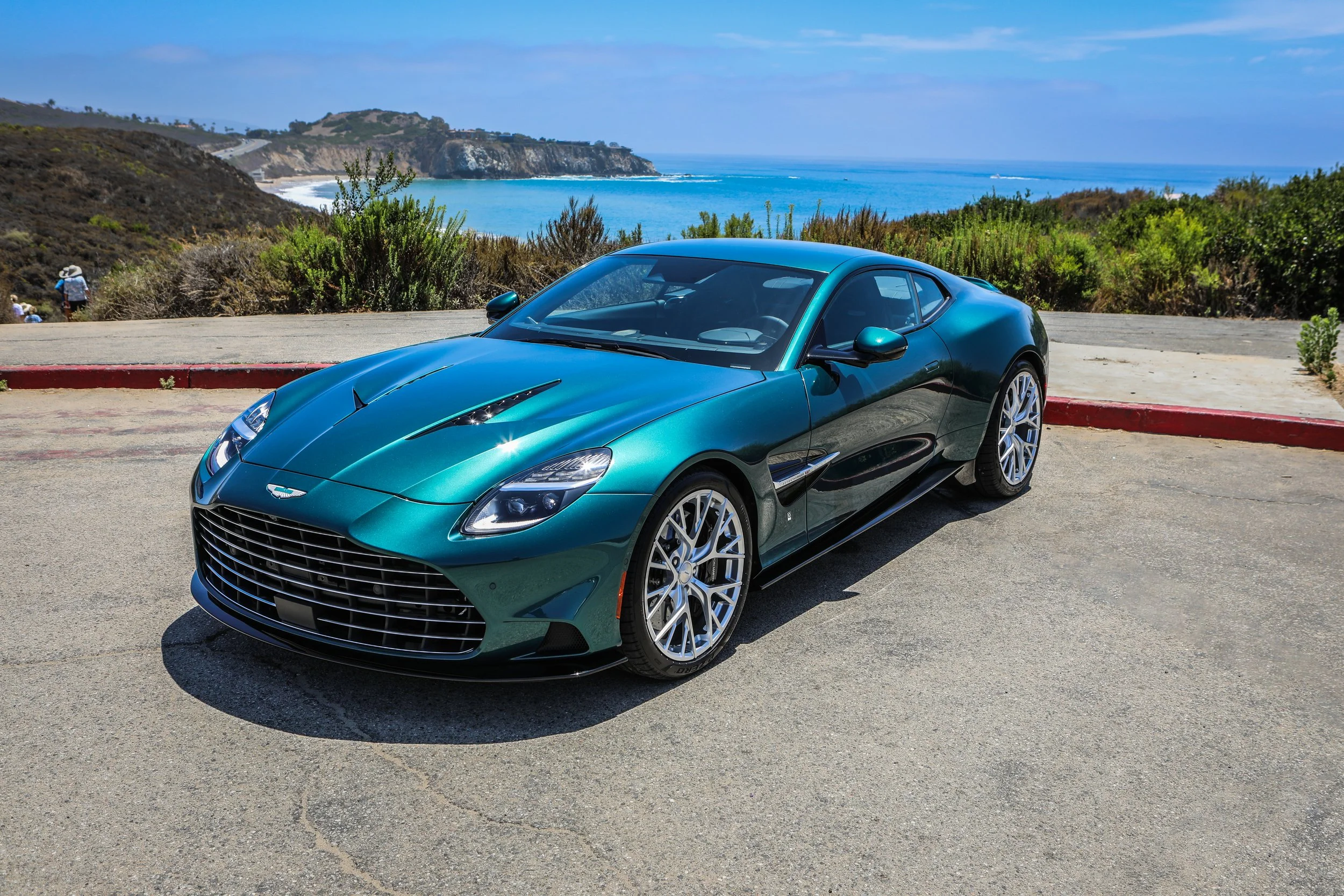
Image © Aston Martin Lagonda. Used for editorial purposes. Aston Martin Newport Beach Heritage Edition Collection.
Seeing a current Vanquish in Tudor Green or a modern Vantage wearing Winchester Blue reminds us that Q personalisation doesn’t always have to mean increasingly unusual materials or dramatic combinations.
Sometimes one of the best places to look for inspiration is Aston Martin’s own back catalogue, and with only one example of each being created, I suspect all five will look rather special sitting together in Newport Beach, as the above photographs show.
The Vantage S Reaches Singapore

Image © Aston Martin Lagonda. Used for editorial purposes. Aston Martin Vantage S.
Staying with the current range, the Vantage S has also been receiving attention in Singapore, another reminder of just how central Aston Martin’s expanding ‘S’ family has become to the current product line-up. The Vantage S itself isn’t a new model this week, of course, but its continuing international rollout gives us another opportunity to look at what differentiates it from the standard Vantage.

Image © Aston Martin Lagonda. Used for editorial purposes.
Its hand-built 4.0-litre twin-turbocharged V8 produces 680PS, 670bhp and 800Nm of torque, with 0–62mph taking 3.4 seconds and a top speed of 202mph. Aston Martin has given the car a solid-mounted rear subframe, revised Bilstein DTX adaptive-damper calibration, further chassis tuning and a recalibrated launch-control system. The rear decklid spoiler adds 44kg of rear downforce at maximum speed, while optional lightweight components including carbon-ceramic brakes, a carbon-fibre roof and performance seats can improve the car’s power-to-weight ratio further.
Interestingly, Aston Martin’s own technical information describes reduced stiffness in the rear suspension aids, rather than simply making everything harder in pursuit of performance. The aim is to sharpen the car while retaining some low-speed refinement, something rather important for a road-going Aston Martin rather than a track car wearing number plates.
The Vantage S now sits alongside the DB12 S and DBX S in what has become a much more clearly defined performance tier across Aston Martin’s range.
For me, there’s something reassuring about the continued use of that little ‘S’ badge. Aston Martin has used it at various points throughout its history to identify cars given a little more potency and focus. The machinery beneath it may have changed enormously, but the principle remains familiar.
Almost New - But Already Looking for Its Second Home
Now we come to something considerably rarer. A 2024 Aston Martin Valour has appeared for sale with German specialist Schaltkulisse, and describing it as lightly used would be something of an understatement. The car has covered fewer than 20 kilometres. To see the images of this particular stunning car, click on the link highlighted in the previous sentences.
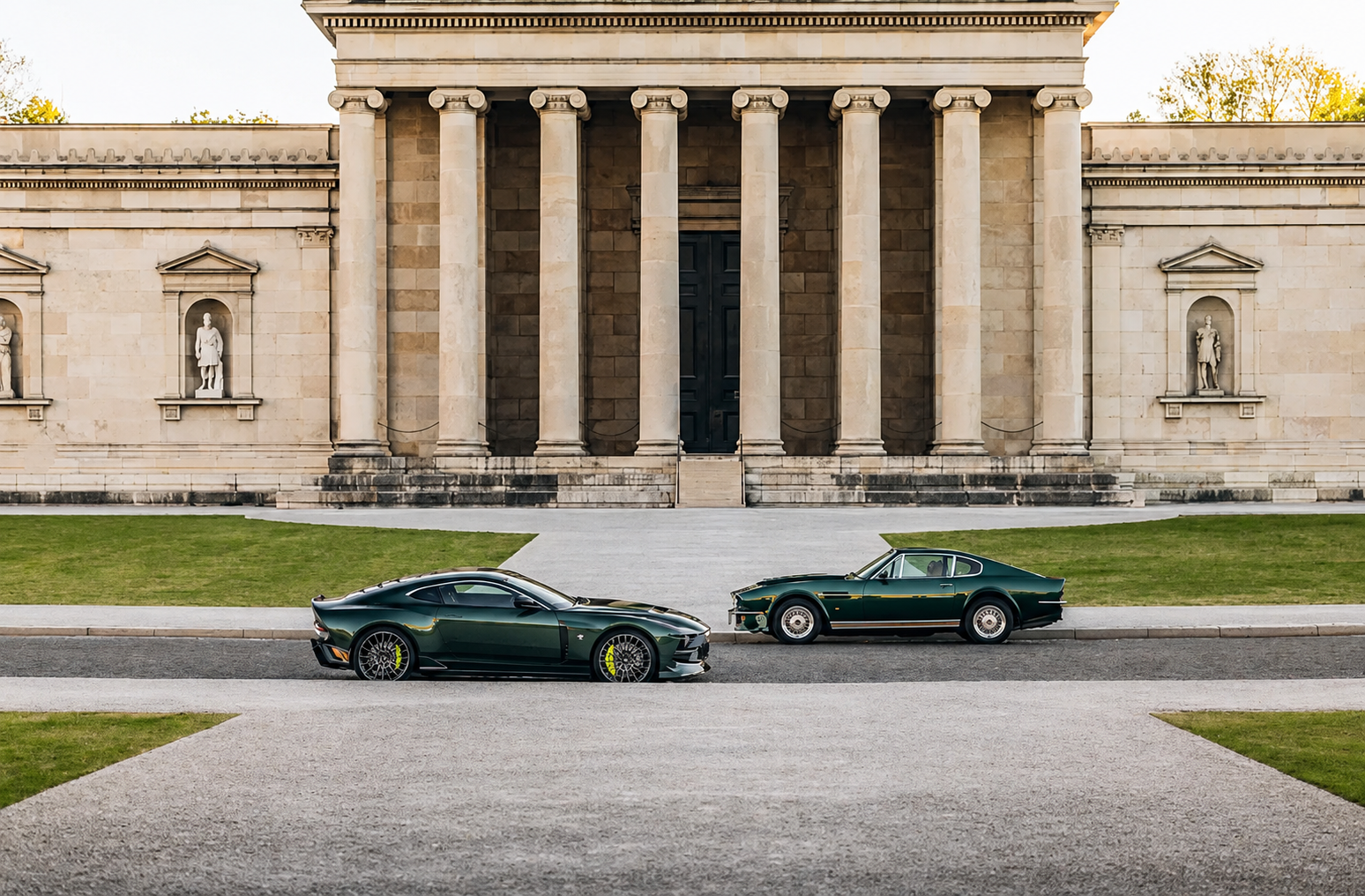
Image © Schaltkulisse. Used for editorial purposes.
It was supplied new to its first and only owner in Germany and has been specified rather extravagantly, with Schaltkulisse saying the factory options amounted to nearly €150,000. Finished in Q Aston Martin Racing Green, the specification includes carbon-fibre exterior detailing, 21-inch Honeycomb wheels, lime brake calipers, lightweight carbon seats trimmed with DBR1-inspired tweed and a wonderful billet-steel and walnut gear knob, apparently a €6,600 option on its own.
Underneath all of that sits one of the principal reasons Valour has already become such an intriguing modern Aston Martin. Just 110 examples were produced, combining Aston Martin’s 5.2-litre twin-turbocharged V12 with a six-speed manual gearbox and rear-wheel drive. In an era when electrification, automated transmissions and increasing digitalisation are transforming performance cars, Valour was deliberately conceived as something much more traditional.
Schaltkulisse describes it as a spiritual successor to cars such as the V8 Vantage X-Pack and V600 Le Mans, and you can certainly see where that thinking comes from. Whether a car with fewer than 20 kilometres should remain preserved in virtually delivery condition or finally be taken out and properly enjoyed is probably a debate for another day. I suspect most FTP readers already know which side of that particular argument I tend to occupy.
After all, Aston Martins generally become considerably more interesting once they start accumulating stories as well as miles.
For the next section we widen the view beyond the cars themselves, because Aston Martin’s name has appeared in some rather different places this week, from a troubled luxury development in Miami to a famous musician’s DB5, along with one or two lighter stories from around the wider Aston Martin world.
Around the Wider Aston Martin World
Of course, Aston Martin’s reach extends considerably further than the cars leaving Gaydon, and this week the famous wings have appeared in a few rather different stories. We’ll begin in Miami, where one of Aston Martin’s most high-profile non-automotive collaborations has found itself attracting attention for rather less glamorous reasons.
Aston Martin Residences Miami - Behind the Name, a Developing Legal Dispute
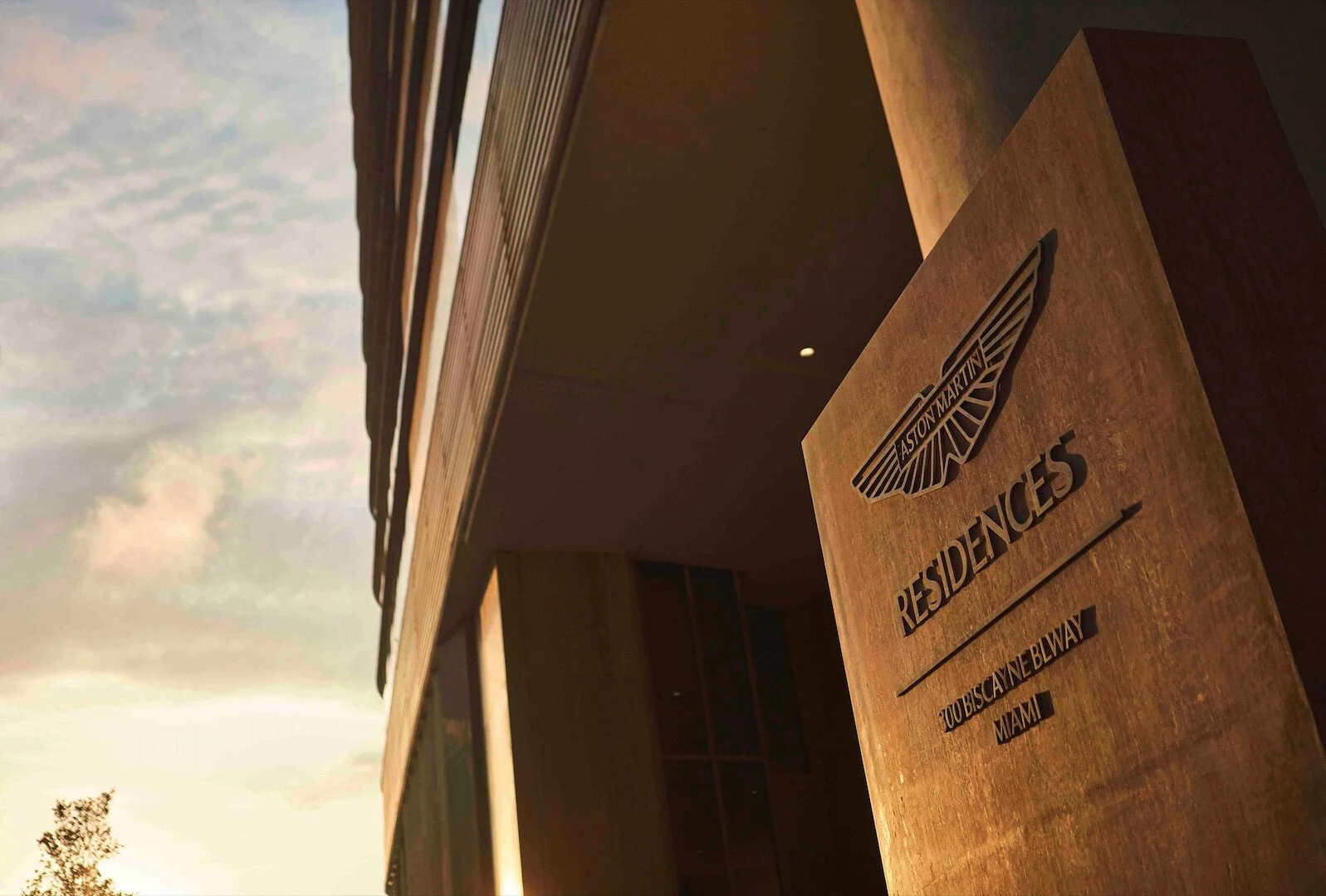
Image © Aston Martin Lagonda. Used for editorial purposes. Aston Martin Residences, Miami.
One of Aston Martin’s most ambitious ventures beyond the motor car has found itself attracting some unwanted attention. The Aston Martin Residences Miami, a 66-storey luxury residential tower standing where the Miami River meets Biscayne Bay, opened in 2024 following a collaboration between Aston Martin and property developer G&G Business Developments.
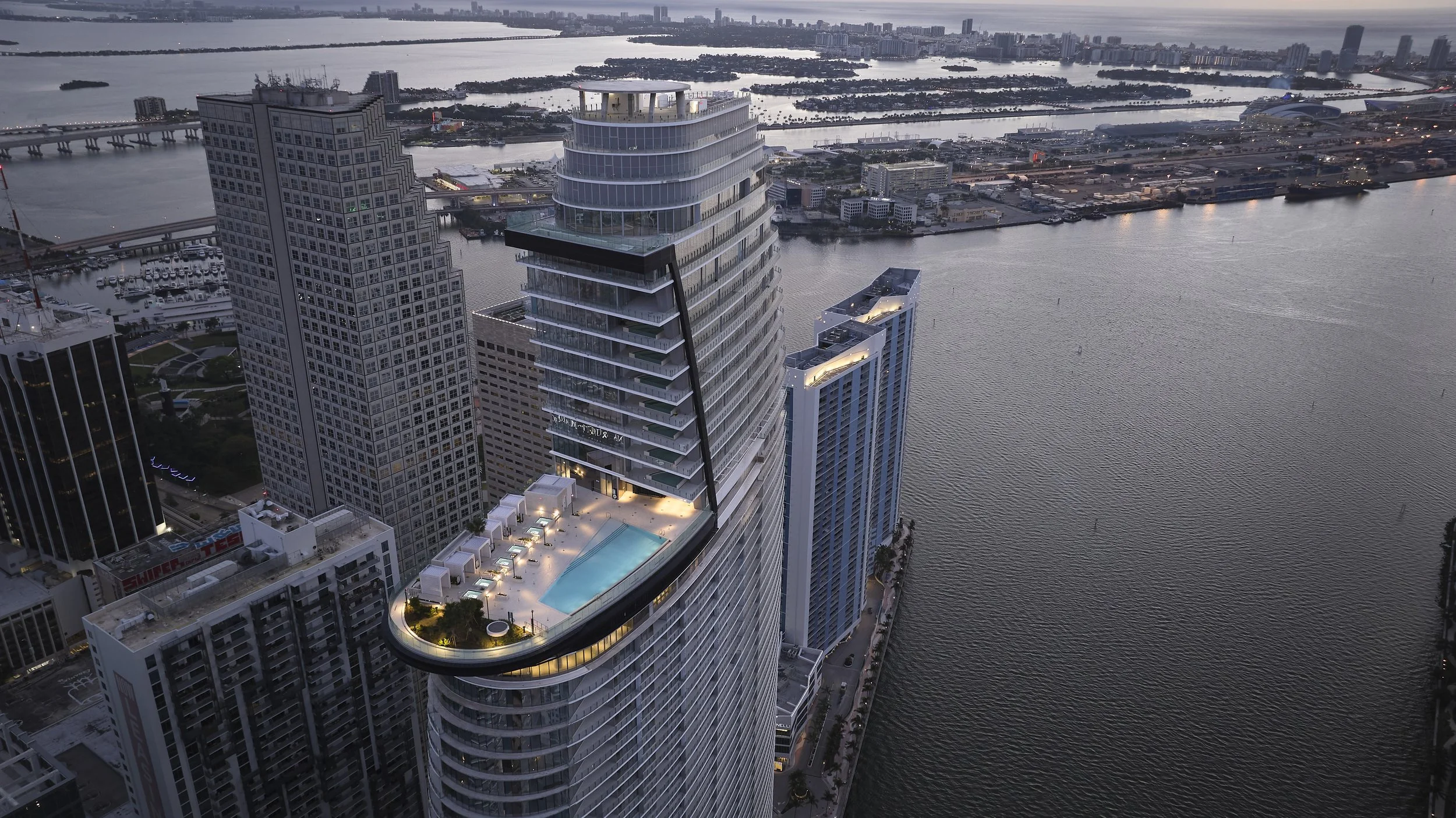
Image © Aston Martin Lagonda. Used for editorial purposes. Aston Martin Residences, Miami.
It’s a remarkable building and one that was deliberately designed to carry elements of Aston Martin’s identity far beyond Gaydon. The marque contributed to the building’s design character and interiors, with touches including carbon-fibre detailing, luxury materials and areas intended to reflect the experience and aesthetic associated with the cars.
There is, however, an important distinction to make before going any further; Aston Martin didn’t build the tower.
Its involvement centred upon branding and design consultation. The development, construction, structural engineering, financing and subsequent management involved separate companies. That becomes particularly important when we consider what has happened since residents moved in. The condominium association representing owners has now brought legal proceedings alleging a range of construction defects within the relatively new building.
According to reports and engineering assessments referenced within those proceedings, the alleged problems include cracking and spalling of concrete, water intrusion, corrosion, waterproofing problems and issues affecting areas of the balconies and seawall, alongside concerns involving a number of other building systems. Those are serious allegations, particularly given the age and positioning of the development, but they remain exactly that: allegations being examined through an ongoing legal process.
The developer and other parties named in the proceedings dispute the claims and deny wrongdoing, while Aston Martin has said that it’s aware of the allegations and that the matter is under review. There has been no court ruling establishing liability for the alleged defects. That distinction is particularly important with a story like this, because the Aston Martin name naturally dominates the headlines even though Aston Martin wasn’t responsible for pouring the concrete, engineering the structure or physically constructing the building.
A Much Deeper Look at the Story
While researching this week’s Roundup, I also came across an interesting film from the MegaBuilds YouTube channel entitled: Miami’s Newest Luxury Tower Is Already Falling Apart. The title is considerably more dramatic than the language we would choose here at FTP, but the film itself provides a detailed look at the history of the project, the parties involved, the engineering allegations and the legal action now surrounding the development.
Importantly, it also makes the same distinction we’ve made above: Aston Martin’s involvement was centred upon branding and design, rather than responsibility for the building’s construction, engineering, financing or property management.
The MegaBuilds film goes considerably deeper into the engineering claims than we can reasonably do within a Weekly Roundup. It discusses allegations surrounding exposed post-tensioning components, corrosion, waterproofing, balcony defects and other building systems, while also examining separate legal allegations involving the management and finances of the condominium association before control transferred to the owners. Again, those claims remain contested.
The video also draws some broader comparisons with building safety in South Florida following the tragic Surfside condominium collapse of 2021. To its credit, however, MegaBuilds explicitly states that Aston Martin Residences is a different building, constructed using different systems, and that there’s no evidence of imminent structural failure. For anyone wishing to explore this developing story in greater depth, we’ll include a link to the MegaBuilds film below.
The Wider Aston Martin Question
There is a broader Aston Martin angle here beyond the building itself. As Aston Martin continues to extend its name into luxury residences, watches, clothing, whisky and other collaborations, it inevitably places part of the marque’s reputation in the hands of outside organisations.
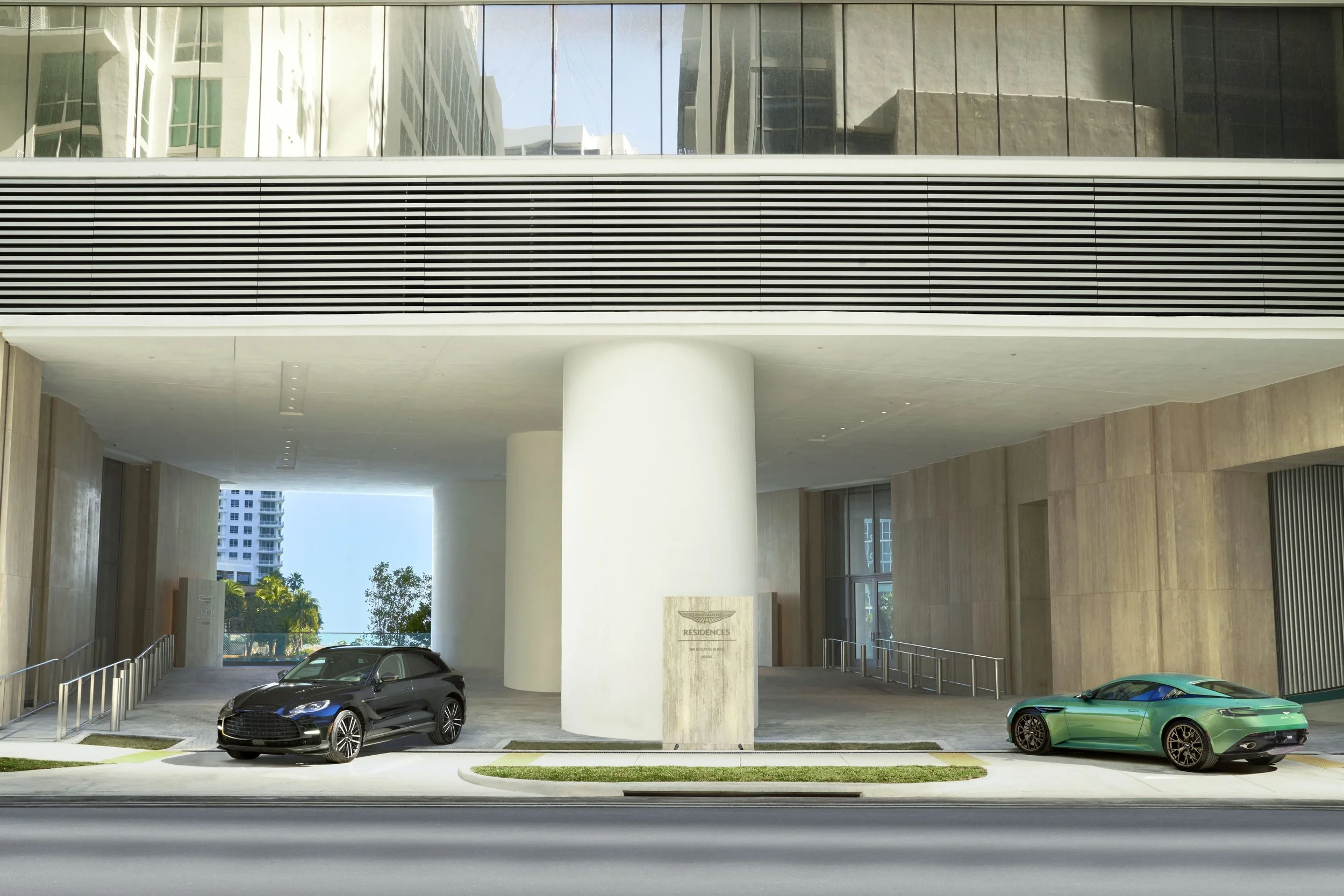
Image © Aston Martin Lagonda. Used for editorial purposes. Aston Martin Residences, Miami.
That can produce extraordinary opportunities. A brand with Aston Martin’s history and international recognition has genuine value far beyond the cars. But it also demonstrates the other side of brand licensing.
When the Aston Martin name is displayed prominently across a £1 billion luxury development, most people seeing the headline won’t immediately distinguish between the company responsible for designing and manufacturing cars and the organisations responsible for constructing a skyscraper. That doesn’t make Aston Martin responsible for alleged defects it didn’t create.
It does mean the company has an understandable reputational interest in how any major project carrying its name performs.
We’ll therefore keep an eye on the legal proceedings and return to the story if there’s a meaningful development or eventual judgment. For now, perhaps the fairest conclusion is simply this: the Aston Martin name helped sell the dream, but responsibility for what lies behind the walls is a much more complicated question, and ultimately one for the courts to determine.
From one rather unusual Aston Martin story to another, we now return to something considerably more familiar: a DB5. Although in Ed Sheeran’s case, what’s happening beneath the bonnet is anything but conventional.
Time for a cuppa?
You’re roughly halfway through Issue 36. From here, we move to Ed Sheeran’s electric DB5, the Meccano AMR25, Oscar India, AM Quarterly and AM Monthly, Vanquish at 25, Bertone’s return, Market Watch, Car of the Week and the latest from FTP.
Ed Sheeran’s DB5 Is Going Electric - But Would You Do This to a Classic Aston?
An unusual story involving Ed Sheeran and his Aston Martin DB5 appeared this week following a case heard at Bradford Magistrates’ Court. Sheeran was fined after the DB5 failed to meet continuous-insurance requirements while it had been away undergoing restoration. According to the report, the car had been with a specialist since 2021 and hadn’t been used on the road during that period. Sheeran said he believed the car was covered while it was in the workshop.
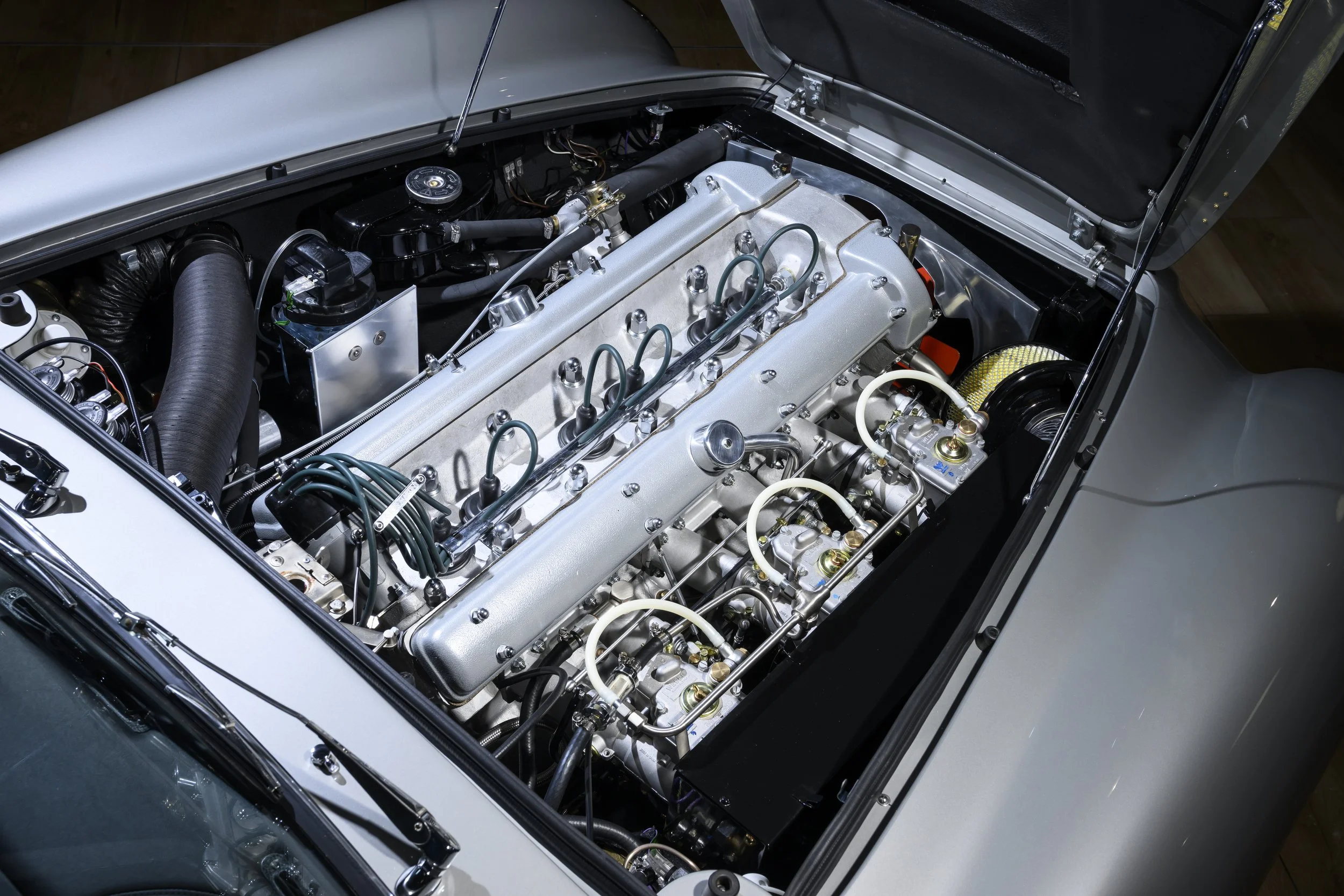
Image © Aston Martin Lagonda. Used for editorial purposes. DB5 Combustion Engine - stunning!
The administrative side of the story is interesting enough, particularly for anyone keeping a classic car off the road for an extended period, but what caught our attention at FTP was what is actually happening to the DB5 itself. It’s being converted to electric power.
The work is being carried out by Aston Workshop, which offers a reversible electric conversion for DB4, DB5 and DB6 models. Its system uses a 60kWh lithium-ion battery and an electric motor producing up to 328hp, with a quoted typical range of around 200 miles. Crucially for a car of this significance, Aston Workshop says the conversion has been engineered so that no irreversible changes need to be made to the chassis. The original engine and associated components can therefore be retained, allowing the car to be returned to its original specification in the future.
This isn’t actually the first time we’ve come across an electrically converted classic Aston Martin at Fuel the Passion.
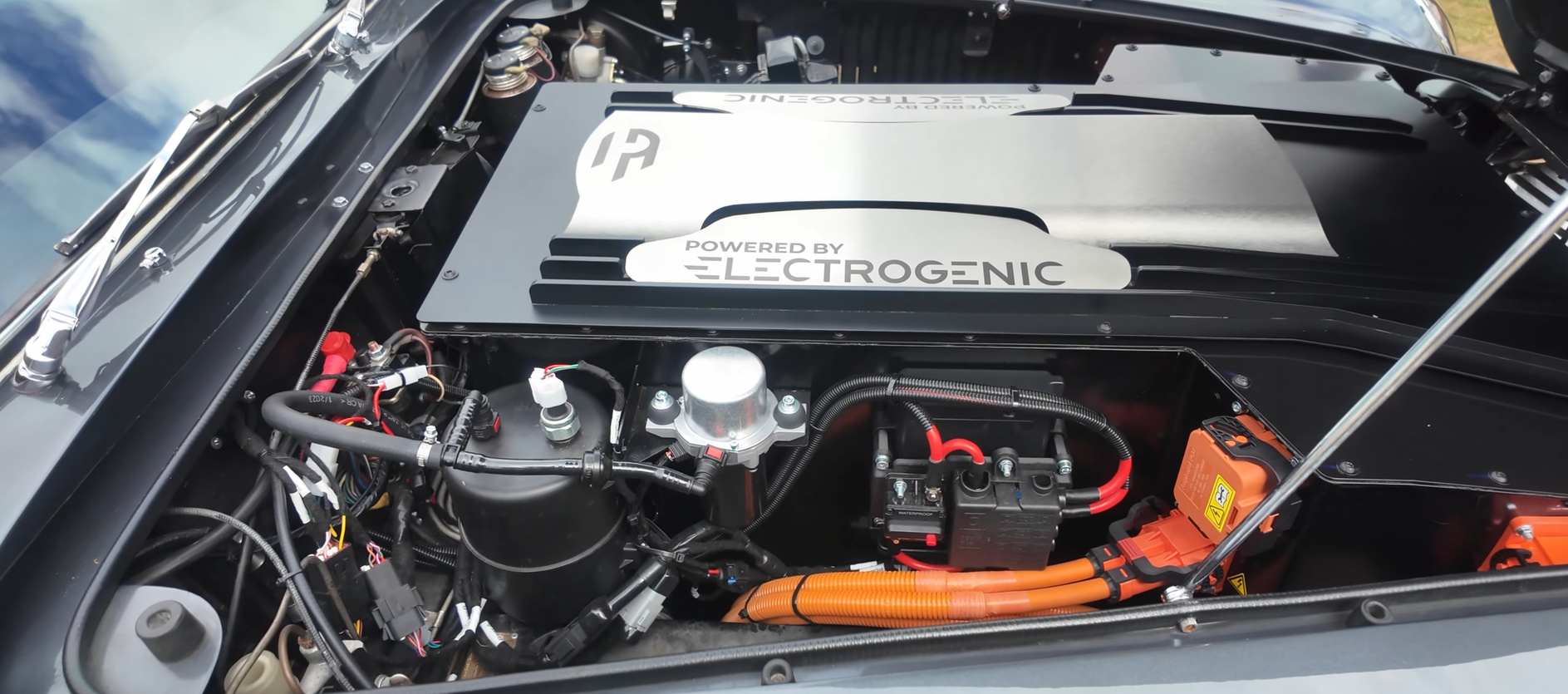
Image © Fuel the Passion
During our visit to Salon Privé at Blenheim Palace last year, we discovered a beautiful Aston Martin DB6 whose original straight-six engine had been removed and replaced with an electric drivetrain.
From the outside the car still looked unmistakably like a DB6, although the absence of an exhaust system provided one of the few obvious clues that something very different was happening underneath. I remember standing beside it and not being entirely sure how I felt about what I was looking at.
Later in the film, we watched the DB6 glide almost silently past the Salon Privé stage. A shape normally accompanied by the familiar sound of an Aston Martin straight-six suddenly moved through the crowd with barely a whisper. The conversion was also described as reversible, meaning the batteries and electric system could ultimately be removed and the combustion engine reinstated.
For anyone who would like to see that car for themselves, we’ll leave the film below taking you directly to the relevant section of our FTP film:
That brings us to the much more interesting question, one which we asked after we published the film above; Would You Convert a Classic Aston Martin to Electric Power? I suppose there are arguments on both sides.
A reversible conversion could potentially allow a classic Aston Martin to remain usable in circumstances where emissions restrictions, fuel availability or maintenance of an ageing original drivetrain might otherwise make ownership increasingly difficult. The original engine can be preserved rather than destroyed, and the car can theoretically be returned to factory specification later. There’s also something intriguing about combining one of the most beautiful shapes Aston Martin has ever produced with quiet, effortless electric power. But then there’s the other side.
For many of us, the engine isn’t simply the mechanism that moves a DB5 or DB6 down the road. The sound, vibration, smell, gearbox and mechanical character are part of the experience, part of what makes an old Aston Martin feel like an old Aston Martin.
Remove the straight-six and, even if the body, cabin and steering remain untouched, have you removed part of the car’s soul with it?
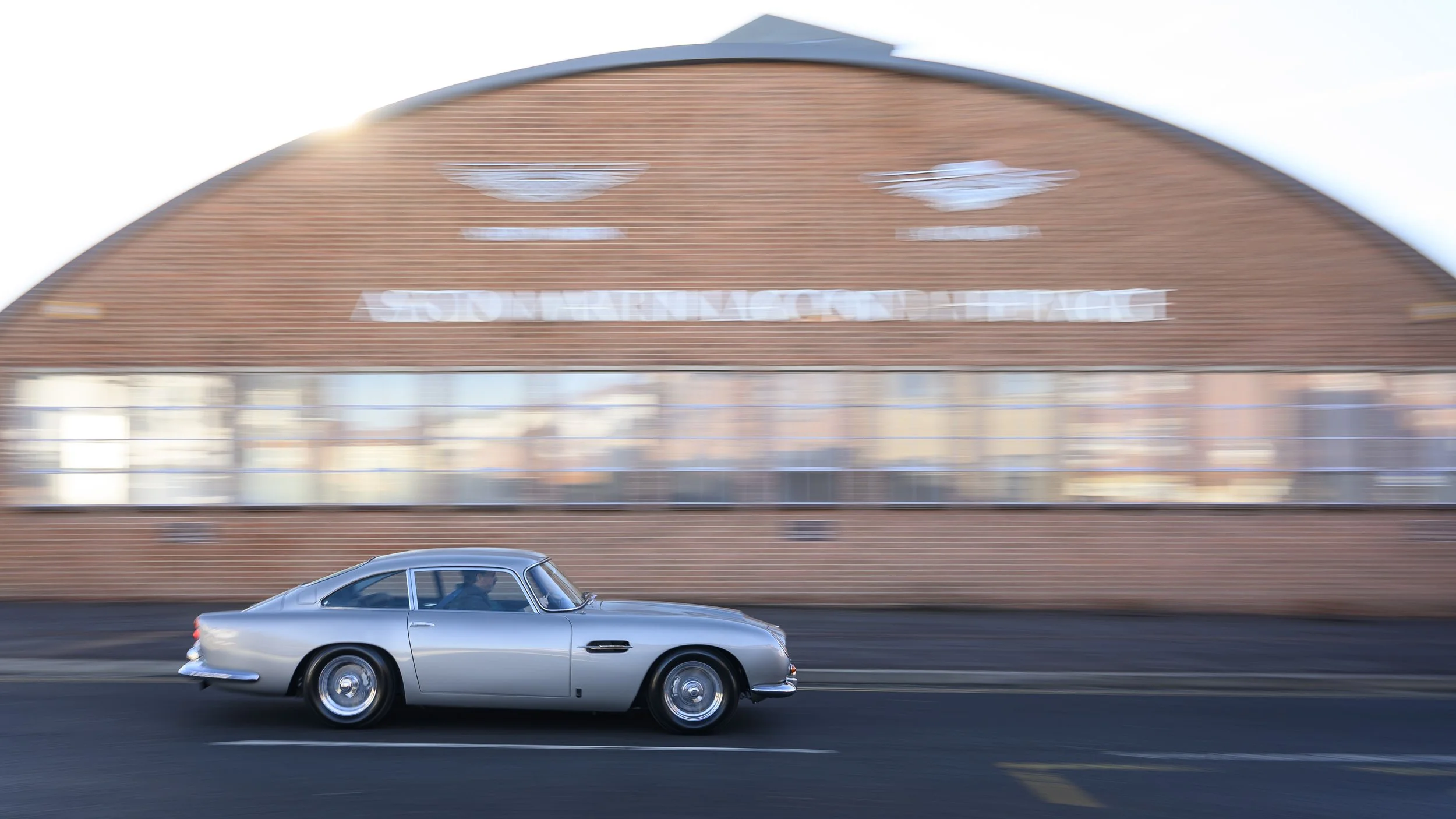
Image © Aston Martin Lagonda. Used for editorial purposes. A 1965 DB5 Vantage restored at Aston Martin Works.
That was the question I found myself asking at Blenheim, and Ed Sheeran’s DB5 has brought it straight back again. There probably isn’t one correct answer. A reversible conversion is very different from permanently modifying an irreplaceable historic car, and ultimately owners will make their own decisions about how they want to use and preserve them. But I’d genuinely love to know what FTP readers think.
Would you ever remove the combustion engine from a classic Aston Martin and replace it with electric power, even if the conversion were completely reversible? Or is the original engine simply too important a part of the car’s character to remove?
Let us know in the comments at the end of this roundup, below 👇.
Affiliate link note: Some links may be affiliate links, which means Fuel the Passion may earn a small commission if you purchase through them, at no extra cost to you. Thank you for your support.
An AMR25 You Can Build Yourself
We can end this part of the Roundup on something considerably lighter. The Meccano Pro Aston Martin Aramco Formula One car is due for global release this month, giving those of us who enjoy slightly more mechanical model building an opportunity to construct an AMR25 without needing access to the Silverstone factory.
For anyone tempted by this one, just click on the picture below, so you can take a closer look at the Meccano Aston Martin AMR25 and see the full specification for yourself. (This is not an affiliate link).
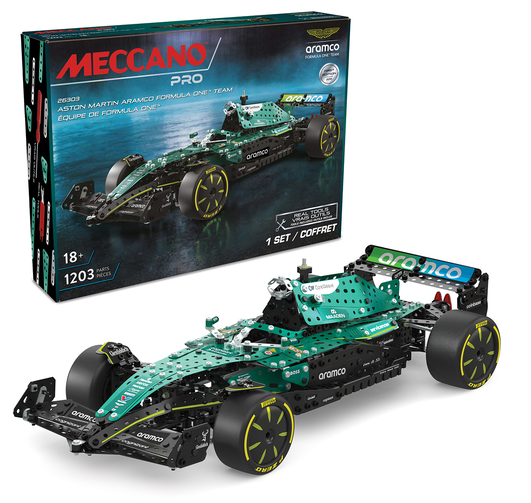
Image © Meccano & thetoyshop.com. Used for editorial purposes.
The officially licensed model is built at 1:8 scale and is aimed at experienced adult builders, with working steering, a functioning engine mechanism and movable Drag Reduction System, or DRS, among its features. Aston Martin Aramco also became the first Formula One team to collaborate with Meccano on an officially licensed product of this type.
It’s another example of just how wide the Aston Martin world has become. In the space of a few paragraphs we’ve travelled from luxury apartments in Miami, to a converted DB5 in Yorkshire and finally to an AMR25 waiting to be assembled on somebody’s dining-room table.
Next, however, we’re turning the clock backwards. Because this week’s heritage stories include one wonderfully distinctive Oscar India, a package arriving through the letterbox from the Aston Martin Owners Club, a welcome mention for FTP from the Aston Martin Heritage Trust, and some very timely news from Bertone that connects beautifully with one of the stars of our latest film.
Heritage, Community and a Few Familiar Aston Martins
After everything from electric conversions to Formula One models, it feels like a good time to settle into another part of the Aston Martin world I particularly enjoy, the cars, stories and people that keep the marque’s history alive, and we’ll begin with a car carrying one of the more unusual names in Aston Martin history.
A Civilised Beast - Rediscovering the Oscar India
Regular FTP supporter George Johnson kindly pointed me towards a recent film from the Number 27 YouTube channel entitled The Most Luxurious Car Aston Had Ever Built - Aston Oscar India V8 (1979). The car belongs to Keith and Suzanne Loveday, fellow Aston Martin Owners Club members, and it’s a particularly lovely example of an era of Aston Martin that perhaps doesn’t always receive the attention it deserves.
For anyone wondering what on earth “Oscar India” means, it refers to the substantially revised Series 4 version of Aston Martin’s V8 introduced in 1978. The widely accepted explanation is that the name came from “October Introduction”, with Oscar and India representing O and I in the phonetic alphabet. The update was unveiled at the Birmingham International Motor Show that October.
The changes weren’t revolutionary individually, but together they gave the V8 a more resolved character. The open bonnet scoop of the earlier cars disappeared beneath a smoother power bulge, an integrated rear spoiler tidied the tail and the interior became noticeably more luxurious, with extensive leather and burr-walnut trim, and then, of course, there’s that 5.3-litre V8.
Number 27’s film gives Keith and Suzanne’s car a proper workout and reveals that this particular example isn’t entirely standard either. Keith has fitted a six-speed manual conversion, while the car also benefits from X-Pack suspension. The result appears to retain the grand-touring character of the Oscar India while adding a little more driver involvement. I can understand why George thought we’d enjoy it.
We’ve Met an Oscar India Before
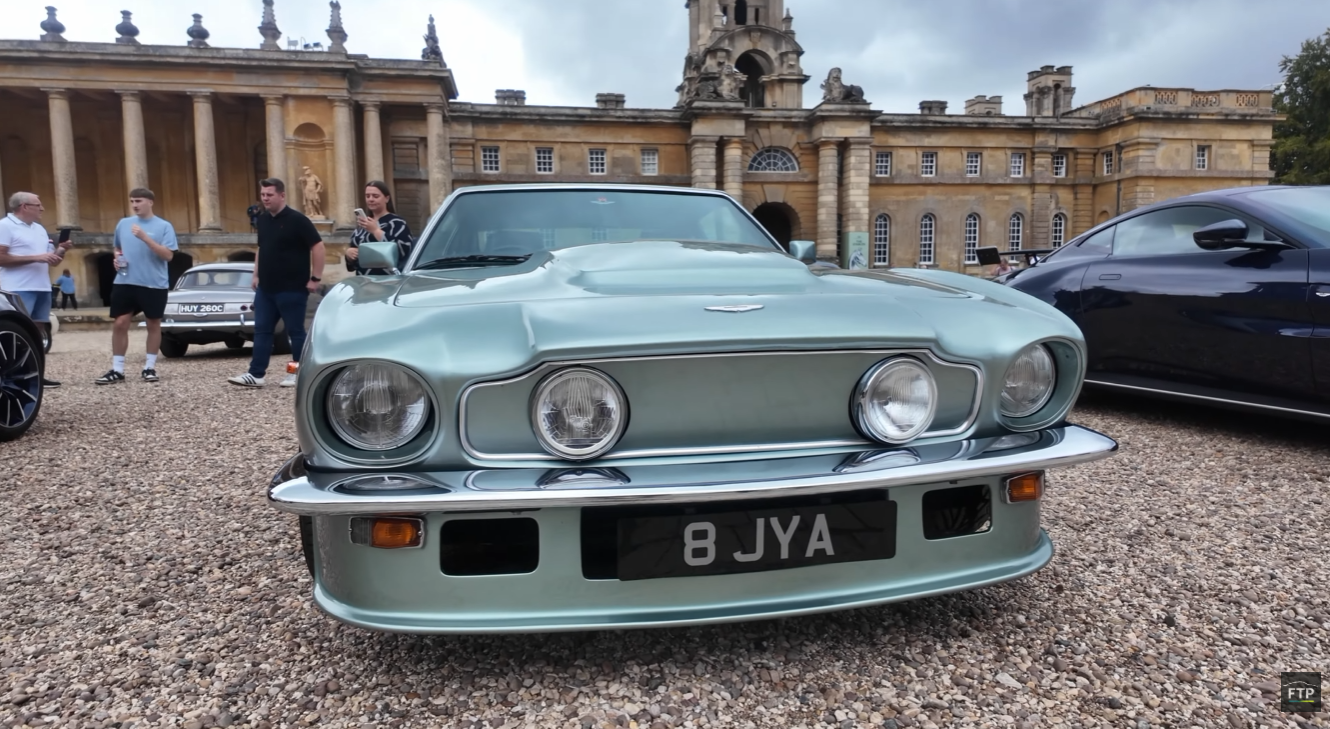
Image © Fuel the Passion. Screenshot from FTP Film ‘Everyone Stopped For This!’
There’s also a nice connection with the FTP archive. During our visit to Salon Privé at Blenheim Palace last year, (the video we’ve featured above, with the electronic powered DB6), we spent some time looking around a beautiful 1979 Aston Martin Vantage in Oscar India specification. Its smooth bonnet bulge, integrated rear treatment and wonderfully period interior immediately stood out amongst an extraordinary collection of cars.
So if Number 27’s film leaves you wanting another look at this fascinating period of Aston Martin history, I’ll also leave a link to the relevant section of our own Blenheim Palace film.
Watch below: Number 27 - The Most Luxurious Car Aston Had Ever Built – Aston Oscar India V8 (1979)
From the FTP Archive - our 1979 Oscar India Vantage at Salon Privé - Click HERE. A big thank-you to George for sending the Number 27 film our way. Suggestions like this are always welcome, particularly when they lead us back towards an Aston Martin with such an interesting story.
A Welcome Delivery from the Aston Martin Owners Club
There was another rather pleasant Aston Martin moment this week when the latest AM Quarterly and AM Monthly arrived through the letterbox.
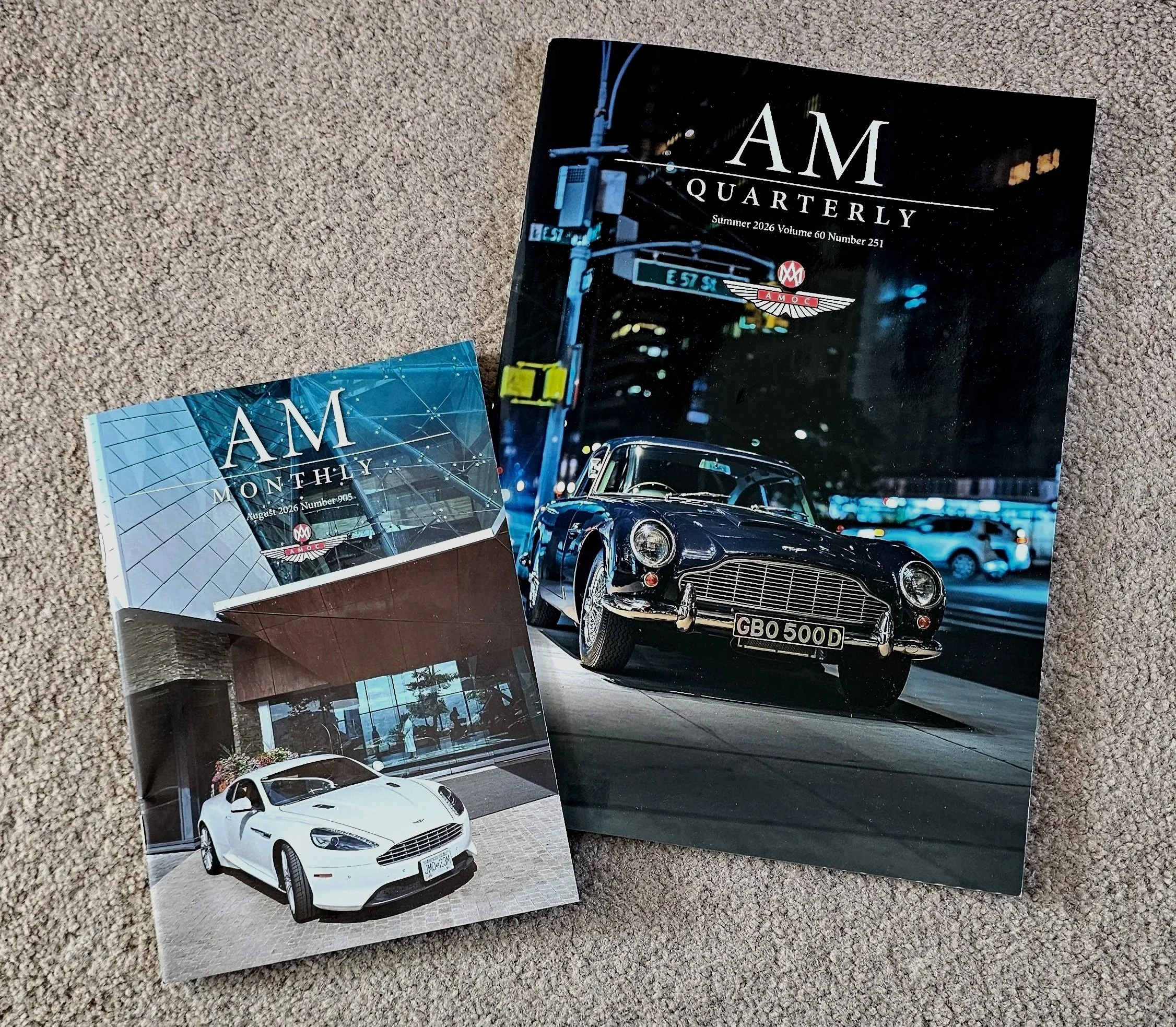
Image © Fuel the Passion, front covers Aston Martin Owners Club. Used for editorial purposes.
I always enjoy receiving these. There’s something very different about sitting down with a proper printed magazine rather than endlessly scrolling through another screen, particularly when there are so many familiar cars and subjects inside.
One story in the Summer edition of AM Quarterly immediately caught my eye: From New York With Love, following a DB5 that spent time being enjoyed on the roads of London before making the journey across the Atlantic to New York, with California eventually also on the itinerary. “Enjoyed” really is the appropriate word.
The philosophy behind the car is that it was bought to be driven rather than hidden away…
…something illustrated beautifully by photographs of the DB5 making its way through London and later the streets of New York. That rather resonated with me.
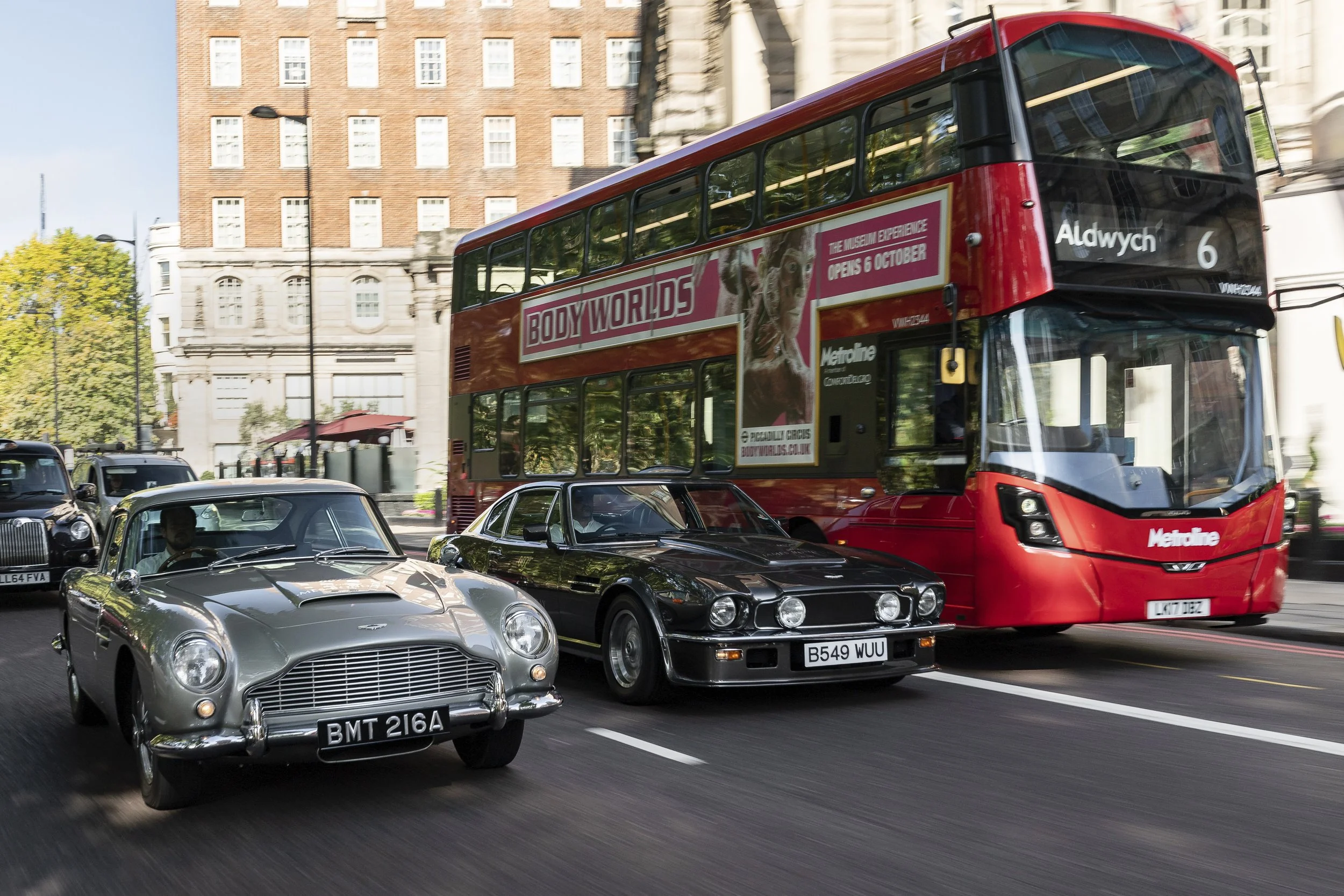
Image © Aston Martin Lagonda. Used for editorial purposes. International James Bond Day.
I only wish I’d spotted it while it was still travelling around London. A DB5 is hardly inconspicuous at the best of times, but threading one through Manhattan must create quite a reaction.
It also took me straight back to the incredible collection of James Bond Aston Martins we saw in London during International James Bond Day, (held every year on 5th October) proof, if ever it were needed, that certain Aston Martins can still bring a city street almost to a standstill.
There’s more to the story than simply moving the car from one great city to another. Before leaving Britain, the DB5 underwent a carefully considered programme of work intended to make it more dependable and enjoyable in modern use while preserving the character that makes it so special. The article then follows the car into a completely different environment, where those changes begin to make perfect sense.
It’s exactly the sort of feature that makes AM Quarterly such an enjoyable read: a beautiful Aston Martin, a strong sense of place and an owner determined to use the car rather than preserve it as a static object. That’s only one story in a particularly varied Summer edition, with plenty more covering heritage, restoration, ownership, motorsport and significant Aston Martins from across the Club.

Affiliate link note: Some links may be affiliate links, which means Fuel the Passion may earn a small commission if you purchase through them, at no extra cost to you. Thank you for your support.
Vanquish at 25 - The Celebrations Continue
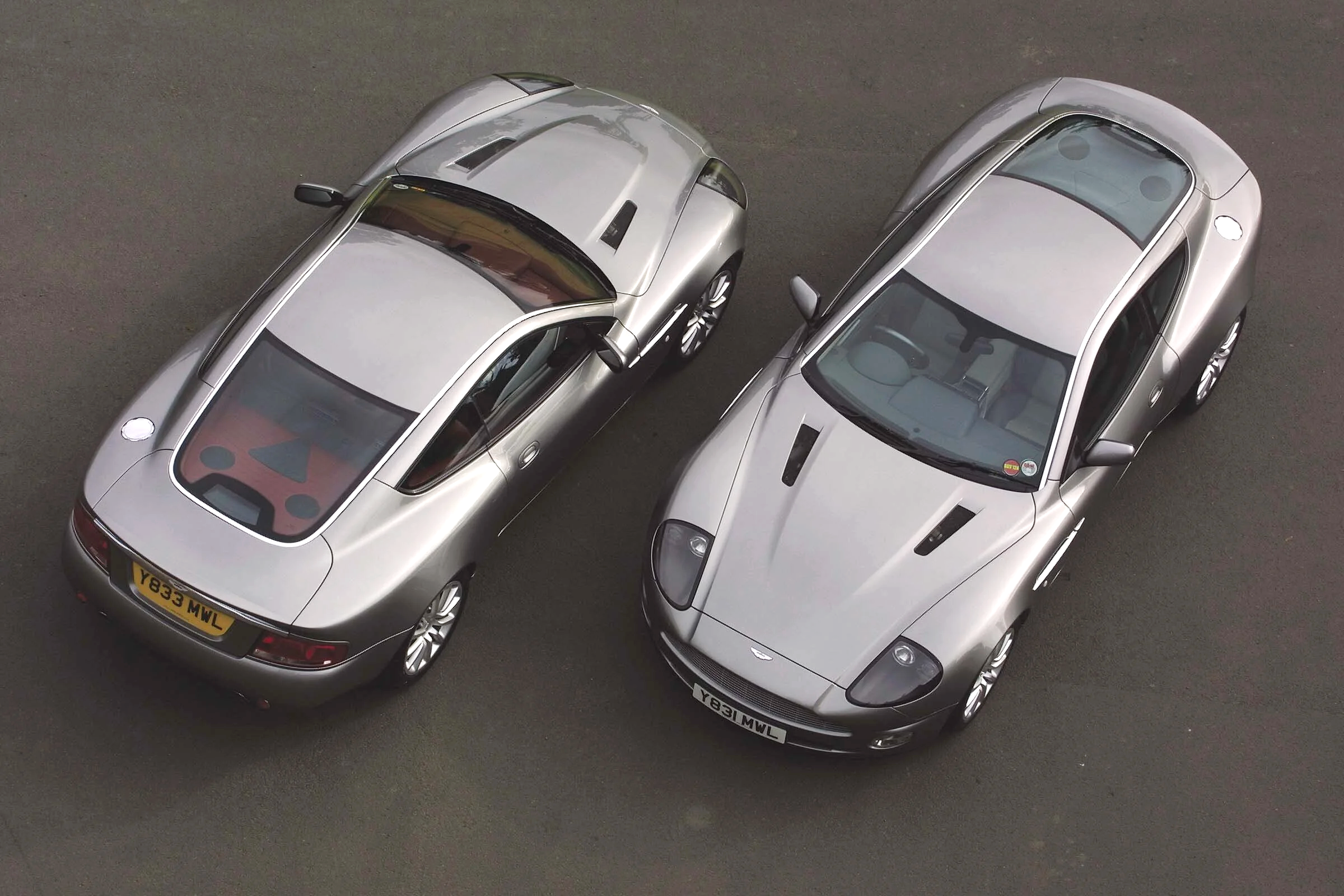
Image © Aston Martin Lagonda. Used for editorial purposes. Vanquish, First Generation.
There’s another very familiar subject inside AM Quarterly too. “Unvanquished: Why the Newport Pagnell Vanquish is a Car for the Ages” celebrates the first-generation Vanquish during its 25th-anniversary year, and naturally this was one I was never going to flick past quickly.
The feature looks back at what made the original Vanquish such an unusual and significant Aston Martin. There’s Ian Callum’s beautifully judged design, the naturally aspirated V12 beneath that long bonnet and, perhaps most importantly, the fascinating way the car brought together two different periods of Aston Martin history. It was still built at Newport Pagnell and carried much of the craftsmanship and character associated with that famous factory, yet underneath it introduced construction techniques and technology that pointed firmly towards Aston Martin’s future.
The article also touches on one of the subjects that continues to provoke plenty of discussion amongst Vanquish enthusiasts: the original paddle-operated transmission and the relatively small number of cars subsequently converted to a six-speed manual by Aston Martin Works. Alongside that are some lovely photographs of the cabin, V12 engine and those unmistakable Ian Callum lines.
I won’t give too much more away, because this is one of those features best enjoyed properly with the magazine in front of you. What comes across particularly strongly is just how difficult the first-generation Vanquish is to place neatly into one era of Aston Martin history, and perhaps that’s precisely why it’s become so interesting with the passing of time.
It feels fair to say the Vanquish’s 25th anniversary has been well and truly celebrated this year, and we’re not finished yet at FTP either.
Our first-generation FTP Aston Martin Buyers Guide is now live, our films with the Aston Martin Heritage Trust have already taken viewers beneath the skin of the car, and there’s still our coverage from the AMOC Vanquish celebration at the British Motor Museum to come. We’re also waiting, fingers firmly crossed, for final Aston Martin approval on another particularly special Vanquish film. There’s plenty more Vanquish to come from us, but if you receive AM Quarterly, Charles Churchill’s Unvanquished is certainly worth settling down with first.
Fancy reading the full Vanquish feature for yourself?
If you love Aston Martin but you’re not yet a member of the Aston Martin Owners Club, membership includes both AM Quarterly and AM Monthly, together with access to the Club’s wider community, events and member benefits. If that sounds like something you’d enjoy, click the “Love Aston Martin?” box below to find out more;
A Lovely Mention from the Aston Martin Heritage Trust
Opening AM Monthly brought an especially nice surprise. Within the Aston Martin Heritage Trust pages is a section devoted to the first-generation Vanquish, accompanied by imagery from one of the videos FTP created as part of this year’s 25th-anniversary celebrations. That was genuinely lovely to see.
The relationship we’ve developed with the Aston Martin Heritage Trust has allowed us to share parts of the marque’s history that would otherwise be extremely difficult to bring to the channel. Access to the collection is one part of that, but equally valuable is the knowledge, time and enthusiasm so generously shared by the people around the Trust.
Our Vanquish films are a good example. Being able to explore the car alongside the people and material held by AMHT has helped us tell the story with considerably greater depth than simply standing beside a finished car and describing what we can see.
So, simply: Thank you, AMHT.
AMHT weren’t the only Aston Martin organisation to give Fuel the Passion a rather lovely mention recently. The Aston Martin Owners Club also circulated an email to its membership looking back at the Club’s Spring Weekend at Alnwick Castle, specifically thanking me as a Club member for sharing our film bringing together the highlights from the weekend.
AMOC included a direct link to the FTP film before looking ahead to its forthcoming Autumn Weekend at Bowood Estate on 26th and 27th September.
I wasn’t expecting that either, and it was genuinely appreciated.
Our Alnwick film, Unforgettable, became much more than simply a record of another Aston Martin gathering. There were wonderful cars, spectacular locations and plenty of driving, but some of my strongest memories came from meeting the people behind those cars and hearing what ownership means to them.
For AMOC to then share that film with its wider membership feels particularly special because those are, ultimately, their stories too.
It’s also rather nice that within such a short period FTP’s work has been acknowledged by both the Aston Martin Heritage Trust and the Aston Martin Owners Club. They fulfil different roles within the Aston Martin world, but both contribute enormously to preserving the history, knowledge, cars and community surrounding this remarkable marque.
Fuel the Passion remains an independent enthusiast project, and support like this is never something I want to take for granted.
So, thank you AMOC. It really is appreciated.
There’s plenty more happening within AM Monthly too. One story worth mentioning is the latest chapter of Phil and Will Churchill’s Vantage World Tour, following their Australian leg. Their V8 Vantage covered around 3,500 miles in just 11 days, taking in locations including Mount Panorama and the extraordinary 90 Mile Straight across the Nullarbor before reaching Perth.
Their Vantage has now travelled through 33 countries, with the journey continuing to raise funds for the Campaign Against Living Miserably, or CALM. It’s another wonderful example of an Aston Martin being properly used: covering serious distances, experiencing different parts of the world and accumulating the sort of memories no garage queen ever could.
There are plenty of other stories across both AM Monthly and AM Quarterly, so if you’re an AMOC member and those magazines have recently arrived through your own letterbox, they’re well worth setting aside some time for.
From owners and organisations keeping Aston Martin history alive, we finish this part of the Roundup with another famous name doing something rather similar, because, quite unexpectedly, Bertone appears to be writing a new chapter of its own.
Bertone Is Back - And Expanding
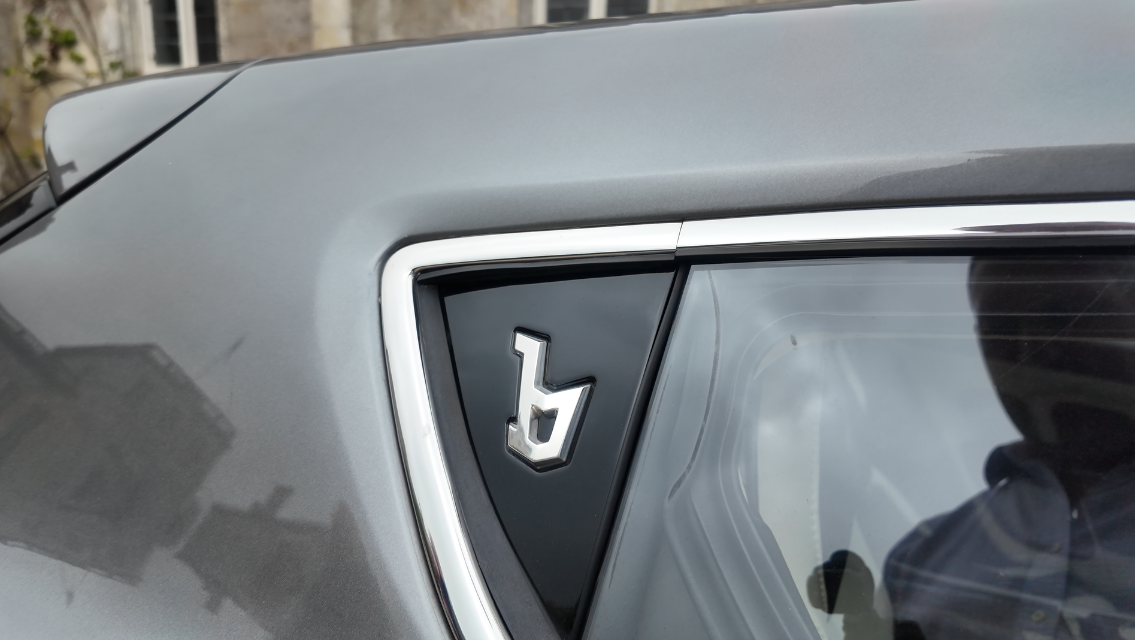
Image © Fuel the Passion. Aston Martin Bertone Jet 2+2.
This story arrived at almost the perfect moment. One of the stars of our new Wilton House Concours des Légendes film is the extraordinary Aston Martin Bertone Jet 2+2 the unique shooting-brake interpretation of the Rapide created for Aston Martin’s centenary in 2013.
In the film, we explain that the Jet 2+2 became the final car produced by Bertone before the company folded, and that remains an accurate description of the original Bertone operation. The Jet 2+2 was completed in 2013, and plans for a possible small production run disappeared when Bertone ceased trading the following year.
But happily, that wasn’t the end of the Bertone name. The historic brand was subsequently revived under Mauro and Jean-Franck Ricci, with the modern Bertone announcing its return as a limited-production coachbuilder through the GB110, unveiled in December 2022, and this week brought another encouraging sign of where the reborn company is heading.
Magneto reports that Bertone is expanding its atelier at Roquebrune-sur-Argens on the French Riviera from what has principally been a design studio and showroom into a much more complete coachbuilding facility. The expanded site is due to gain facilities for vehicle assembly and development, paintwork, surface and metal finishing, coachbuilt bodywork and bespoke interior trim. It will operate alongside Bertone’s existing production and engineering activities in Italy.
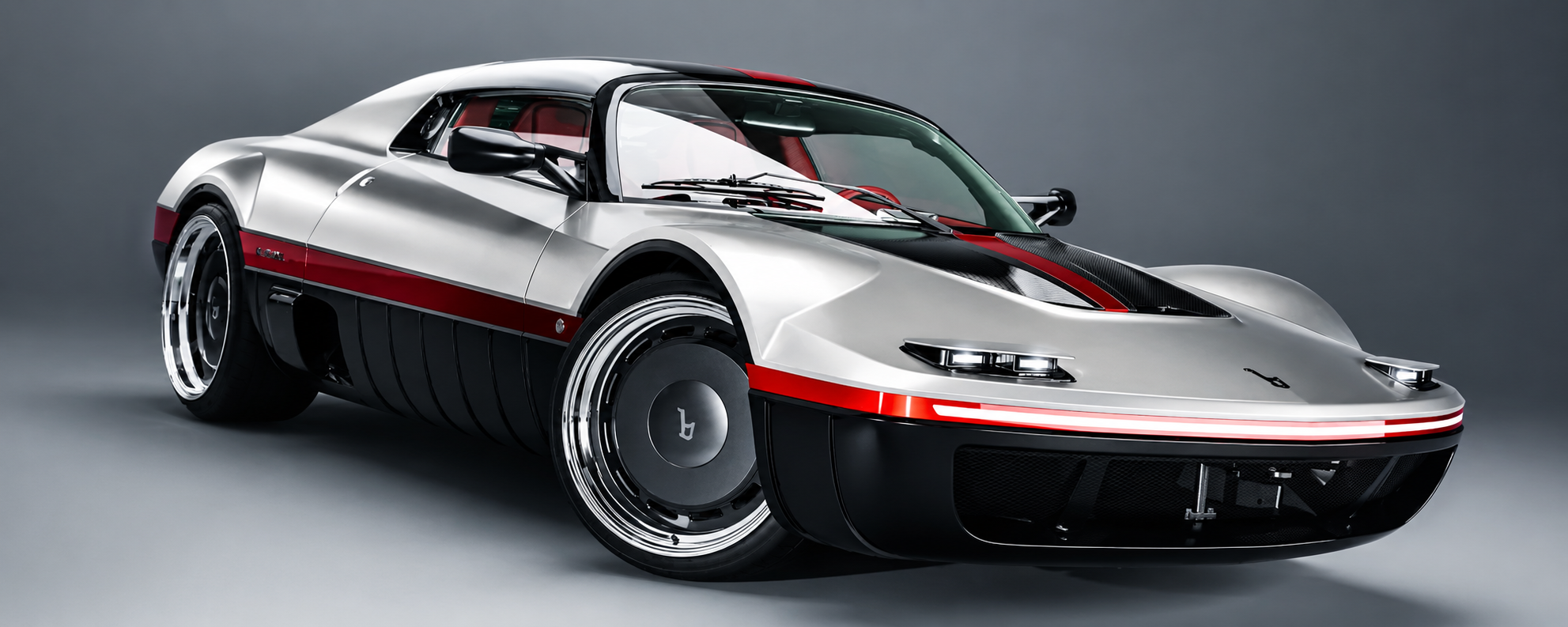
Image © Bertone. Used for editorial purposes. Bertone Runabout.
The move follows renewed interest generated by the Runabout, Bertone’s modern interpretation of its 1969 concept, which was unveiled at Rétromobile this year and is limited to just 25 examples at €390,000 plus taxes. No timetable or investment figure for the French expansion has yet been disclosed, but the direction is certainly interesting. I must admit, it does look rather good. What do you think? Let me know your comments below. 👇
That inevitably leaves me with one slightly mischievous FTP thought.
Does Bertone Have Some Unfinished Business with Aston Martin? Could Bertone and Aston Martin ever write another chapter together?
Their history stretches considerably further back than the Jet 2+2. Yet that remarkable shooting brake became an unexpectedly final statement from the original Bertone company just as plans were apparently being considered to build more of them. Now Bertone is once again talking seriously about coachbuilding, one-offs and very limited-production cars.
There’s absolutely no suggestion that a new Aston Martin collaboration is planned, and we shouldn’t pretend otherwise, but perhaps Bertone has a little unfinished business with Aston Martin. Could somebody one day hand the revived Italian design house another Aston Martin and simply say: “Show us what you would do with this”? I’d rather like to see the answer.
For now, we’ll simply watch where this renewed Bertone story goes, and if you’d like to see the extraordinary Jet 2+2 that prompted the thought, it features prominently in our latest FTP film from Wilton House.
Market Watch - A Vanquish Zagato Volante Heads to Monterey
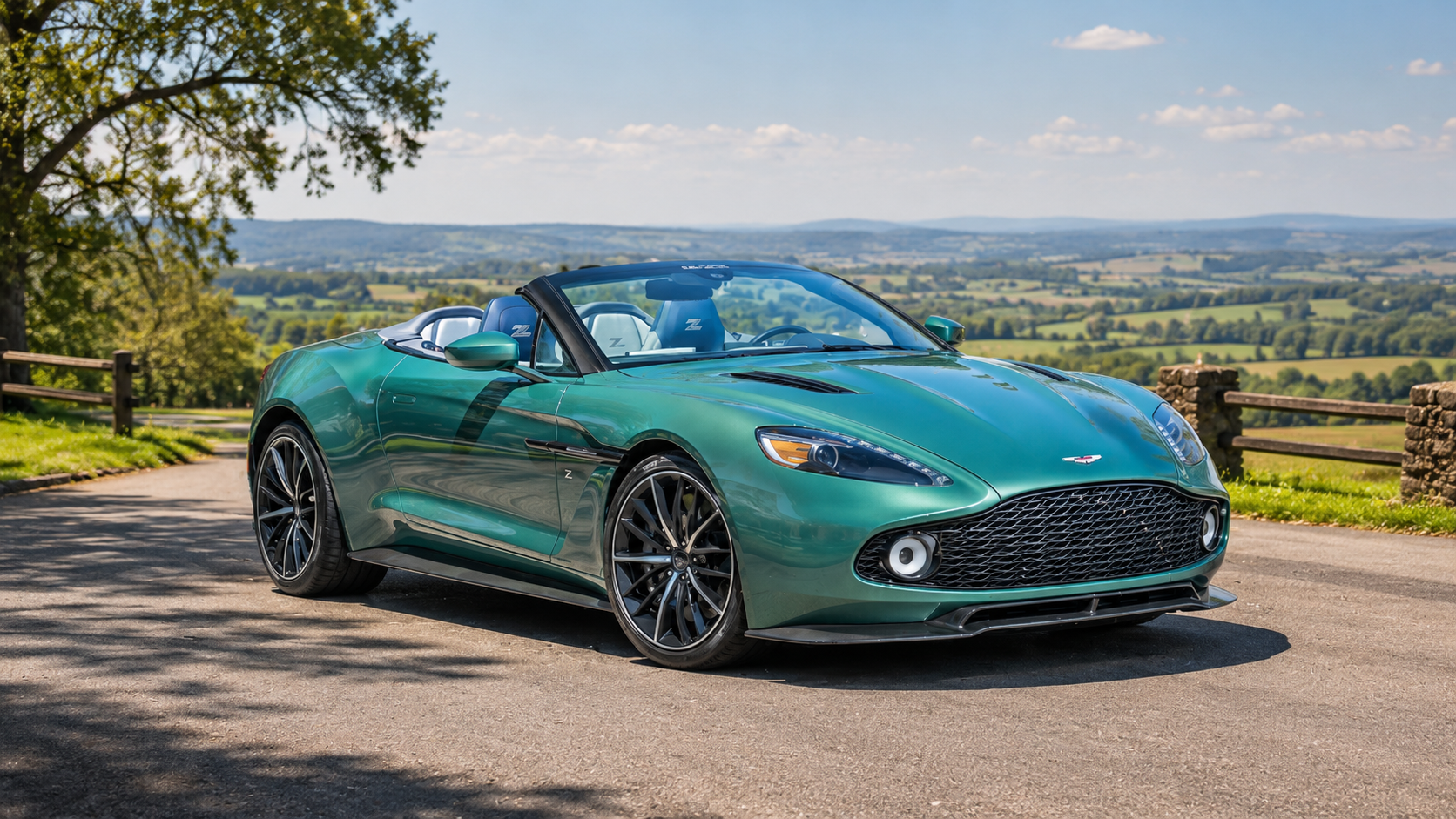
Image © Fuel the Passion. Image used for illustrative purposes.
We’ve deliberately kept Market Watch fairly light this week, but there’s one Aston Martin worth putting on the radar ahead of next weekend. RM Sotheby’s is offering a 2018 Aston Martin Vanquish Zagato Volante at its Monterey auction, taking place between 13th and 15th August.
The car is number 87 of just 99 Vanquish Zagato Volantes produced and has covered approximately 2,046 miles. RM Sotheby’s has placed an estimate of $375,000-$425,000 on the car.
Open Aston Martins carrying Zagato bodywork have always been particularly scarce. Before this Vanquish there had been the V8 Vantage Zagato Volante of 1987 and the DB AR1 of 2003, making the Vanquish Zagato Volante only the third jointly produced open Aston Martin-Zagato model.
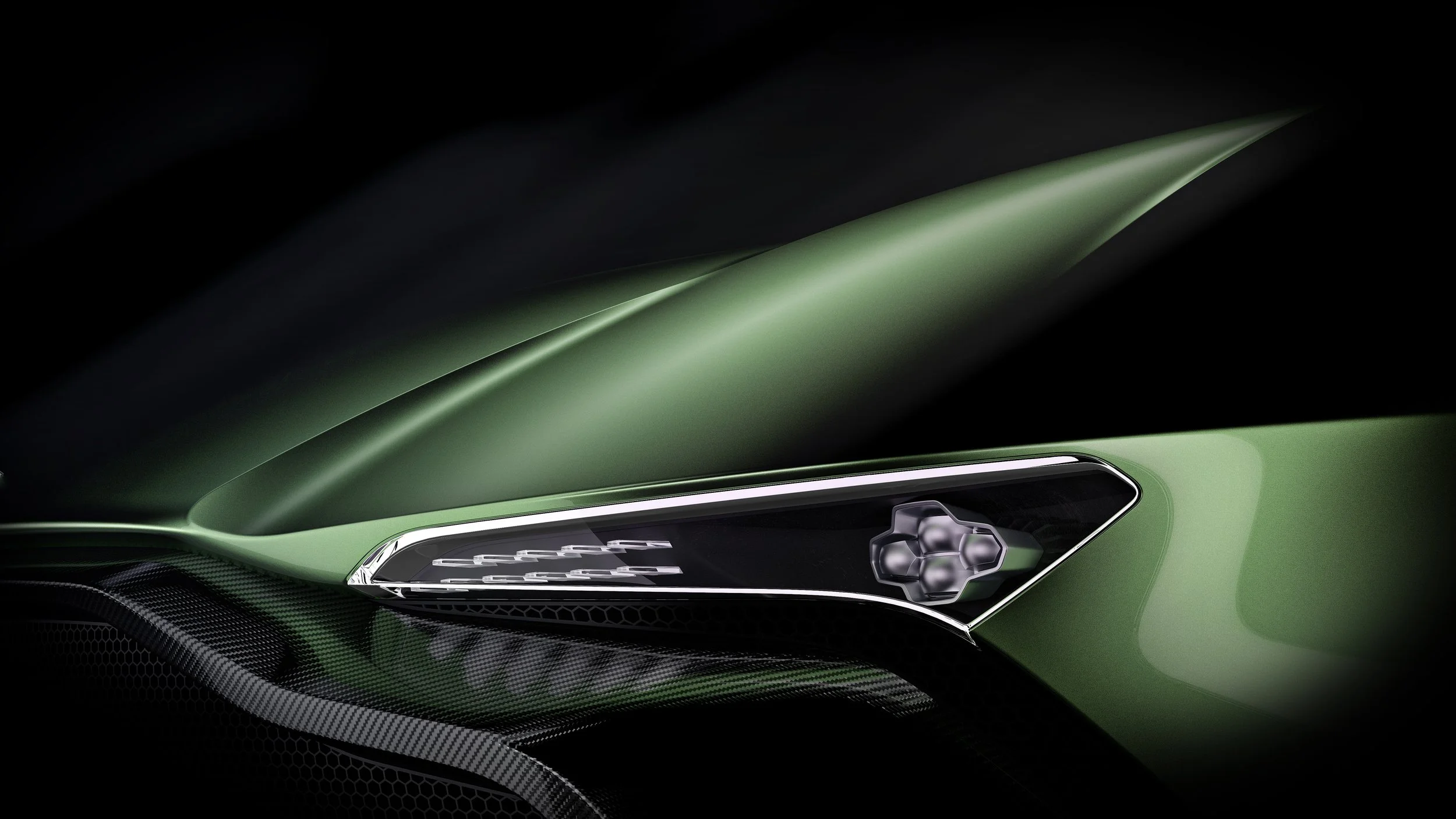
Image © Aston Martin Lagonda. Used for editorial purposes. Aston Martin Vulcan.
The Volante formed part of the remarkable Vanquish Zagato family created towards the end of the second-generation Vanquish era, combining Aston Martin’s naturally aspirated 5.9-litre V12 with Zagato’s much more theatrical interpretation of the bodywork. Its twin rear cowls echoed Zagato’s famous double-bubble roof treatment, while details elsewhere drew inspiration from cars including the Vulcan and One-77.
Alongside the Coupé, Speedster and Shooting Brake, the Volante helped turn what began as another Aston Martin-Zagato collaboration into an entire family of very limited-production cars.
This particular example certainly isn’t short of specification. Delivered new to California, it’s finished in Q by Aston Martin Almond Green with an Atlantic Blue soft-top, while the interior combines Aurora Blue and Argento Grey leather with carbon-fibre and satin-bronze detailing. Those colours work beautifully together and, judging by the photographs, give the car a rather more elegant character than some of the more extrovert Zagato specifications.
Its low mileage is supported by comparatively recent maintenance too. RM Sotheby’s notes that an official Aston Martin dealership in Mexico City carried out work in December 2023 including fluid and filter changes, a replacement battery and injector cleaning.
We’ll resist getting too carried away with the estimate because, as always, the more interesting number is the one reached when the bidding stops. With our second-generation Vanquish Buyers Guide currently being researched, this is also a particularly timely sale for FTP. It’ll be interesting to see how collectors currently value one of the rarest and most distinctive members of the Vanquish family.
So rather than try to predict the outcome, we’ll simply make a note of it this week and come back to the car in Issue 37, once Monterey has given us an actual result to discuss.
FTP Car of the Week - 1990 Aston Martin V8 Vantage Zagato - 600 Miles from New
After spending part of this week talking about Bertone, another famous Italian name provides us with a rather fitting FTP Car of the Week. Currently offered for sale by Nicholas Mee & Company is an extraordinary Aston Martin V8 Vantage Zagato, first registered in January 1990 and showing just 600 miles from new. Finished in its original Gladiator Red with Parchment Connolly hide piped in red, it looks every bit as dramatic today as the Vantage Zagato did when it first appeared in the mid-1980s, and dramatic is probably the right word.
Nicholas Mee & Company released a video just under five minutes long about this very car, which I’ve included below. It’s well worth a watch. The film appeared a couple of weeks ago, but I was waiting for the right opportunity to feature both the car and the video here in the Roundup.
The V8 Vantage Zagato has never been an Aston Martin that disappears quietly into the background. Aston Martin renewed its relationship with Italian coachbuilder Zagato in the mid-1980s with the intention of creating something shorter, lighter and faster than the already formidable V8 Vantage. The wheelbase was reduced, the rear seats disappeared, weight was cut and Zagato clothed the car in an aerodynamically developed aluminium body incorporating flush glazing and that unmistakable bonnet bulge. Aston Martin says all 50 production coupés were pre-sold before customers had even had much opportunity to digest the finished design. The styling certainly divided opinion.
Its bluff nose, enormous bonnet bulge, truncated tail and almost geometric surfaces were a dramatic departure from the traditional Newport Pagnell V8. Yet nearly 40 years later, perhaps that uncompromising appearance has become one of the reasons the car is so interesting. It looks unmistakably of its period and unmistakably like a Zagato.
Underneath sits Aston Martin’s 5.3-litre V8, with the Vantage Zagato using a highly developed version of Aston Martin’s formidable 5.3-litre V8. In period Aston Martin was chasing a projected 300km/h, around 186mph maximum speed, remarkable performance for a road car of the mid-1980s.
But it’s the history of this particular example that makes it especially unusual. Nicholas Mee says the car was signed off by production in November 1987, yet wasn’t first registered until January 1990. Having covered almost no mileage during its life, it has recently undergone a comprehensive recommissioning programme. More than 250 miles of proving and road testing have since been completed, bringing the total mileage to just 600 miles. Nicholas Mee now describes the car as fully functional and ready for the road.
That word, recommissioned, is important with cars like this.
Extremely low mileage can sound automatically desirable, but a machine sitting unused for decades still ages. Fluids, seals, hoses, braking systems and numerous mechanical components require attention whether the odometer is moving or not. In this case, the attraction isn’t simply the remarkable mileage; it’s that considerable work has apparently been undertaken to bring the car back into proper operating condition before sale, and that creates quite a dilemma for its next custodian.
With only 600 miles showing, preservation is understandable. Yet Nicholas Mee has gone to the trouble of recommissioning and extensively road-testing it precisely so that it can be driven again. Personally, I’d struggle to own something this mechanically interesting and never discover what it actually feels like on the road.
A V8 Vantage Zagato was built as a genuine high-performance Aston Martin, not merely as a design exercise. Beneath those controversial lines sits a lightweight, shortened and extremely powerful evolution of one of Aston Martin’s great V8s. Almost four decades later, here is one that has barely begun its life.
The asking price is available on application, which perhaps tells you everything you need to know about the type of collector Nicholas Mee expects to attract. Would you preserve those 600 miles as part of the car’s extraordinary story, or add a few thousand more and finally use it as Aston Martin and Zagato intended? I know which temptation would be strongest for me, and unusually for Car of the Week, this one also brought back a very recent FTP memory.
We’ve Met One of These Before
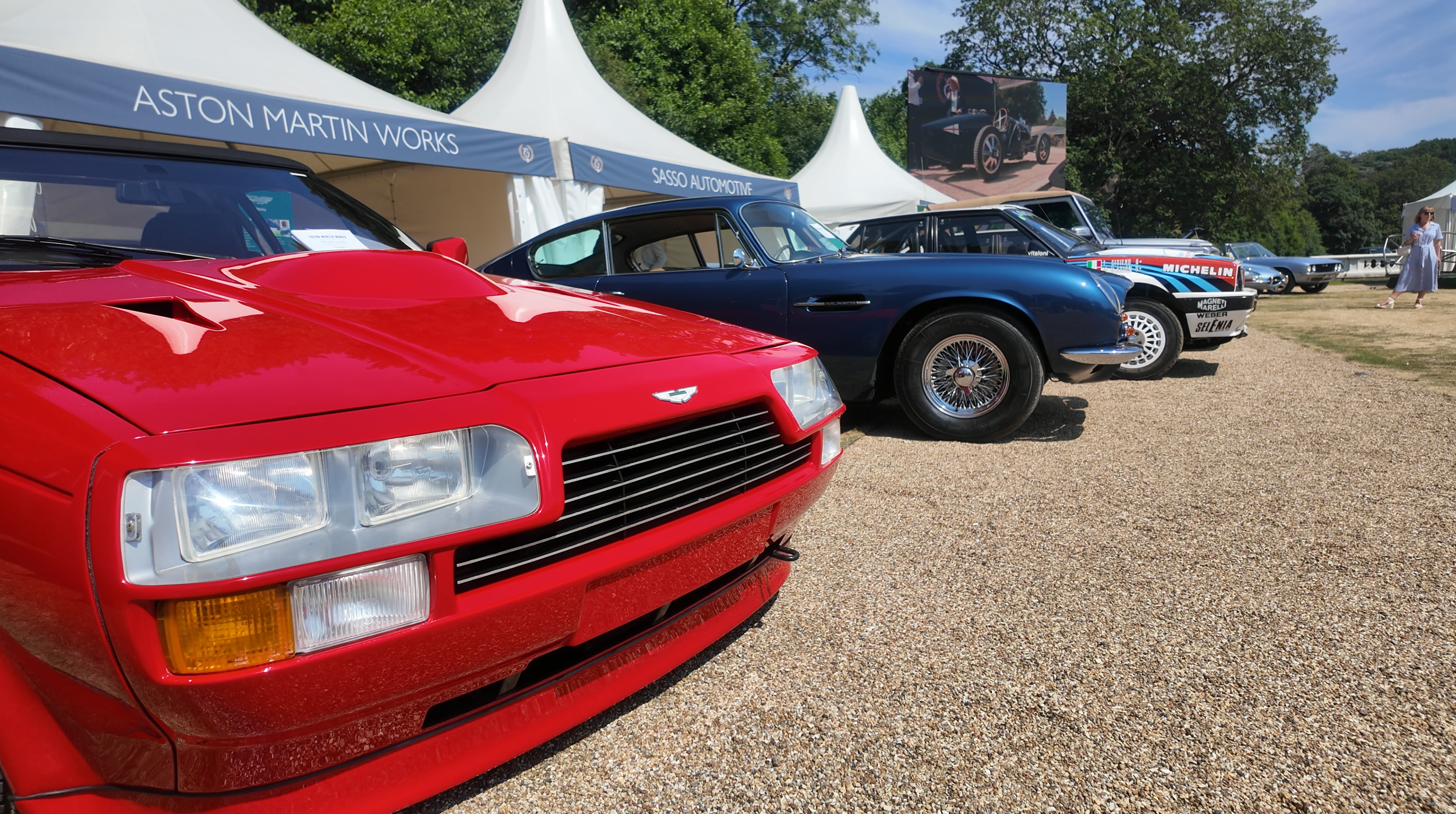
Image © Fuel the Passion. Aston Martin Vantage V8 Zagato and the special DB6 Mk2 Fuel Injection, Yorkshire Elegance 2026.
There’s also a rather nice FTP connection to this week’s Car of the Week. Earlier this summer, while filming at Yorkshire Elegance, Aston Martin Works brought along another remarkable V8 Vantage Zagato, giving me the chance to see one of these extraordinary cars properly in the metal.
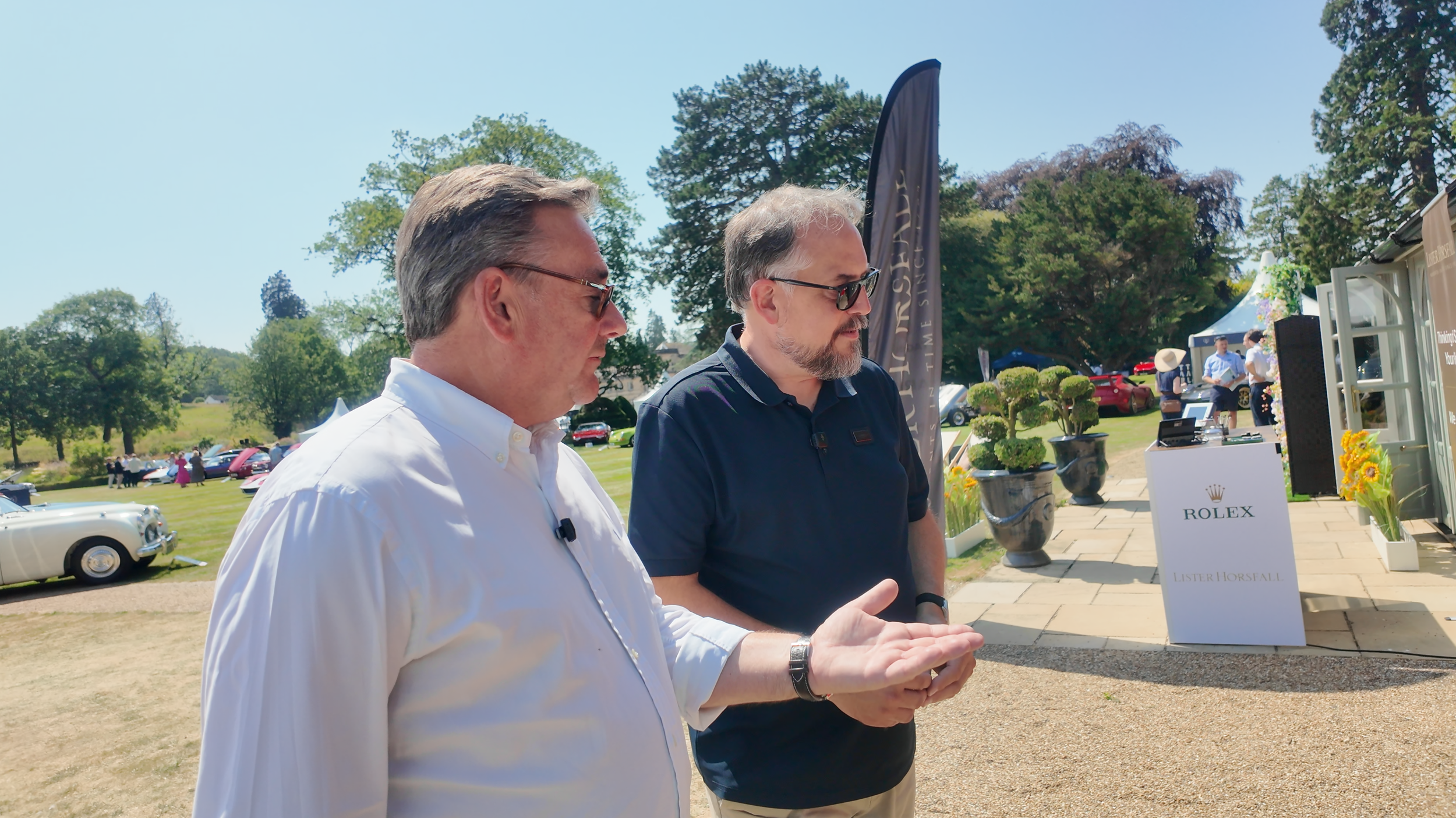
Image © Fuel the Passion. Paul Spiers and Steve Waddingham, Yorkshire Elegance 2026.
It gave me the opportunity to spend some time filming Paul Spires, President of Aston Martin Works, together with my friend Steve Waddingham, Aston Martin Lagonda historian, as they talked us through the car and explained some of the history behind it, and it wasn’t the only special Aston Martin they had brought with them.
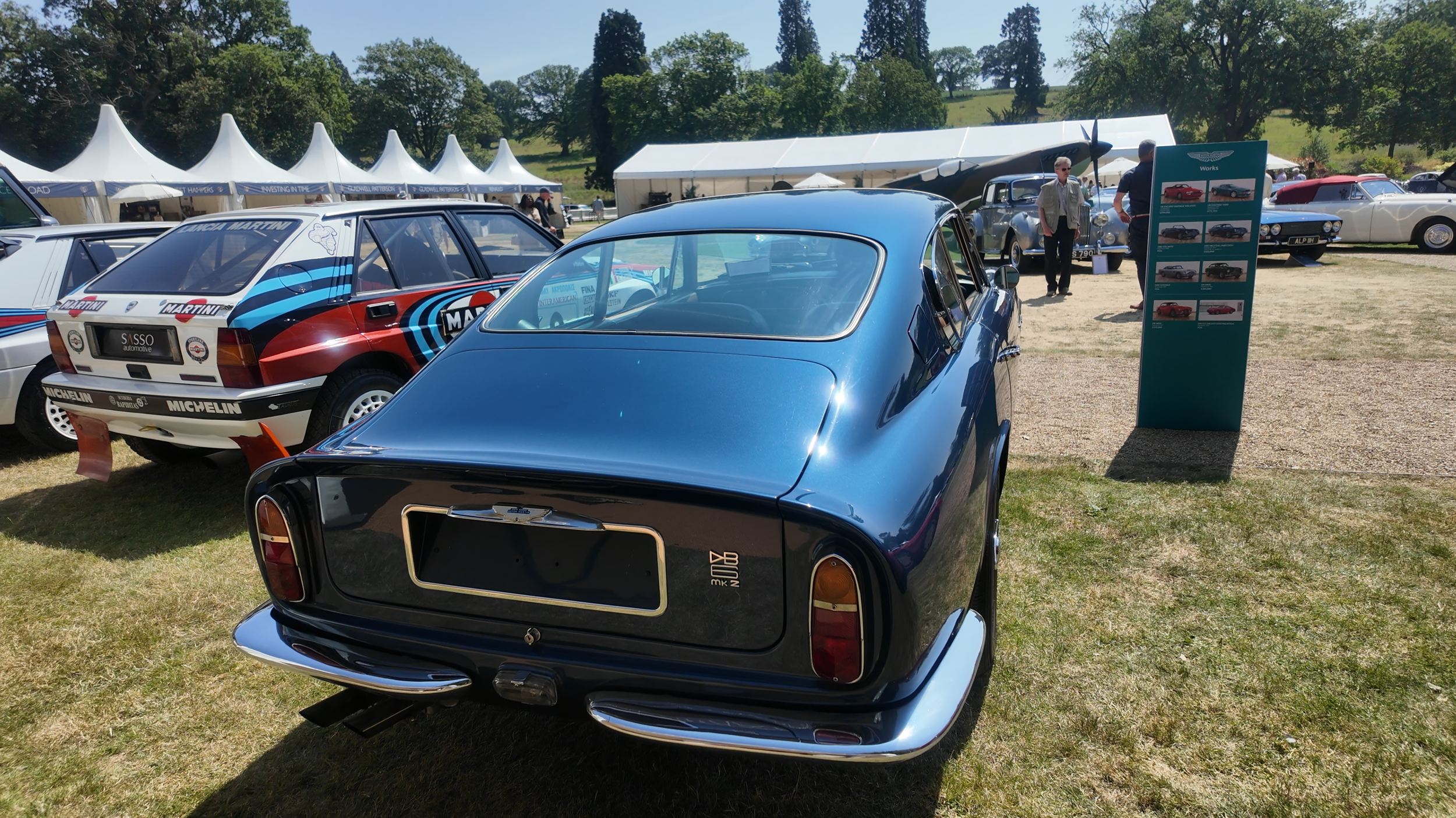
Image © Fuel the Passion. The special DB6 Mk2 Fuel Injection, Yorkshire Elegance 2026.
Alongside the Zagato sat an equally fascinating DB6 Mk2 with fuel injection, giving Paul and Steve the chance to talk through two very different examples of Aston Martin engineering: one representing the increasingly sophisticated final development of the DB6 era, the other the much more dramatic Aston Martin-Zagato collaboration that emerged nearly two decades later.
Standing beside the Zagato in Yorkshire also reinforced something that photographs don’t always convey particularly well. These cars have enormous presence. The proportions, the shortened body, the huge bonnet treatment and Zagato’s uncompromising interpretation of the familiar V8 make much more sense when you can actually walk around one.
They certainly aren’t conventionally pretty in the way a DB4 GT Zagato might be, but perhaps that’s missing the point.
The V8 Vantage Zagato was intended to be lighter, faster and considerably more aerodynamic than the Vantage upon which it was based, with Aston Martin targeting the emerging supercars of the period. Nicholas Mee and Kingsley Riding-Fel recall that Aston Martin wanted roughly 400kg removed, while extensive aerodynamic development was undertaken to help the car approach a target top speed around 300km/h.
That makes seeing one in the metal, and hearing people with such deep Aston Martin knowledge explain its story, especially valuable. We’ll have much more from that Yorkshire Elegance encounter coming soon to the FTP YouTube Channel, where you’ll be able to hear Paul and Steve’s conversation for yourself. Spotting this extraordinary 600-mile example for sale immediately took me back to the car they showed us that day.
If you’d like to learn more about Aston Martin Works and its heritage-car expertise, you can contact the team HERE. For further details on this week’s 600-mile V8 Vantage Zagato, contact Nicholas Mee & Company HERE.
FTP Update
A Quiet Week for the Vantage - But Certainly Not for FTP
There’s actually very little to report from behind the wheel of the FTP Vantage this week, for the simple reason that it hasn’t turned a wheel. I had hoped to get out at some point, but family life, working on FTP and everything else that seems to fill a week had other ideas. Sometimes that’s simply how it goes. I’m definitely beginning to miss driving it, though.
Perhaps next week I’ll keep things deliberately simple: take the cameras, point the Vantage towards some of the lovely Peak District roads not too far from home and just go for a drive. No major event, no complicated filming plan and no particular destination required, simply an Aston Martin, some good roads and a chance to get back behind the wheel. There are worse ideas for a film! While the Vantage has been resting, however, there’s been plenty happening behind the scenes at Fuel the Passion.
Our latest FTP film, Inside Wilton House Concours des Légendes | Aston Martin, F1 Icons & One-Offs, went live on the channel on Friday evening.
The thumbnail perhaps sums it up rather nicely: Aston Martins Amongst Legends
This was my first visit to the inaugural Concours des Légendes at Wilton House, and it turned into one of those films where the variety of what we encountered became part of the story. There are, of course, some wonderful Aston Martins.
We spend time with a first-generation Vanquish, a 1959 DB Mark III, a pre-war MkII Short Chassis Tourer, a competition-prepared DB2 and the extraordinary Bertone Jet 2+2 we’ve already talked about elsewhere in this week’s Roundup. But the film wanders beyond Aston Martin too.
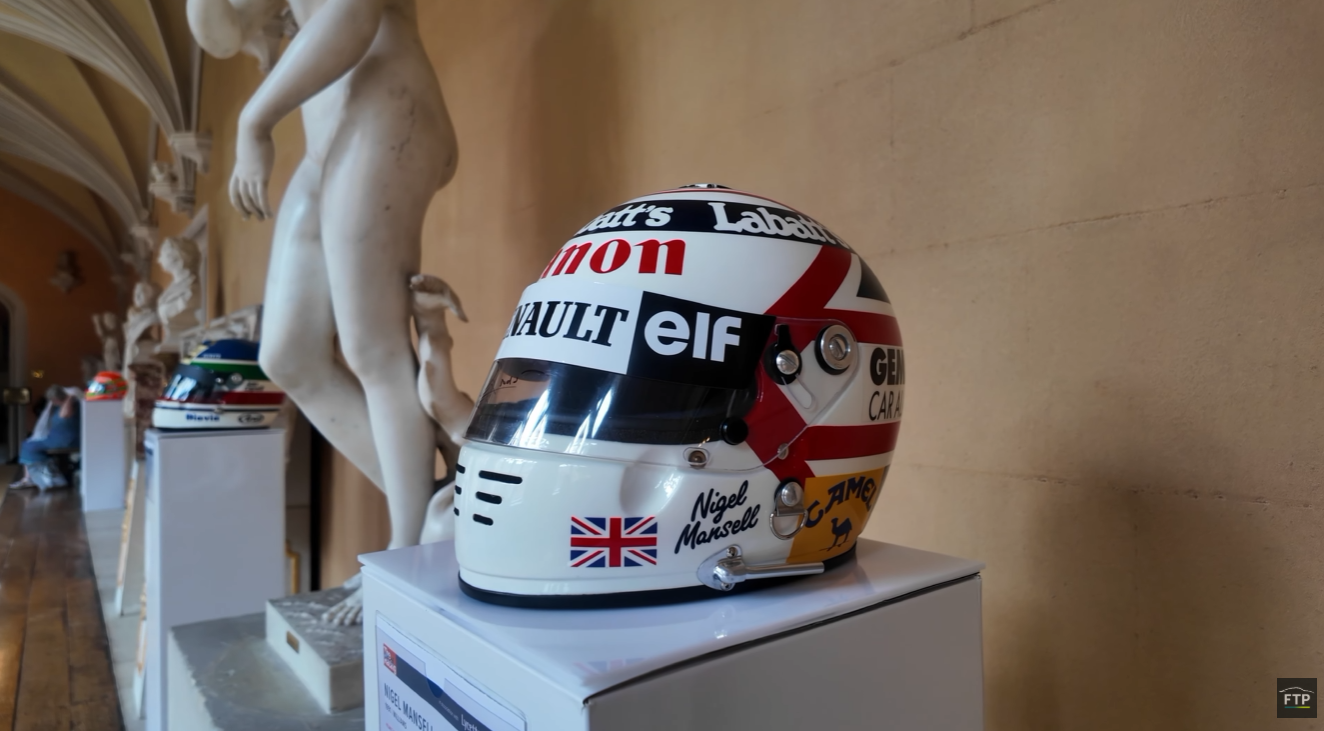
Image © Fuel the Passion
Inside Wilton House we discover a remarkable collection of Formula One helmets connected with names including Nigel Mansell, Mika Häkkinen, Eddie Irvine, Johnny Herbert and David Coulthard, while elsewhere sits the actual 1989 Camel Trophy Land Rover 110 driven to victory by Bob and Joe Ives, still the only British pairing to win the event, and then there are the people.
Thank You, David. One of my favourite parts of the film came courtesy of David Reed, owner of the wonderful maroon competition-prepared Aston Martin DB2. David very kindly spent time talking us through the car, its competition preparation and some of the equipment fitted for historic racing. He also allowed us to include some of his own in-car footage of the DB2 being driven on track, which brings a completely different perspective to the story. Access like that makes an enormous difference to an FTP film.
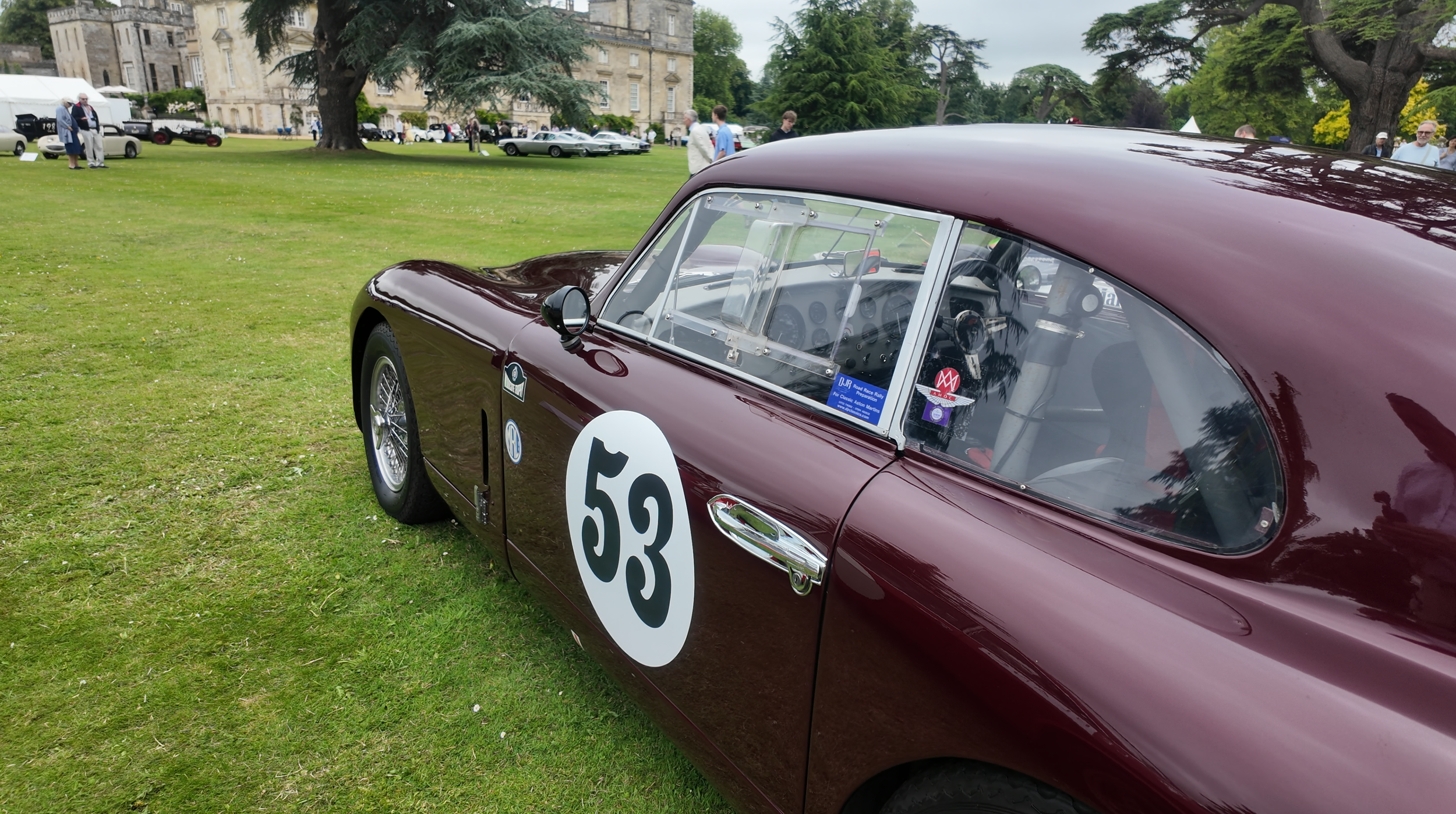
Image © Fuel the Passion David Reed DB2, Wilton House 2026.
Rather than simply walking around a beautiful old Aston Martin, we get to hear from the person who actually owns, understands and uses it, and then see the car doing what it was prepared to do. So, David, if you’re reading this: thank you for your time, your enthusiasm and for allowing us to share the additional footage.
Thank You to, James. There’s another little contribution towards the end of the film that deserves a mention too. Fifteen-year-old James, who creates automotive content under @jmz_c_, filmed and edited a lovely sequence featuring the FTP Vantage while we were at Wilton.
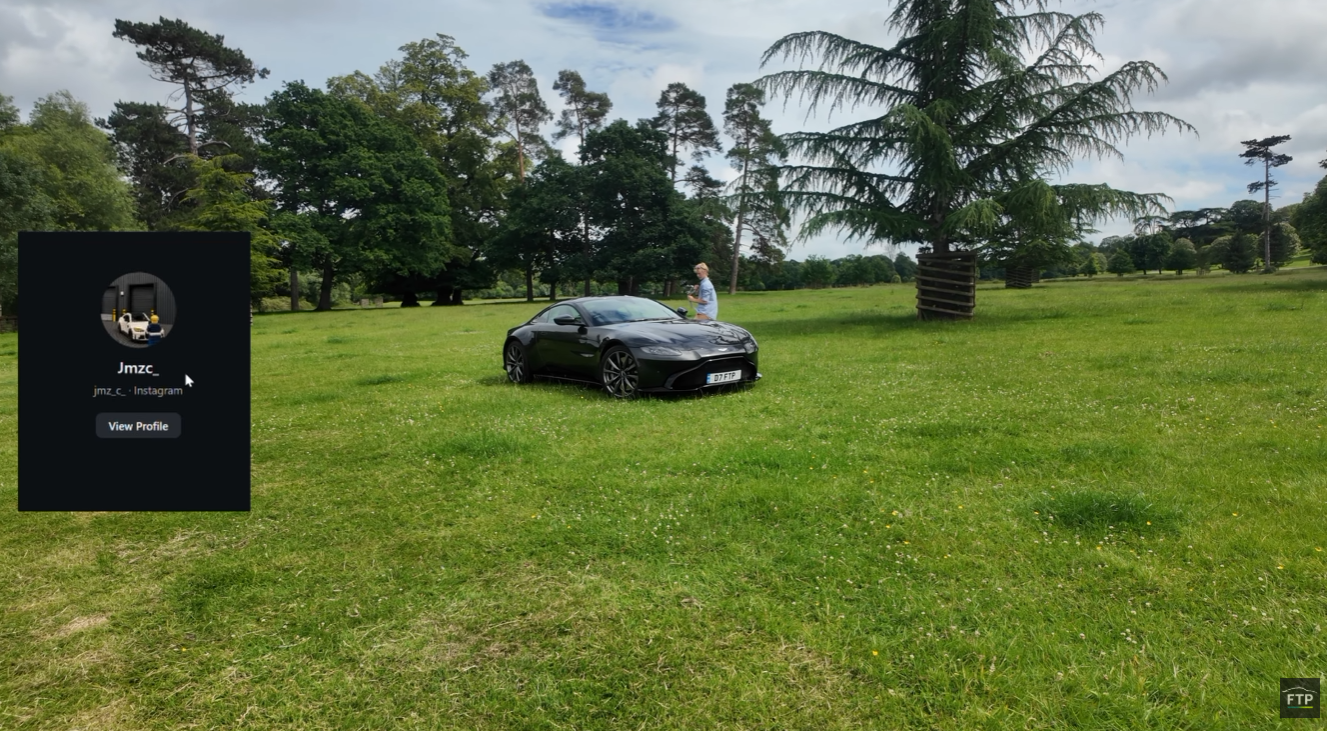
Image © Fuel the Passion. James working his magic with the FTP Vantage, Wilton House, 2026.
I liked what he created so much that, with his permission, we incorporated part of his work into the closing section of the film. It’s always good to encourage young people developing their own skills in filming and editing, particularly when they’re clearly enthusiastic about cars, so I’ll leave James’s Instagram details alongside the film as well. If you enjoy that closing Vantage sequence, please take a moment to have a look at his original work and give him some support.
So, although the FTP Vantage hasn’t travelled anywhere this week, Fuel the Passion certainly hasn’t been standing still.
There’s been a new film to finish and release, Vanquish projects moving forward, Buyers Guide research continuing, this enormous Weekly Roundup to put together and, as you’ve probably gathered from everything above, no shortage of developments across the wider Aston Martin world to research and understand. Perhaps that makes next week’s hoped-for drive even more appealing.
Sometimes, after spending hours writing about Aston Martins, researching Aston Martins and editing films about Aston Martins, the best reminder of why FTP exists is simply to get into one and drive it! The Peak District may well be calling!
Closing Reflection
So that brings us to the end of Issue 36, another remarkably varied week in the Aston Martin world.
There’s been plenty to celebrate on the racetrack, from Car Blanche’s superb weekend at Road America and another step forward for Valkyrie, to encouraging signs that Aston Martin’s Formula One development programme may finally be beginning to move in the right direction. At the same time, the continuing financial story around Aston Martin Lagonda has required a rather different approach: slowing things down, separating what we know from what’s being alleged and trying to make sense of developments that can otherwise become buried beneath complicated terminology and dramatic headlines.
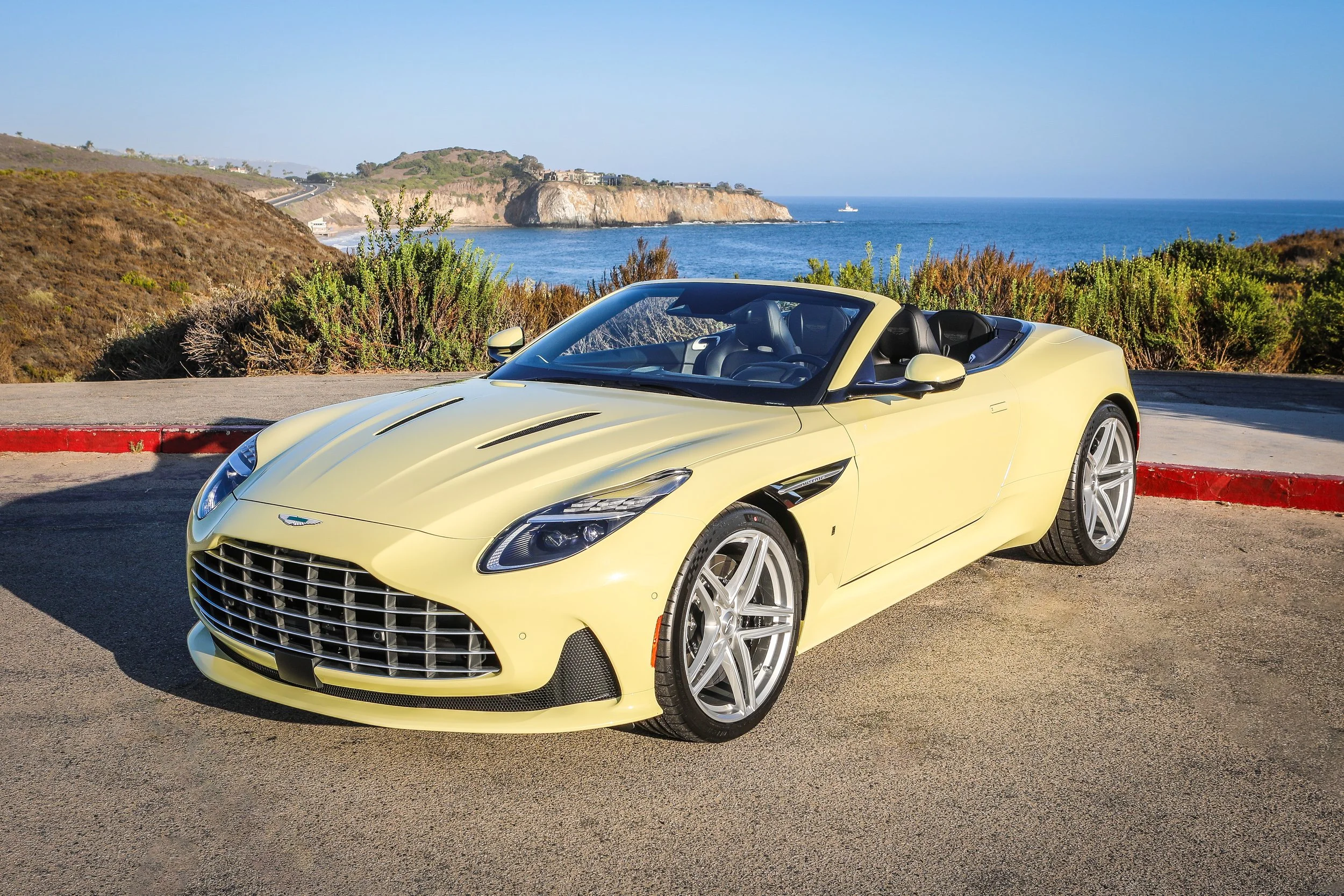
Image © Aston Martin Lagonda. Used for editorial purposes. Aston Martin Heritage Edition Collection, Newport Beach.
Thankfully, Aston Martin rarely allows us to remain in one corner of its world for very long. This week has also taken us through wonderful heritage colours, a 600-mile V8 Vantage Zagato, electrically converted classics, the pages of AM Quarterly and AM Monthly, a revived Bertone and, rather appropriately, back to Wilton House with our latest FTP film.
There’s already plenty to keep an eye on next week. We’ll continue following the creditor dispute and any further clarification around Aston Martin’s new financing, while the extraordinary Vanquish Zagato Volante heading to auction at Monterey should give us something interesting for Market Watch once the hammer has fallen. Motorsport will continue to move towards its next rounds too, and behind the scenes at FTP there are still Vanquish films, Buyers Guide research and more footage waiting patiently to be worked through. Perhaps, somewhere amongst all of that, I might finally find a few hours to point the FTP Vantage towards the Peak District and simply enjoy driving it again.
As always, thank you for spending part of your Sunday with Fuel the Passion. If something in this week’s Roundup has caught your attention, whether it’s Aston Martin’s finances, an electric DB5, the V8 Vantage Zagato, Bertone’s return or anything else we’ve covered, feel free to leave your thoughts below. I always enjoy reading the different perspectives within our little Aston Martin community.
Have a wonderful week, enjoy your cars if you’re fortunate enough to be taking one out, and I’ll see you back here next Sunday for Issue 37.
Thanks as always for being here. See you on the next one! 👆
Kind regards,
Dan 💚💛
💬 We’d Love to Hear Your Thoughts
You’re welcome to answer any of this week’s questions, or simply share your own view on anything Aston Martin - whether it’s something you’ve read here, a car that’s caught your attention, or a subject you think deserves further discussion. We would love to hear from you, leave some comments in the section below👇
1. Would you convert a classic Aston Martin to electric power?
If a DB5 or DB6 conversion were completely reversible and the original engine safely retained, would you consider it, or is the combustion engine simply too fundamental to the character and soul of the car?
2. Does Bertone have some unfinished business with Aston Martin?
Now that the famous Italian coachbuilder is back and expanding again, would you like to see Bertone create another Aston Martin? If so, which current Aston Martin would you hand them the keys to?
3. What would you do with a 600-mile V8 Vantage Zagato?
Would you preserve such an extraordinarily low-mileage car as part of its history, or would you accept that Aston Martin and Zagato built it to be driven and start adding some proper miles?
4. What would give you the greatest confidence in Aston Martin Lagonda’s future?
After everything we’ve explored around the improving underlying business, debt burden and latest financing dispute, what would you most like to see next, sustained profitability and cash generation, meaningful debt reduction, continued product success, (or all of that and more!) or something else?
Still Fancy a Little More Aston Martin Reading?
If you’ve reached the end of this week’s Roundup and would still like to explore a little further, there’s plenty more to discover across the Fuel the Passion website.
You can visit the FTP Motorsport Hub, where we continue to build detailed race reports, result tables, classification updates and championship standings across Aston Martin’s international racing programmes.
There’s also the growing FTP Aston Martin Buyers Guide library. We now have complete guides covering the DB9, VH-generation V8 Vantage, DB11, first-generation Vanquish and the VH-era DBS.
Each guide is written to offer honest, enthusiast-focused help for anyone researching, buying, owning or simply learning more about these cars. They cover the model’s history, versions, ownership considerations, servicing, known issues, buying checks and the details that can make the difference between a rewarding purchase and an expensive mistake.
Our next guide will focus on the second-generation Vanquish, and research is already under way. Owners are very welcome to contribute their own experiences and help us make the finished guide as accurate and useful as possible.
Published alongside this Roundup is our latest FTP Featured Article: Aston Martin Beyond the Debt: What Could the Future Hold?
It looks beyond the immediate headlines surrounding debt, losses and refinancing to examine the wider position of Aston Martin Lagonda. The article considers both the seriousness of the financial pressure and the signs of operational improvement seen during the first half of 2026.
I’ve included the links below, so feel free to make yourself a coffee, settle in and keep exploring. 👍
